
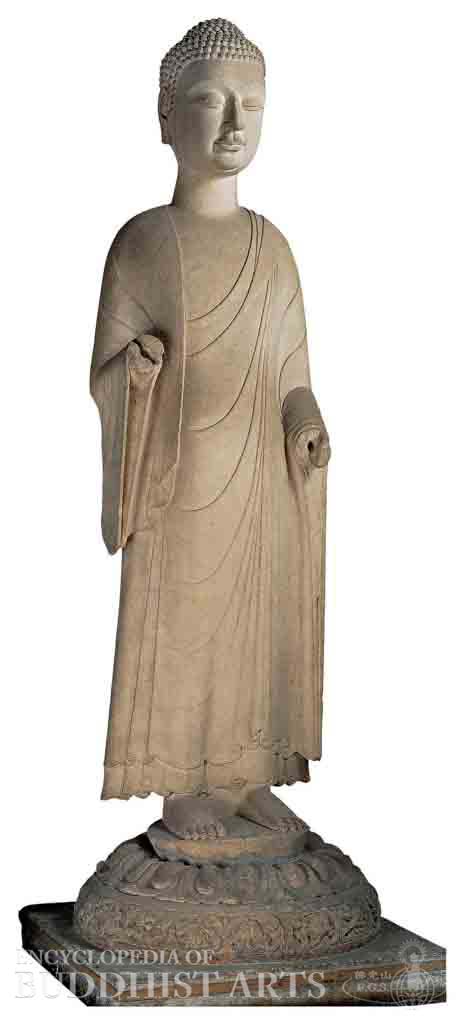
Standing Buddha
Marble
Standing Buddha
CHINA; Northern Qi dynasty
This work, believed to be discovered in Dingzhou, Hebei, is a large sculpture dating from late Northern Qi (550–577) and early Sui (581–618) dynasties. It is representative of white stone statues of that time. It was later moved to Japan. A long neck and elegantly sloping shoulders distinguish the Buddha. The diagonal folds of the monastic robes are carved in low relief and give way to a vertical rippling effect below the waist. The figure stands on an elaborately carved lotus pedestal. The arms are broken and the original mandorla is missing.
For more details, go to the Encyclopedia of Buddhist Arts: Sculpture St-Z, page 1134.
Cite this article:
Hsingyun, et al. "Standing Buddha." Encyclopedia of Buddhist Arts: Sculpture St-Z, vol. 13, 2016, pp. 1134.
Hsingyun, Youheng, Yann Lovelock, Yuan Chou, Susan Huntington, Gary Edson, and Robert Neather. 2016. "Standing Buddha" In Encyclopedia of Buddhist Arts: Sculpture St-Z, 13:1134.
Hsingyun, Youheng, Lovelock, Y., Chou, Y., Huntington, S., Edson, G., & Neather, R.. (2016). Standing Buddha. In Encyclopedia of Buddhist Arts: Sculpture St-Z (Vol. 13, pp. 1134).
@misc{Hsingyun2016,
author = Hsingyun and Youheng and Lovelock, Yann and Chou, Yuan and Huntington, Susan and Edson, Gary and Neather, Robert,
booktitle = {Encyclopedia of Buddhist Arts: Sculpture St-Z},
pages = 1134,
title = {{Standing Buddha}},
volume = 13,
year = {2016}}
author = Hsingyun and Youheng and Lovelock, Yann and Chou, Yuan and Huntington, Susan and Edson, Gary and Neather, Robert,
booktitle = {Encyclopedia of Buddhist Arts: Sculpture St-Z},
pages = 1134,
title = {{Standing Buddha}},
volume = 13,
year = {2016}}