
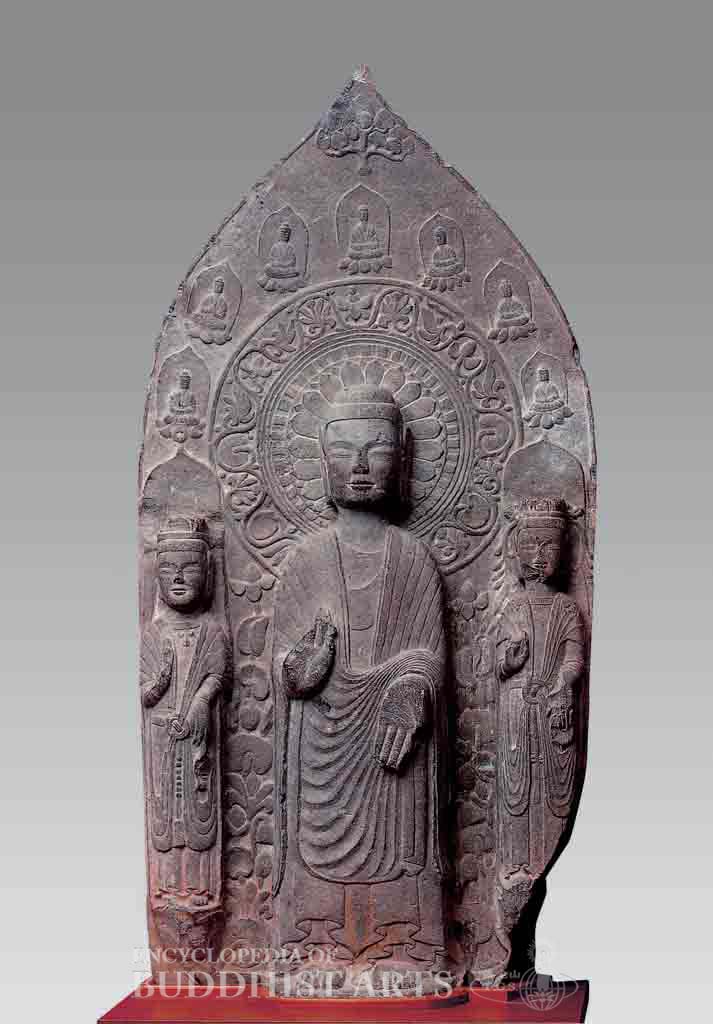
Buddha Triad
Stone
Buddha Triad
CHINA; Eastern Wei dynasty
The Buddha forms the abhaya (fearlessness) and varada (wish-granting) mudras with large hands, and wears a stylized monastic robe with neatly carved folds. The two flanking Bodhisattvas wear inner and outer robes. The latter passes through a ring at the front. The two figures have long, thin nimbuses with a petal-shape tip. The Buddha’s ornate nimbus has a lotus at the center followed by concentric circles, and scrolling vines on the outer rim. Seven Buddhas surround the outer ring of the nimbus. A plant design separates the three figures, while an image of a tree is located at the very top. All these elements are within a petal-shaped mandorla.
For more details, go to the Encyclopedia of Buddhist Arts: Sculpture A-F, page 214.
Cite this article:
Hsingyun, et al. "Buddha Triad." Encyclopedia of Buddhist Arts: Sculpture A-F, vol. 10, 2016, pp. 214.
Hsingyun, Youheng, Yann Lovelock, Yuan Chou, Susan Huntington, Gary Edson, and Robert Neather. 2016. "Buddha Triad" In Encyclopedia of Buddhist Arts: Sculpture A-F, 10:214.
Hsingyun, Youheng, Lovelock, Y., Chou, Y., Huntington, S., Edson, G., & Neather, R.. (2016). Buddha Triad. In Encyclopedia of Buddhist Arts: Sculpture A-F (Vol. 10, pp. 214).
@misc{Hsingyun2016,
author = Hsingyun and Youheng and Lovelock, Yann and Chou, Yuan and Huntington, Susan and Edson, Gary and Neather, Robert,
booktitle = {Encyclopedia of Buddhist Arts: Sculpture A-F},
pages = 214,
title = {{Buddha Triad}},
volume = 10,
year = {2016}}
author = Hsingyun and Youheng and Lovelock, Yann and Chou, Yuan and Huntington, Susan and Edson, Gary and Neather, Robert,
booktitle = {Encyclopedia of Buddhist Arts: Sculpture A-F},
pages = 214,
title = {{Buddha Triad}},
volume = 10,
year = {2016}}