
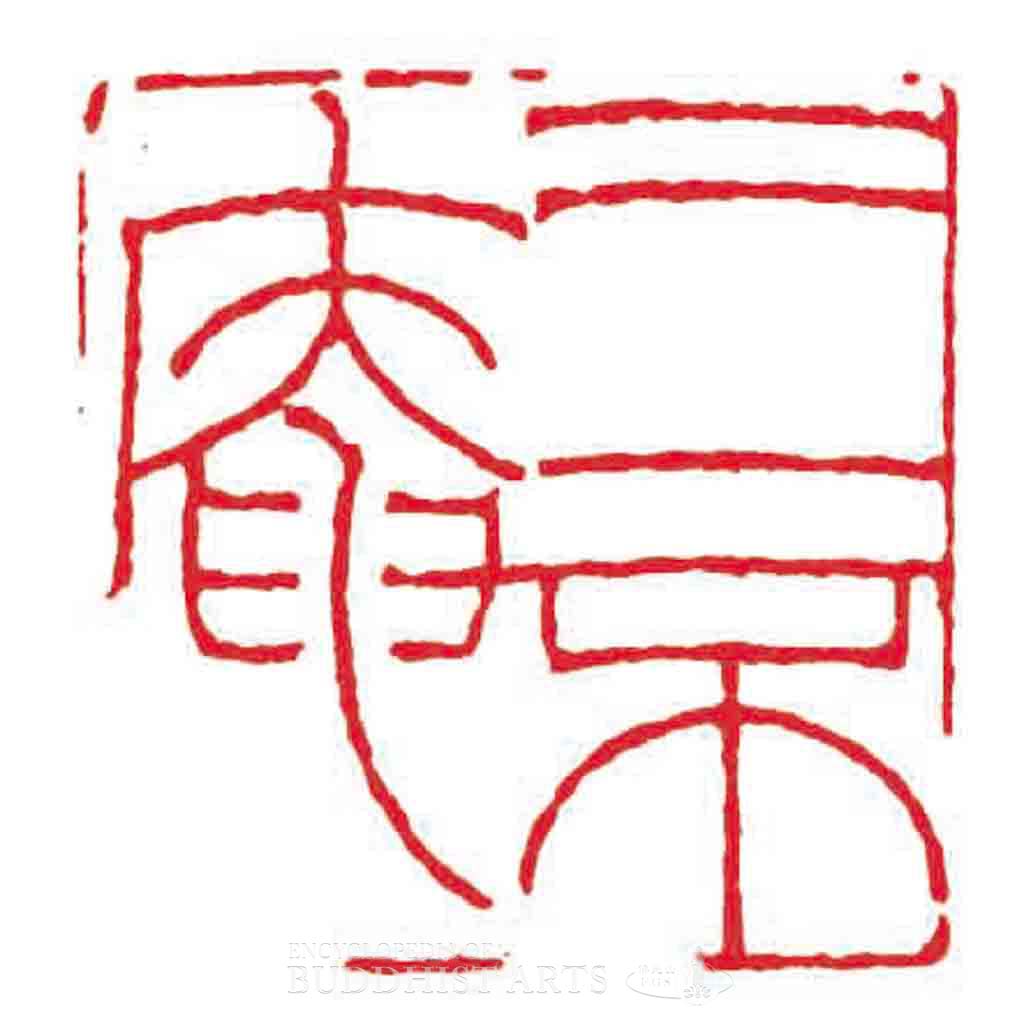
Neither Three Hermitage by Dun Lifu; 20th century
Red-character square seal
Dun Lifu
CHINA, Hebei, Baoding
Dun Lifu had an original name of Qun and an alias of Qiesou. He was a native of Zhuozhou, Baoding, but later lived in Beijing after his father’s passing. Growing up poor, he worked doing various tasks for the renowned seal engraving artist, Wang Ti. He often collected Wang’s discarded drafts, and in his free time, he deliberately studied and imitated them. Later, he learned the art from Wang himself.
In engraving, he often created thin and round red-character seals. He later devoted himself to the study of innovative seal engraving styles. Dun eventually developed his own easy and balanced style which incorporated the charm of ancient Han seals, as well as features of the works of Huang Shiling and Zhao Zhiqian.
He authored several written works including Dun Lifu’s Sixty Tang Poems in Seal Script and various editions of Dun Lifu’s Seal Works. His Buddhist seal, Self-Abandonment to Dunhuang, is considered a refined and elegant piece. Other seals by Dun include Neither Three Hermitage, Dun Lifu Writes After Seventy Years Old, and Composed Tone and Mood on Paper.
For more details, go to the Encyclopedia of Buddhist Arts: People, page 53.
Cite this article:
author = Hsingyun and Youheng and Youlu and Pokorski, Stefanie and Yichao and Mankuang and Miaohsi,
booktitle = {Encyclopedia of Buddhist Arts: People },
pages = 53,
title = {{Dun Lifu}},
volume = 19,
year = {2016}}