

Mingxiu Temple: Main Hall

Mingxiu Temple: Main Hall - Horizontal Inscribed Board
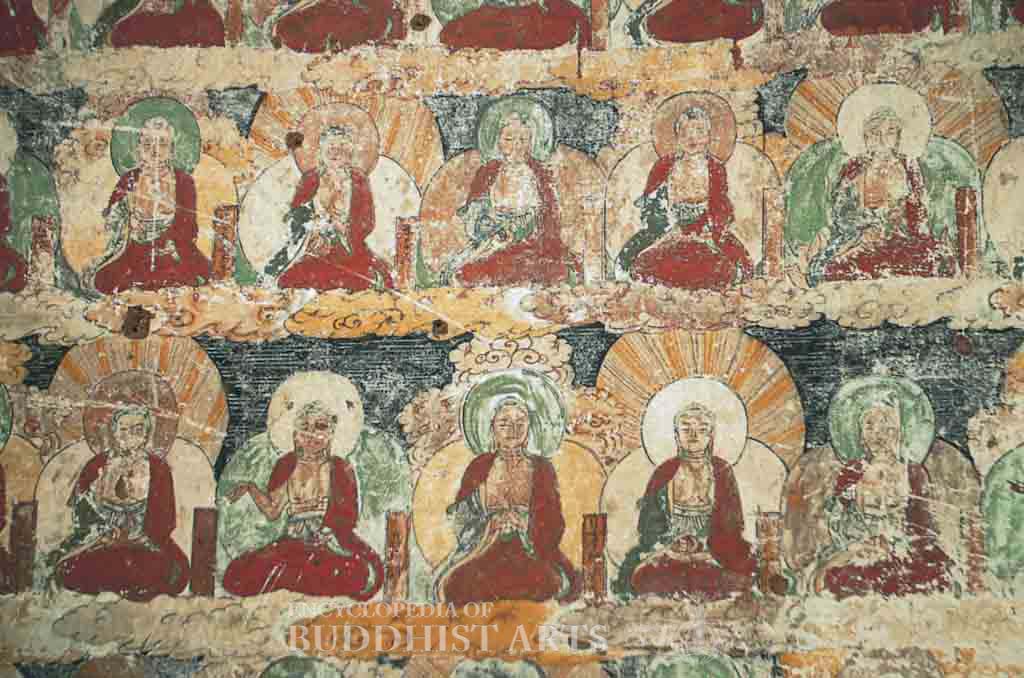
Mingxiu Temple: Main Hall - Thousand Buddhas (detail)
Mingxiu Temple
CHINA, Shanxi, Taiyuan
Mingxiu means Clear Elegance. According to a stele erected in 1783 during the Qing dynasty, the temple was built during the Han dynasty (206 BCE–220 CE). It was destroyed by warfare during the rule of Emperor Jiajing (reigned 1521–1566) of the Ming dynasty, and then rebuilt. It was listed as a National Cultural Heritage Site in 2006.
The temple faces east and occupies 1,144 sq m. Along the central axis there are the main temple gate, Heavenly King Hall, middle hall, main hall, the bell and drum towers on either side, and the meditation hall. The five-by-three bay main hall has a single-eave hip-and-gable roof. The roof is covered by round, glazed tiles, and has a blue border. There is a set of four lattice doors in the central bay, as well as in the two adjoining bays. Statues of the Three Buddhas are enshrined within the hall, with disciples, attendant Bodhisattvas, and warriors located on either side. The back wall and the gables have murals of Thousand Buddhas and Buddhist stories.
For more details, go to the Encyclopedia of Buddhist Arts: Architecture M-S, page 741.
Cite this article:
author = Hsingyun and Youheng and Johnson, Peter and Mankuang and Lancaster, Lewis,
booktitle = {Encyclopedia of Buddhist Arts: Architecture M-S},
pages = 741,
title = {{Mingxiu Temple}},
volume = 3,
year = {2016}}