
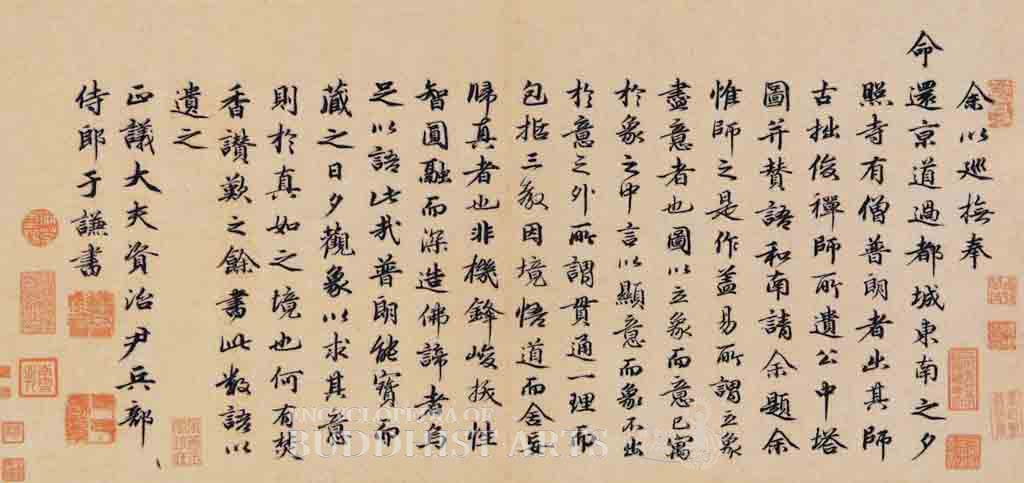
Praise to the Painting of Gongzhong Pagoda by Yu Qian; Ming dynasty
Ink on paper
Yu Qian
CHINA, Zhejiang, Hangzhou; Ming dynasty
Yu Qian was a calligrapher and poet from Qiantang (present day Hangzhou, Zhejiang), who was also known as Tingyi or Jie’an. He became an Imperial Scholar after passing the imperial examination in 1421 and subsequently enjoyed great success in various positions within the government. Yu, honest and righteous, earned the loyalty and respect of the local people by involving himself heavily in the community and helping refugees, building dams, and planting trees. He is reputed alongside Yue Fei and Zhang Huangyan as one of the Three Outstanding Men of West Lake in Hangzhou.
Yu excelled in both calligraphy and poetry. His calligraphic style inherited traits similar to Zhao Mengfu, showing powerful yet graceful brushstrokes. His Buddhist calligraphic piece, Praise to the Painting of Gongzhong Pagoda, in running script, is currently kept at the Palace Museum in Beijing. His poems include Cold New Year’s Eve in Taiyuan, Desolated Village, and On the Road of Pingyang.
For more details, go to the Encyclopedia of Buddhist Arts: People, page 325.
Cite this article:
author = Hsingyun and Youheng and Youlu and Pokorski, Stefanie and Yichao and Mankuang and Miaohsi,
booktitle = {Encyclopedia of Buddhist Arts: People },
pages = 325,
title = {{Yu Qian}},
volume = 19,
year = {2016}}