
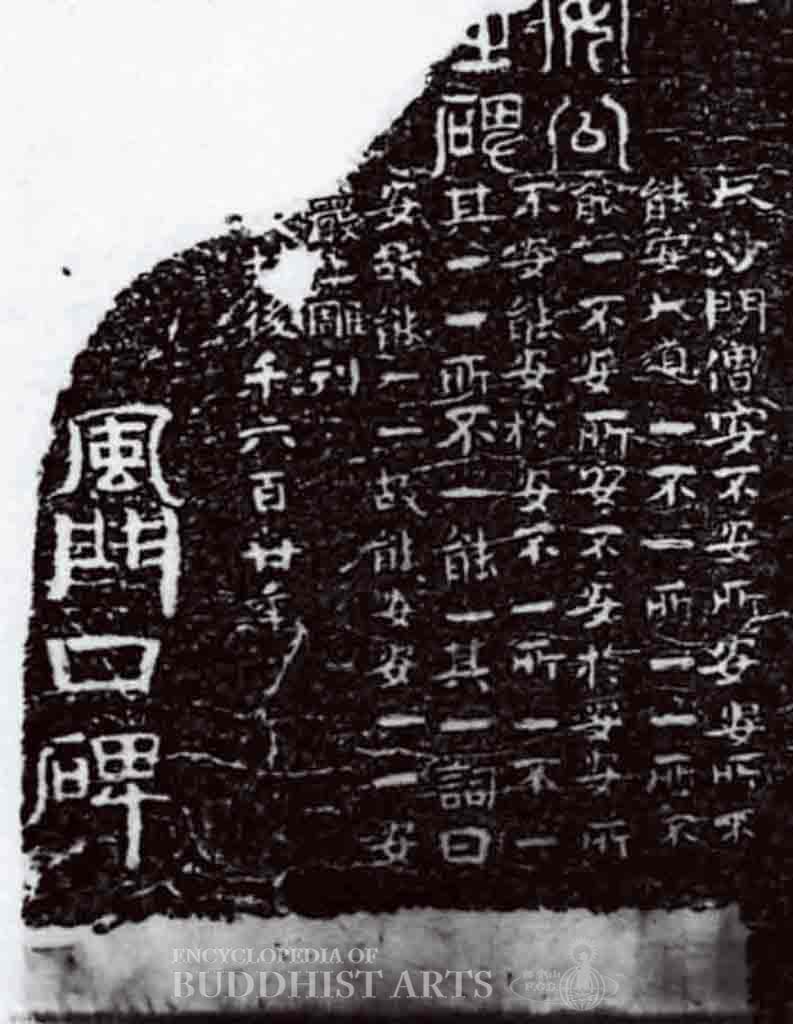
Stele of An Daoyi at Hongdingshan Cliff Carvings
Rubbing
An Daoyi
CHINA; Northern Zhou dynasty
An Daoyi was a monk and calligrapher who specialized in a variety of scripts and utilized vigorous and simple brushwork. He was known for his monumental cliff carvings and was highly praised by the scholar and artist, Kang Youwei of the late Qing dynasty (1644–1911).
His calligraphy can be found at Tieshan and Jianshan in Shandong. The Tieshan Cliff Carvings consists of a transcription of the Mahavaipulya Mahasamghata Sutra in 17 lines and a total of 930 words, some of which are worn away. Created in 579, the Tieshan Cliff Carvings was listed as a National Cultural Heritage Site in 1988. The carving of the Diamond Sutra on the same site is also believed to be his work.
Another set of cliff carvings found in 1994 on Hongdingshan in Shandong were listed as Important Historical Monuments under Special Preservation in 2006. Among them, An’s name can be seen in three places. Some of the inscriptions read “The Buddha of Great Emptiness,” “The Buddha of Great Rock,” and “The Buddha of Peace and Happiness,” reflecting An’s reverence for nature and the Buddhist concept of emptiness. These inscriptions are believed to have been made in 564, making them the oldest cliff carvings in China. The four Chinese character inscription of “The Buddha of Great Emptiness” on the northern cliff, measuring 9.3 m high and 4.1 m wide, is the largest cliff carving made during the Northern Dynasties (386–581). Additionally, there is a stele nearby that was made as a memorial after his death.
For more details, go to the Encyclopedia of Buddhist Arts: People, page 2.
Cite this article:
author = Hsingyun and Youheng and Youlu and Pokorski, Stefanie and Yichao and Mankuang and Miaohsi,
booktitle = {Encyclopedia of Buddhist Arts: People },
pages = 2,
title = {{An Daoyi}},
volume = 19,
year = {2016}}