
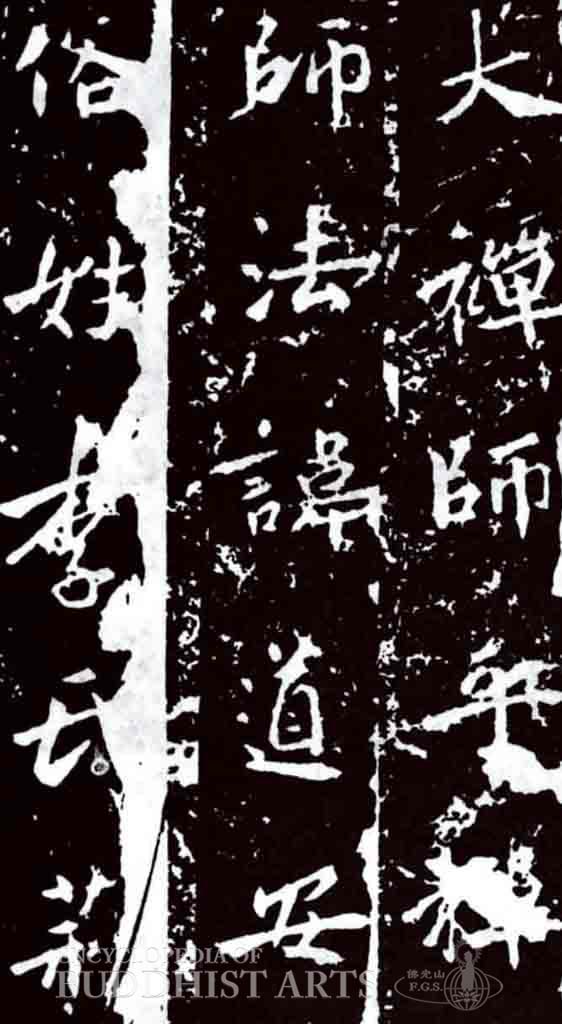
Stele of Master Dao’an at Huishan Temple by Song Dan (detail); Tang dynasty, dated 727
Rubbing
Song Dan
CHINA, Hebei, Handan; Tang dynasty
Song Dan, also known as Cang Zhu, was born in Guangping, Handan (present day Hebei). He was a calligrapher, as well as an editor for the National Archives. Song learned the art of calligraphy from Zhong Yao and excelled in all scripts.
Huang Tingjian praised Song for the power of his calligraphy and stated in Preface and Postscript of Shangu, “Song’s calligraphy is a perfect combination of elegance, excellence, and strength, and is particularly suitable for letter writing.” Admired by many scholars of his time, Song’s calligraphy served as a stylistic guide for civil servant examinations during the Kaiyuan period (713–741) of the Tang dynasty.
Surviving works by Song include Stele of Master Dao’an at Huishan Temple, written in 727. A rubbing of the inscription is now kept at the Shodo Museum in Tokyo. In addition, a Song dynasty (960–1279) copy of one of his works in regular script is kept at the Palace Museum in Beijing.
For more details, go to the Encyclopedia of Buddhist Arts: People, page 242.
Cite this article:
author = Hsingyun and Youheng and Youlu and Pokorski, Stefanie and Yichao and Mankuang and Miaohsi,
booktitle = {Encyclopedia of Buddhist Arts: People },
pages = 242,
title = {{Song Dan}},
volume = 19,
year = {2016}}