
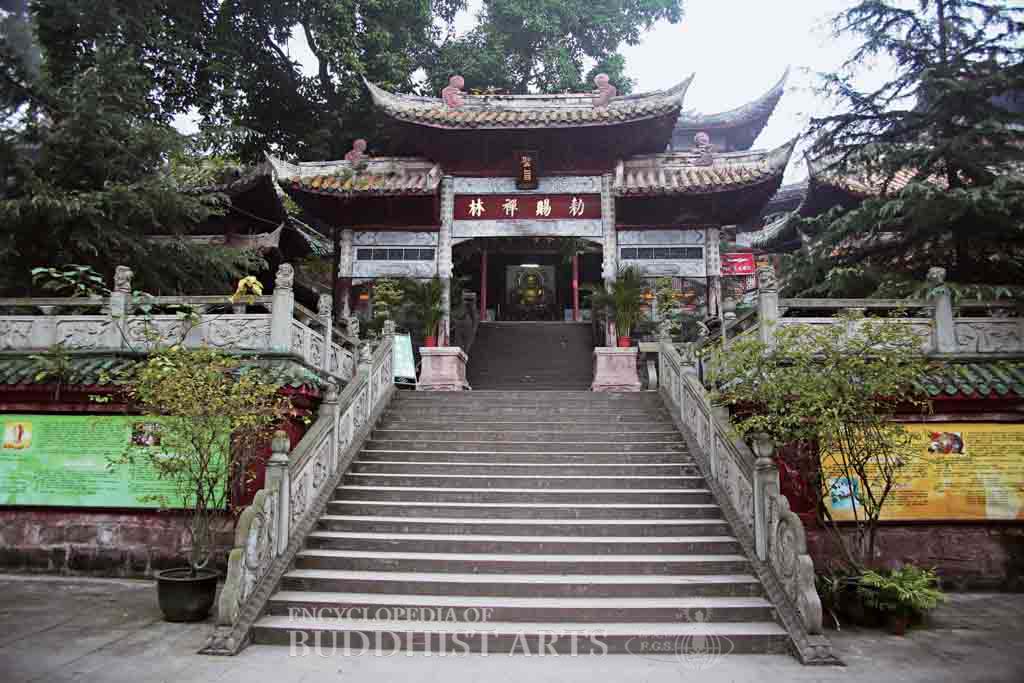
Guangde Temple: Imperial Decree Gateway
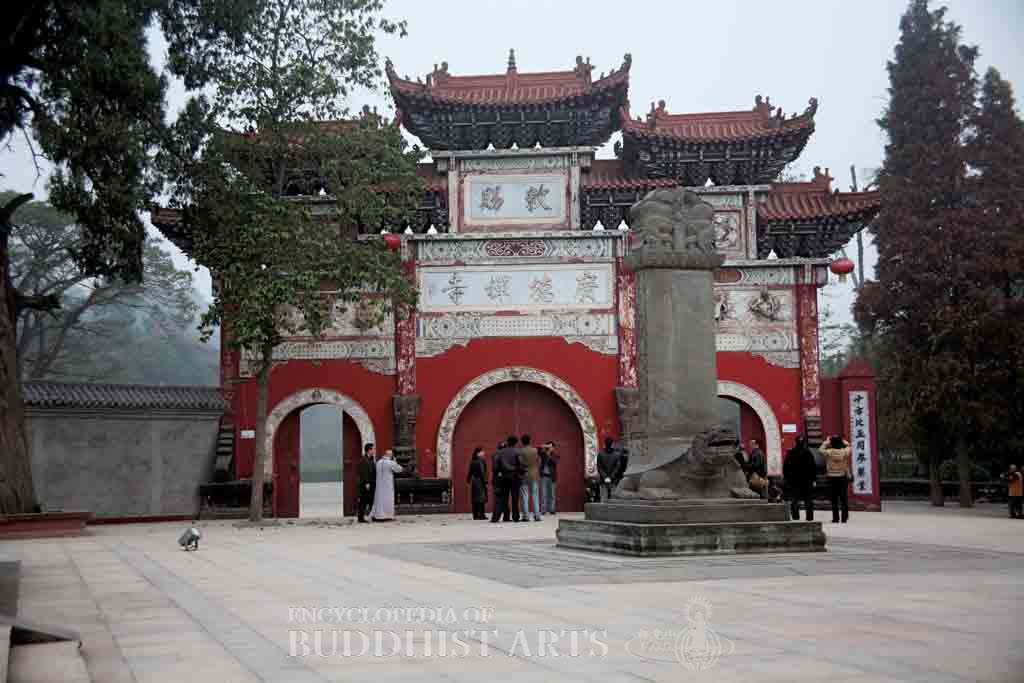
Guangde Temple: South Gate
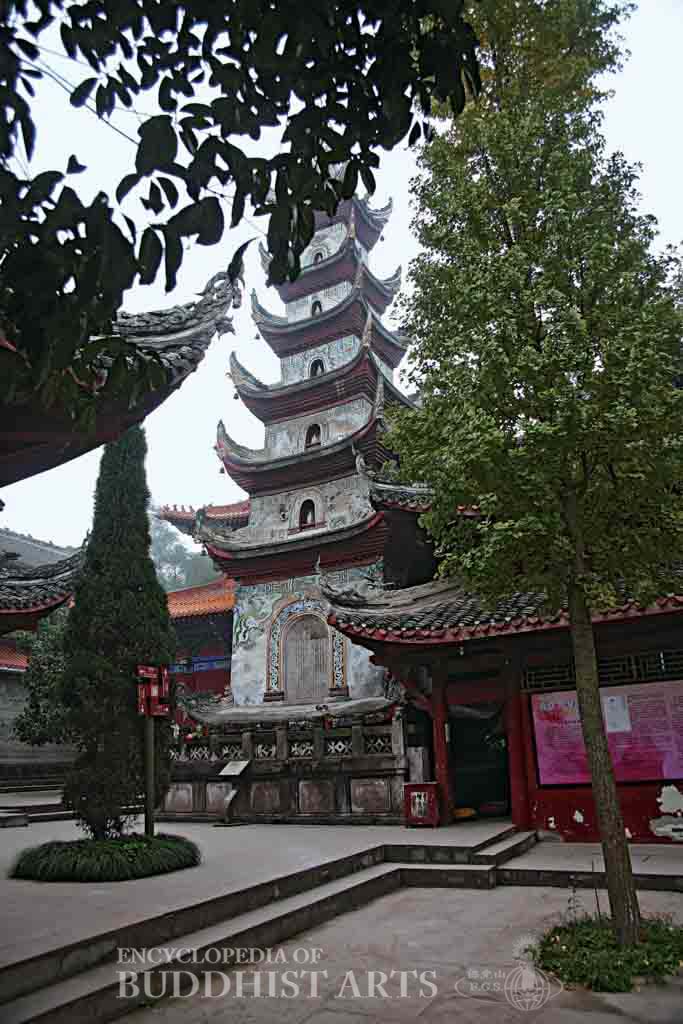
Guangde Temple: Shanji Pagoda
Guangde Temple
CHINA, Sichuan, Suining
Guangde means Vast Virtue. The temple is located on Wolongshan (Crouching Dragon Mountain) and was built during the early Tang dynasty (618–907). The temple was destroyed and reconstructed on a number of occasions. It was listed as a National Cultural Heritage Site in 2006.
The temple is built according to the mountainous terrain and occupies 48 ha. The built area takes up 8,350 sq m. Along the central axis there is the main temple gate, Yuanjue Bridge, south gate, Vajra Hall, Imperial Decree Gateway, stele pavilion, Heavenly King Hall, Great Hero Hall, Vairocana Hall, and Dharma Hall. On the east and west sides there are the Thousand Buddha Building, Dipamkara Hall, Thousand-Armed Avalokitesvara Hall, Avalokitesvara Hall, revolving sutra repository, Shanji Pagoda, and Jade Buddha Hall.
The three-bay wide south gate is 18 m high. The Imperial Decree Gateway was built in the Song dynasty (960–1279). The wooden structure is 18 m high and was reconstructed during the rule of Emperor Chenghua (reigned 1464–1487) of the Ming dynasty. The three-bay wide gate has a central main roof with a lower roof on each side.
Shanji Pagoda, also known as the Body Relic Pagoda, is the funerary pagoda of abbot Keyou. It was built in 787 but was destroyed in the 840s. It was reconstructed between 901 and 904. A second reconstruction took place between 1086 and 1094, resulting in its current appearance. The square, multi-eave stone pagoda is 22 m high. The prominent eaves curve upwards at the corners. Each story is highly decorated.
The temple contains a Song dynasty stele, a jade Buddha statue, a jade seal, and other valuable artifacts.
For more details, go to the Encyclopedia of Buddhist Arts: Architecture G-L, page 383.
Cite this article:
author = Hsingyun and Youheng and Johnson, Peter and Mankuang and Lancaster, Lewis,
booktitle = {Encyclopedia of Buddhist Arts: Architecture G-L},
pages = 383,
title = {{Guangde Temple}},
volume = 2,
year = {2016}}