
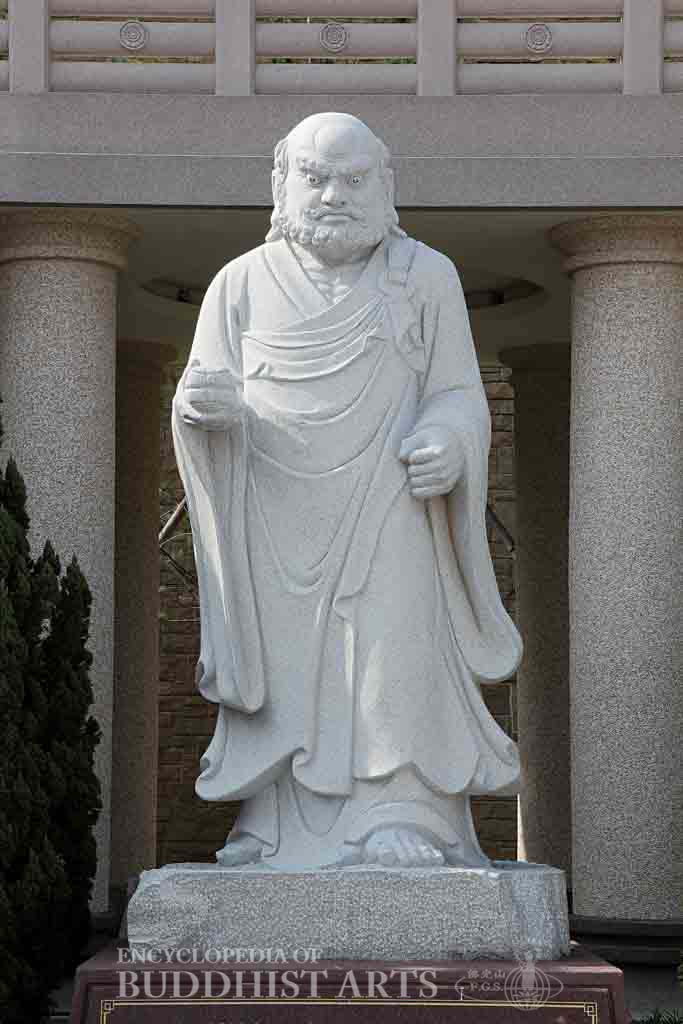
Fo Guang Shan Buddha Memorial Center: Eight Patriarchs - Bodhidharma
White granite

Fo Guang Shan Buddha Memorial Center: Eight Patriarchs - Huiyuan
White granite

Fo Guang Shan Buddha Memorial Center: Eight Patriarchs - Daoxuan
White granite

Fo Guang Shan Buddha Memorial Center: Eight Patriarchs - Subhakarasimha
White granite

Fo Guang Shan Buddha Memorial Center: Eight Patriarchs - Zhiyi
White granite

Fo Guang Shan Buddha Memorial Center: Eight Patriarchs - Xuanzang
White granite

Fo Guang Shan Buddha Memorial Center: Eight Patriarchs - Xianshou
White granite

Fo Guang Shan Buddha Memorial Center: Eight Patriarchs - Jizang
White granite
Fo Guang Shan Buddha Memorial Center: Eight Patriarchs
TAIWAN, Kaohsiung
These statues are located along the front of the main hall at the Buddha Memorial Center. They depict the founding patriarchs of the Eight Mahayana Schools of Chinese Buddhism and were designed by the Taiwanese sculptor Wu Jung-Tzu under the guidance of Master Hsing Yun.
Starting from the far left, they are: Jizang of the Three Treatise school, Xianshou of the Huayan school, Xuanzang of the Faxiang school, Zhiyi of the Tiantai school, Bodhidharma of the Chan school, Huiyuan of the Pure Land school, Daoxuan of the Nanshan Vinaya school, and Subhakarasimha of the Vajrayana school. Those on the left of the entrance represent schools focusing on theory, while the ones on the right emphasized practice.
Jizang stands holding a whisk. Xianshou is seated with his two hands brought to his chest and hidden beneath his sleeves. Xuanzang is in his traveling gear and overshadowed by a canopy. Striding forward in sandals, he has large prayer beads about his neck and sutras in his hands. Zhiyi is seated on a large throne and also holds sutras in both hands. His shoes rest on a footstool below.
Bodhidharma has the most distinctive features since he was from India. He is presented as large-nosed and heavily bearded, with staring eyes. He holds his monastic shoes in his right hand and his robe is of the Chinese type with deep sleeves falling from the wrists and a buckle over the left shoulder. Huiyuan is seated cross-legged in meditation. Daoxuan, similar to Jizang, also holds a whisk. The 80 year old Subhakarasimha, of Indian origin too, has his palms joined and holds a sutra upright between them.
For more details, go to the Encyclopedia of Buddhist Arts: Sculpture A-F, page 331.
Cite this article:
author = Hsingyun and Youheng and Lovelock, Yann and Chou, Yuan and Huntington, Susan and Edson, Gary and Neather, Robert,
booktitle = {Encyclopedia of Buddhist Arts: Sculpture A-F},
pages = 331,
title = {{Fo Guang Shan Buddha Memorial Center: Eight Patriarchs}},
volume = 10,
year = {2016}}