
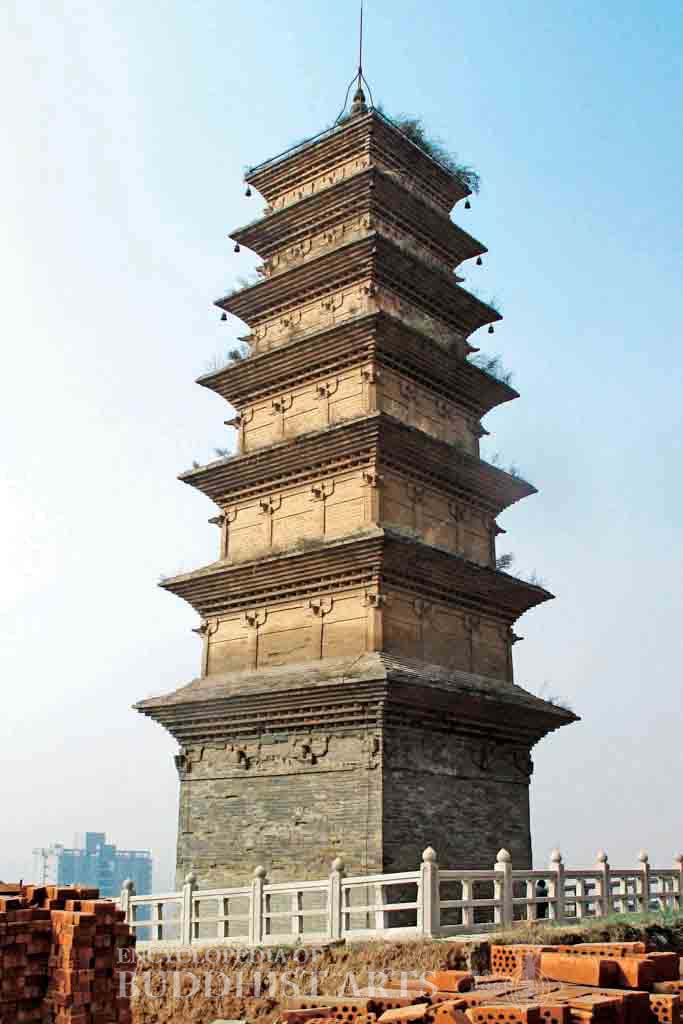
Huayan Temple Pagodas: Dushun Pagoda
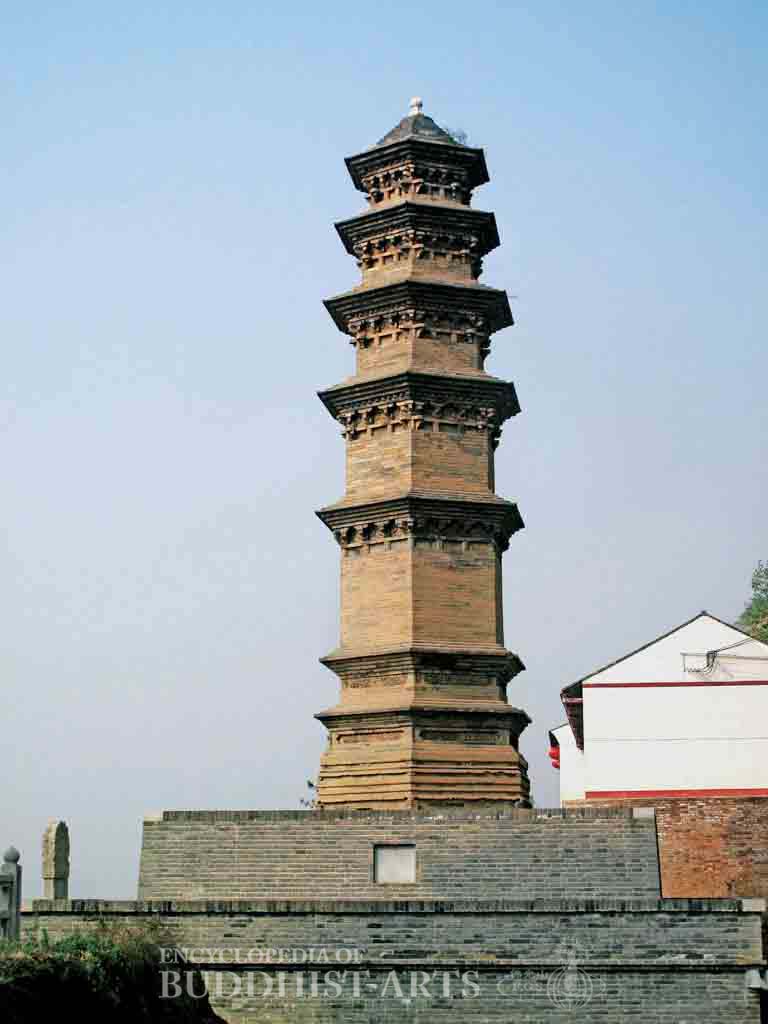
Huayan Temple Pagodas: Chengguan Pagoda
Huayan Temple Pagodas
CHINA, Shaanxi, Xi’an
The pagodas were built on the grounds of Huayan Temple, which no longer exists. The one in the east is dedicated to First Patriarch Dushun, while the one in the west is dedicated to Fourth Patriarch Chengguan. The temple was built during the rule of Emperor Taizong (reigned 626–649) during the Tang dynasty for the purpose of housing Dushun’s pagoda. It was the cradle of the Huayan school. During the rule of Emperor Qianlong (reigned 1736–1795) of the Qing dynasty, the Shaolingyuan area collapsed, causing the total destruction of the temple, apart from the Dushun Pagoda. The Chengguan Pagoda was rebuilt on its original foundations. From 1986 to 1988, work was undertaken to relocate the Chengguan Pagoda a little to the east and it now stands about 20 m away from the Dushun Pagoda. It was listed as a National Cultural Heritage Site in 2006.
Dushun Pagoda is a seven-story, square, gray brick structure that is 22.8 m high. An arched doorway is located on the south side of the first story leading to a chamber. From the second level upwards each wall is decorated with imitation wooden pilasters, architraves, and brackets sets. The pilasters divide each wall into three bays. The eaves consist of corbeling with courses of dogtooth bricks underneath. The pyramidal roof is surmounted by a spire in the form of a vase.
Chengguan Pagoda is also constructed from brick but it has a hexagonal base and is solid. It has five stories and is 13.4 m high. It has a double-layer Sumeru base. The eaves are in the form of corbeling with bracket sets and dogtooth bricks below. The hexagonal pyramidal roof is surmounted by a stone spire in the shape of a vase. When the pagoda was being moved, a stone casket was discovered within its underground palace. The casket contained a white jade vase used in offering to the relic. At the same time, gilt bronze statues of the Buddha from the Qing dynasty (1644–1911) and a stele with a Thousand Buddhas were discovered in the first and second layers of the Sumeru base, as well as within the first and second stories.
For more details, go to the Encyclopedia of Buddhist Arts: Architecture G-L, page 467.
Cite this article:
author = Hsingyun and Youheng and Johnson, Peter and Mankuang and Lancaster, Lewis,
booktitle = {Encyclopedia of Buddhist Arts: Architecture G-L},
pages = 467,
title = {{Huayan Temple Pagodas}},
volume = 2,
year = {2016}}