
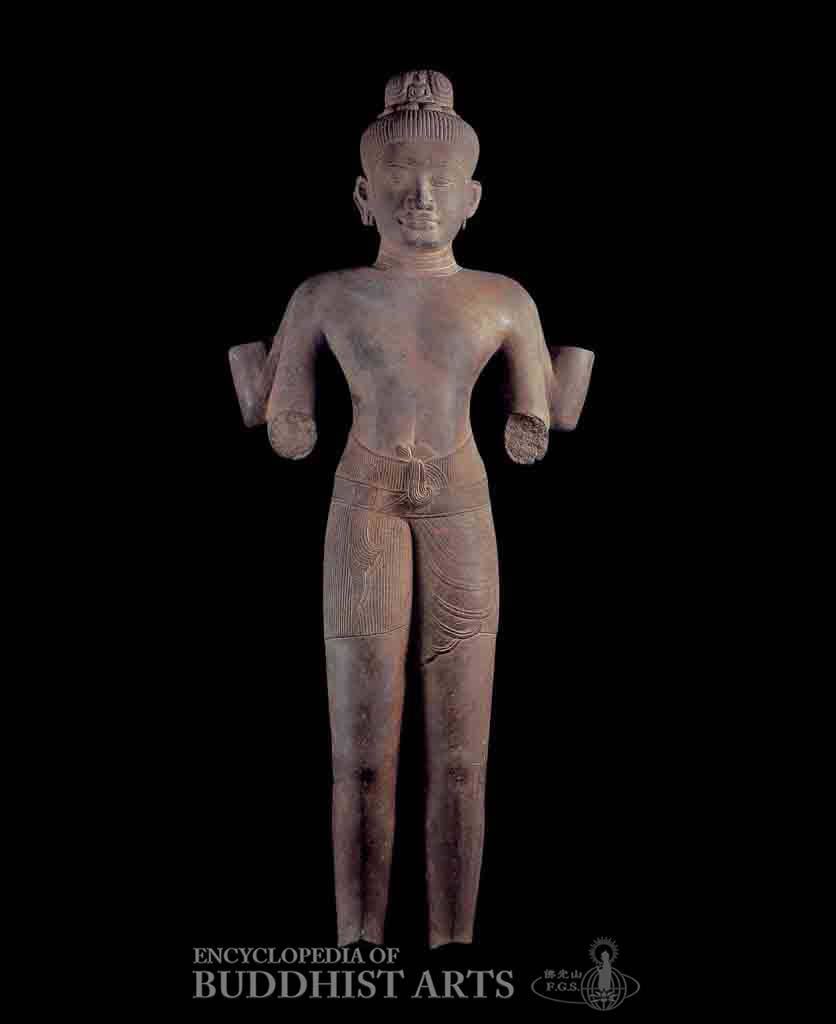
Four-Armed Avalokitesvara
Sandstone
Four-Armed Avalokitesvara
CAMBODIA
The four-armed statue, dated to the Angkor period (circa 9th–15th century), is identified as Avalokitesvara by the Buddha image incorporated into the topknot. The Bodhisattva is depicted with almond-shaped eyes, a prominent nose and the thick lips characteristic of sculptures from the region. The hairline is low, while the braids are coiled into a knot and secured with a string of large beads. The upper body is quite short, while the legs are almost exaggeratedly long. The figure wears the short local skirt, tied high at the back with a butterfly bow and worn low in front, exposing the navel. The simple and lithe sculpture reflects the graceful Baphuon style.
For more details, go to the Encyclopedia of Buddhist Arts: Sculpture A-F, page 348.
Cite this article:
author = Hsingyun and Youheng and Lovelock, Yann and Chou, Yuan and Huntington, Susan and Edson, Gary and Neather, Robert,
booktitle = {Encyclopedia of Buddhist Arts: Sculpture A-F},
pages = 348,
title = {{Four-Armed Avalokitesvara}},
volume = 10,
year = {2016}}