
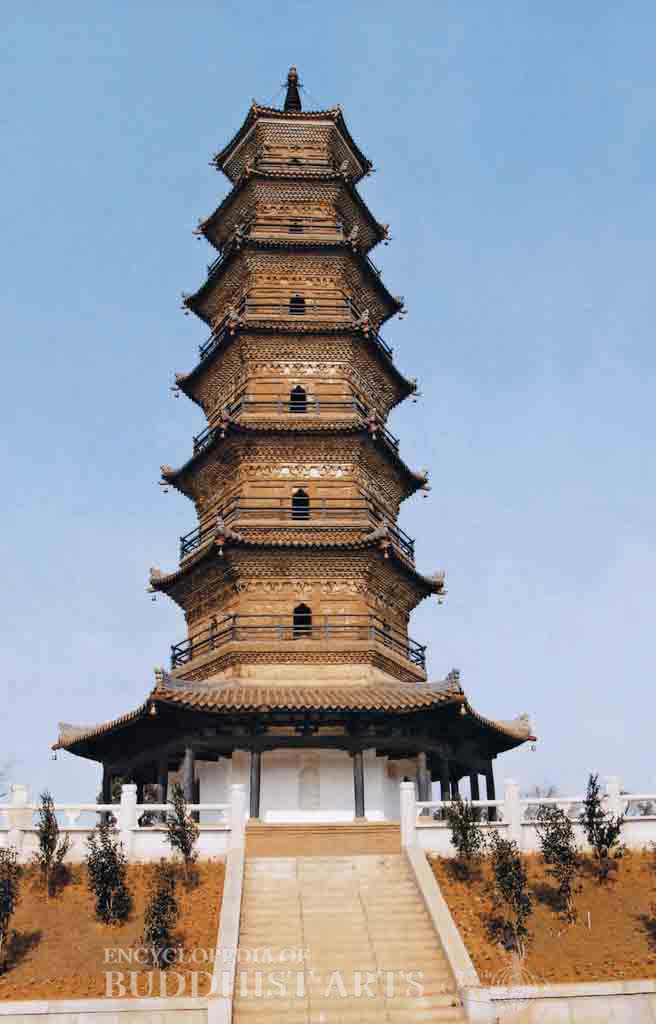
Guifeng Pagoda
Guifeng Pagoda
CHINA, Guangdong, Heyuan
Guifeng means Turtle Peak, and the structure gained its name from being built on top of a turtle-shaped mountain. Also known locally as the Old Pagoda, it was built in 1132 during the Southern Song dynasty and repaired in 1602 during the Ming dynasty. The pagoda was listed as a National Cultural Heritage Site in 2006.
The seven-story hexagonal brick pagoda is 42.6 m high and was built in imitation of a timber structure. The pagoda has 13 stories internally, but externally there are only seven levels. There is a veranda surrounding the first level, and doors and balconies are present on each subsequent level. The eaves consist of corbeling with courses of dogtooth bricks. The edges of the eaves are fitted with tile caps and drip tiles, while bronze bells hang from each corner. There are also architraves, bracket sets, pilasters, and false doors, all typically seen in brick pagodas from the Song dynasty (960–1279). The iron spire consists of an inverted bowl, a vase, stacked rings, and a jewel.
For more details, go to the Encyclopedia of Buddhist Arts: Architecture G-L, page 412.
Cite this article:
author = Hsingyun and Youheng and Johnson, Peter and Mankuang and Lancaster, Lewis,
booktitle = {Encyclopedia of Buddhist Arts: Architecture G-L},
pages = 412,
title = {{Guifeng Pagoda}},
volume = 2,
year = {2016}}