
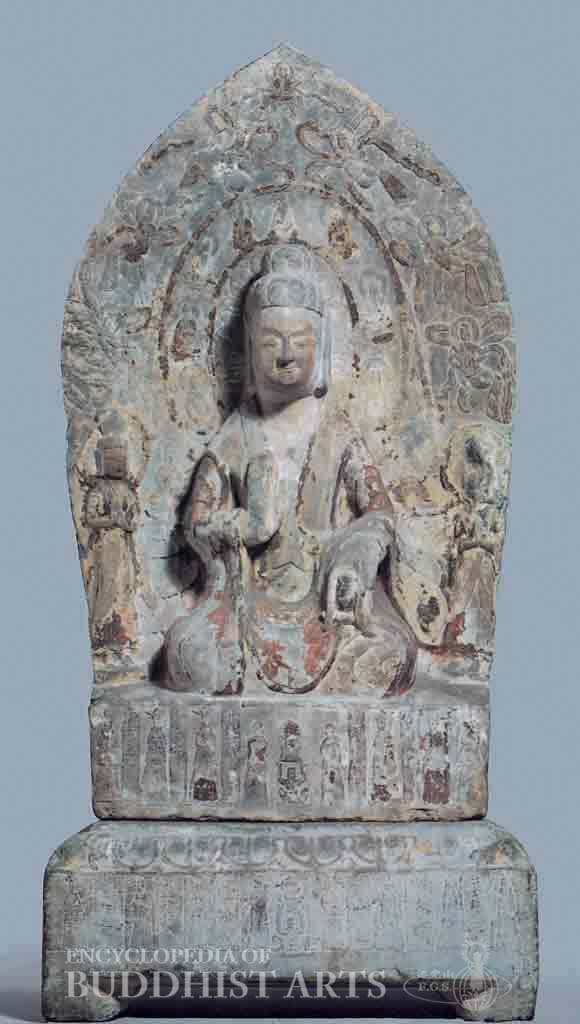
Buddha and Attendants
Limestone
Buddha and Attendants
CHINA; Northern Wei dynasty
The sculpture’s origin is unknown but an inscription on it states that Niu Boyang and other people created it for the emperor in 500. Over 130 images of the donors surround the base and the platform on which the Buddha sits.
The Buddha has curly hair and a usnisa, and wears a long monastic robe with a low collar that covers the whole body. The figure is seated in lotus position and forms the abhaya (fearlessness) mudra while attendant Bodhisattvas flank either side standing with their palms joined in reverence. A lotus nimbus with a circle of seated Buddhas and a mandorla with six apsaras around the edges carved in low relief are behind the figure’s head.
For more details, go to the Encyclopedia of Buddhist Arts: Sculpture A-F, page 192.
Cite this article:
author = Hsingyun and Youheng and Lovelock, Yann and Chou, Yuan and Huntington, Susan and Edson, Gary and Neather, Robert,
booktitle = {Encyclopedia of Buddhist Arts: Sculpture A-F},
pages = 192,
title = {{Buddha and Attendants}},
volume = 10,
year = {2016}}