
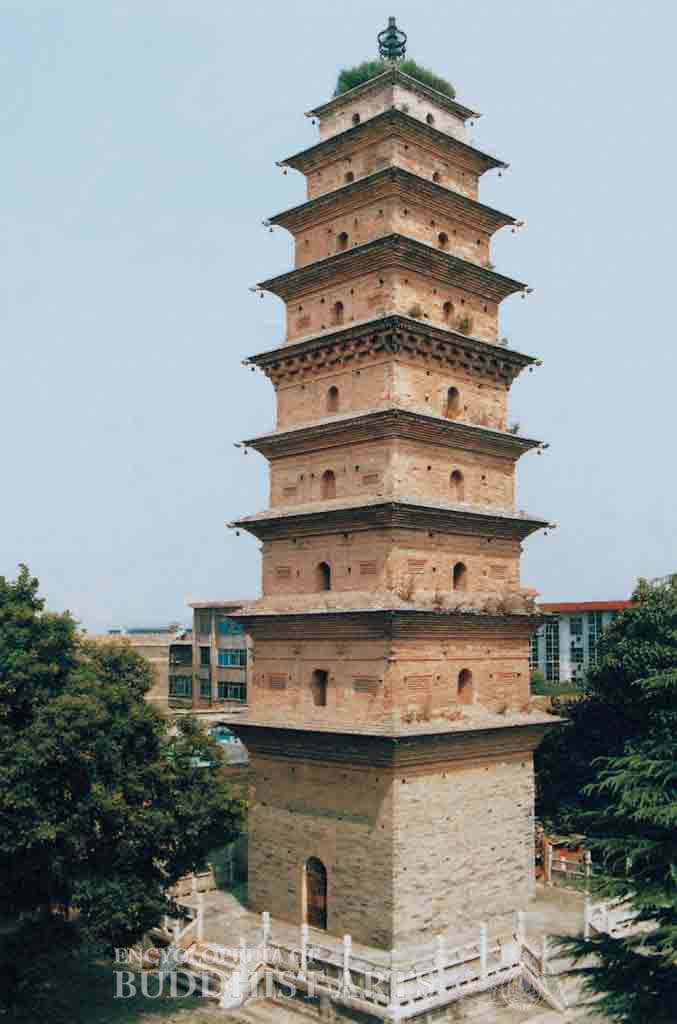
Jingjin Temple Pagoda
Jingjin Temple Pagoda
CHINA, Shaanxi, Weinan
The pagoda was built on the grounds of Jingjin Temple, which no longer exists. It was built during the rule of Emperor Suzong (reigned 756–762) of the Tang dynasty and repaired in 1047 during the Northern Song dynasty. The structure underwent maintenance in 1955 and 1987 to strengthen its foundation. It was listed as a National Cultural Heritage Site in 2006.
The nine-story, square, brick pagoda is 33.3 m high and was built in imitation of a wooden structure. The sides of the base are 7 m long. The first story of the pagoda is markedly taller with an arched doorway on its west side. From the second story upwards, every side of the pagoda has been divided into three bays with an arched door in the central bay and fake vertical bar windows on each side. The north and south doors are real on the even stories, while the east and west doors are fake. On the odd stories the east and west doors are real, while the north and south doors are fake. Apart from the eaves on the fifth story, which are supported by two-tier bracket sets, all the other eaves are in the form of corbeling. The pyramidal roof is surmounted by an inverted bowl, a multiple-tier canopy, and a jewel.
For more details, go to the Encyclopedia of Buddhist Arts: Architecture G-L, page 523.
Cite this article:
author = Hsingyun and Youheng and Johnson, Peter and Mankuang and Lancaster, Lewis,
booktitle = {Encyclopedia of Buddhist Arts: Architecture G-L},
pages = 523,
title = {{Jingjin Temple Pagoda}},
volume = 2,
year = {2016}}