
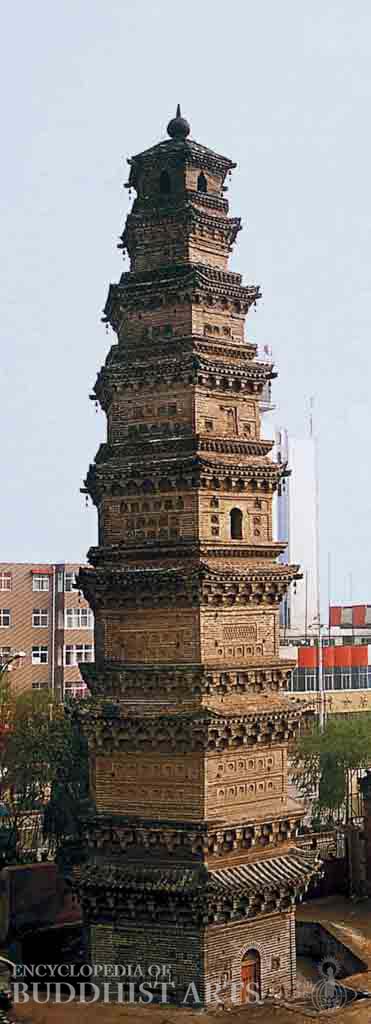
Xingguo Temple Pagoda
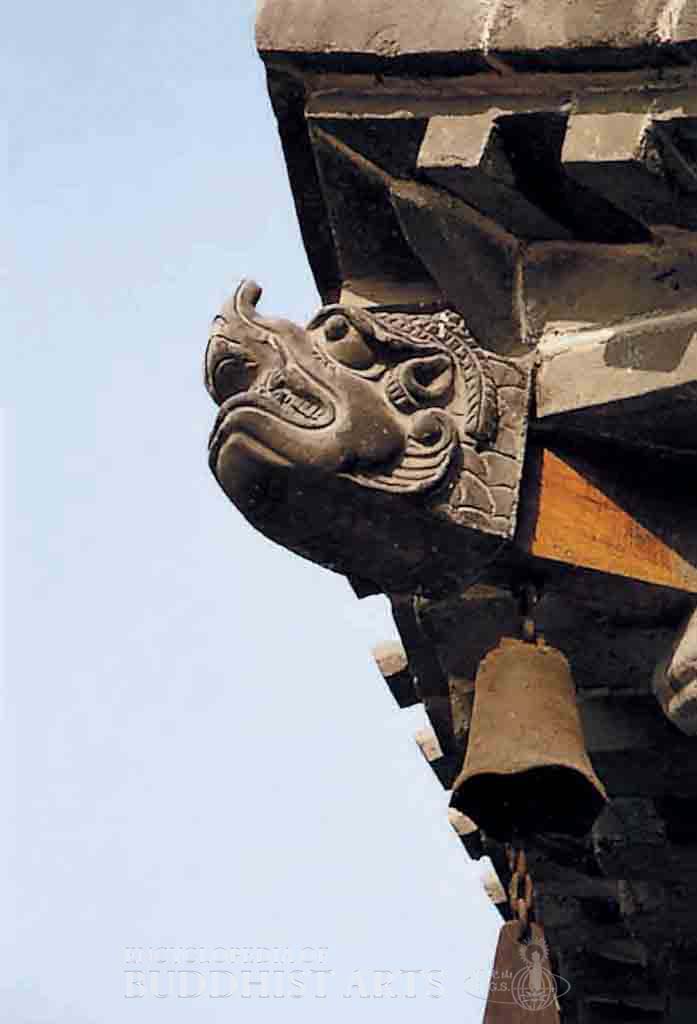
Xingguo Temple Pagoda (detail)
Xingguo Temple Pagoda
CHINA, Henan, Kaifeng
The pagoda was built on the grounds of Xingguo Temple, which no longer exists. It was built between 976 and 984 during the Northern Song dynasty. Due to flooding, the base and the lower part of the first story have sunk into the ground. It was listed as a National Cultural Heritage Site in 2006.
The eight-story, hexagonal, brick pagoda is 29.2 m high. There is an arched doorway on the west side of the first story. Inside the pagoda staircase encircles the central pillar and leads to the top of the structure. Apart from the highest story, doorways are on every story. The eaves are supported by imitation wooden bracket sets and curve upwards at the corners, from which wind chimes are suspended. The roofs are in the form of reverse corbeling and are followed by the base for the next story. The hexagonal pyramidal roof is surmounted by a copper vase followed by a finial. The interior and exterior walls of the pagoda are inlaid with 410 Buddha niches.
For more details, go to the Encyclopedia of Buddhist Arts: Architecture T-Z, page 1321.
Cite this article:
author = Hsingyun and Youheng and Johnson, Peter and Mankuang and Lancaster, Lewis,
booktitle = {Encyclopedia of Buddhist Arts: Architecture T-Z},
pages = 1321,
title = {{Xingguo Temple Pagoda}},
volume = 4,
year = {2016}}