
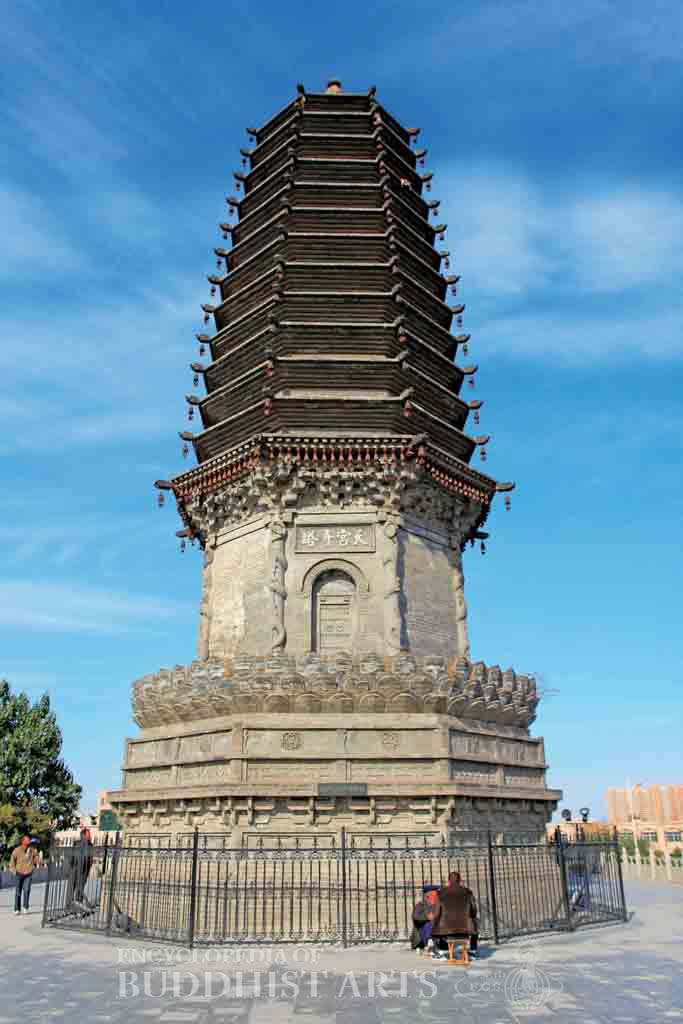
Tiangong Temple Pagoda
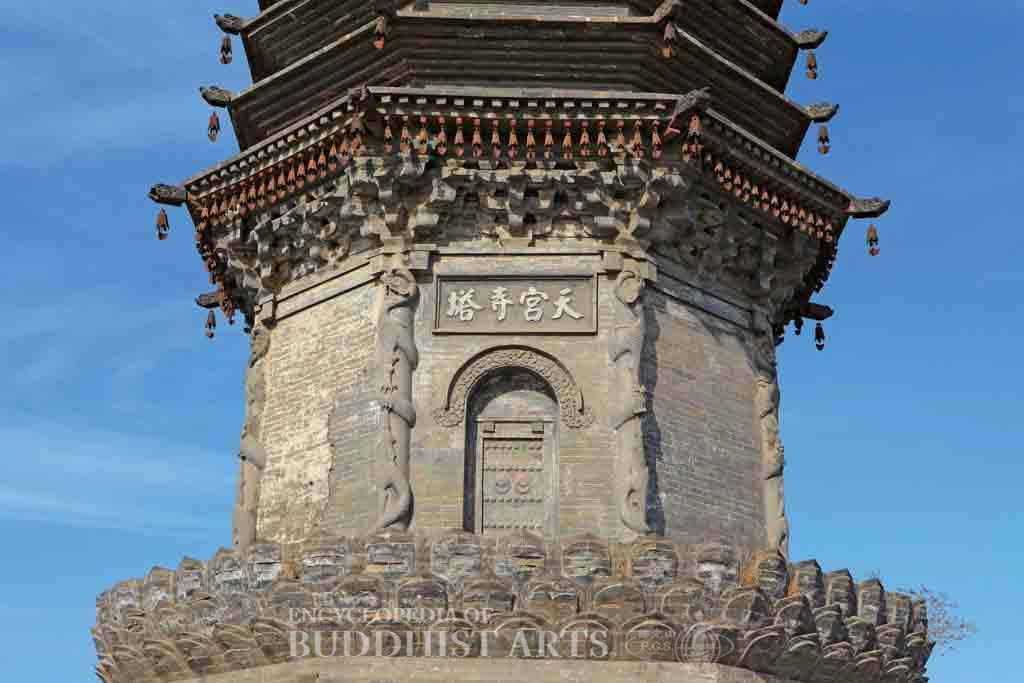
Tiangong Temple Pagoda (detail)
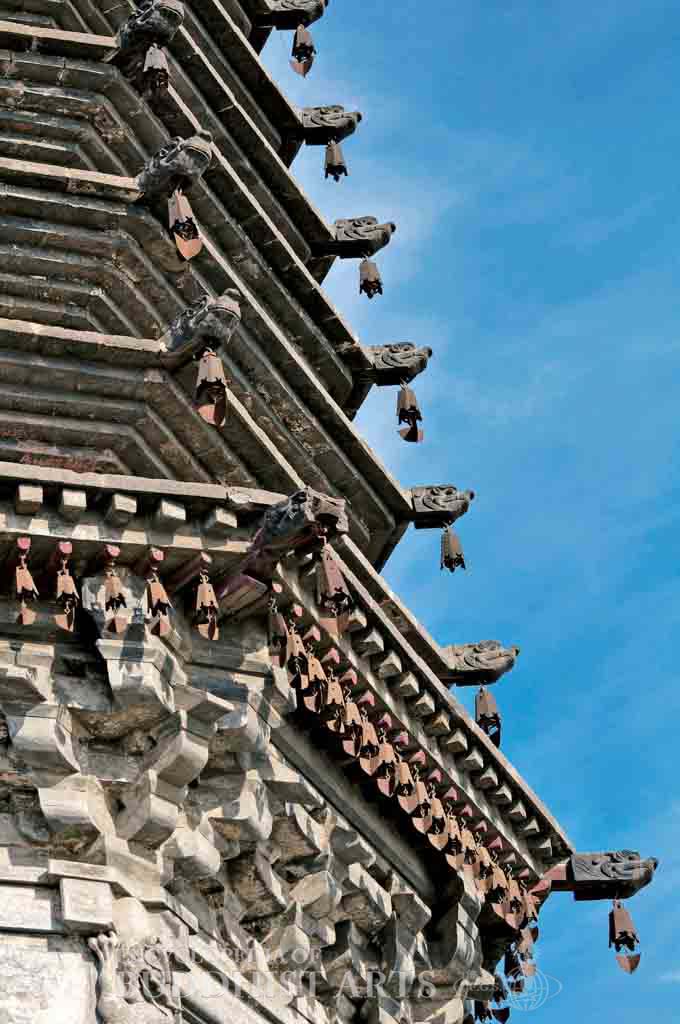
Tiangong Temple Pagoda (detail)
Tiangong Temple Pagoda
CHINA, Hebei, Tangshan
Tiangong means Heavenly Palace. The pagoda is located on the site of Tiangong Temple and was built in 1055 during the Liao dynasty. The pagoda has been repaired a number of times but the temple is no longer extant. It was listed as a National Cultural Heritage Site in 2006.
The solid brick octagonal pagoda has 13 tiers and measures 24.2 m in height. The upper part of the Sumeru base has bracket sets supporting a flat base with imitation balustrades. The panels of the balustrades have carvings of geometric patterns and flowers. A three-layer upturned lotus supports the pagoda body. There are false doors facing the four cardinal directions, while the remaining sides are left unadorned. At the corners there are pilasters with coiling dragons. The first tier is the only one with imitation wooden bracket sets supporting the eaves, while the remaining tiers all have eaves in the form of corbeling. Wind chimes hang from the corners of the eaves. The octagonal pyramidal roof is surmounted by a gilt copper spire. The spire was recast in 1677 during the Qing dynasty.
A variety of valuable artifacts were discovered when the pagoda was being renovated in 1987. There were ten different Buddhist scriptures printed during the Liao dynasty (907–1125), including the Amitabha Sutra and the Golden Light Sutra. There was also a copper statue of the Buddha teaching the Dharma cast during the Liao dynasty, and stone statues of Manjusri and Samantabhadra Bodhisattvas.
For more details, go to the Encyclopedia of Buddhist Arts: Architecture T-Z, page 1119.
Cite this article:
author = Hsingyun and Youheng and Johnson, Peter and Mankuang and Lancaster, Lewis,
booktitle = {Encyclopedia of Buddhist Arts: Architecture T-Z},
pages = 1119,
title = {{Tiangong Temple Pagoda}},
volume = 4,
year = {2016}}