
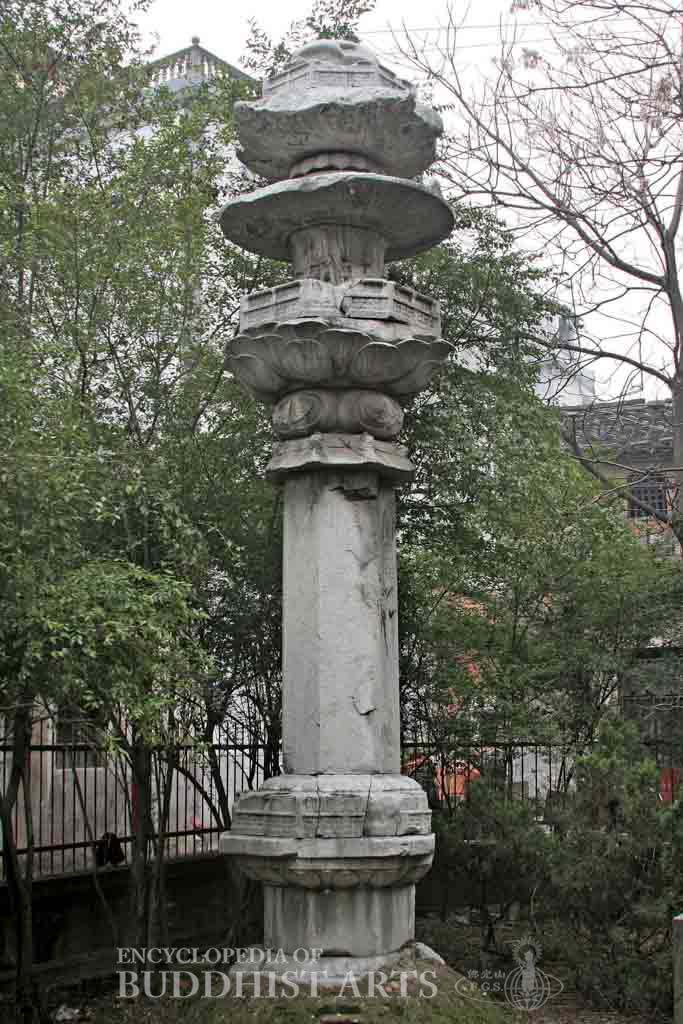
Falong Temple Sutra Pillar
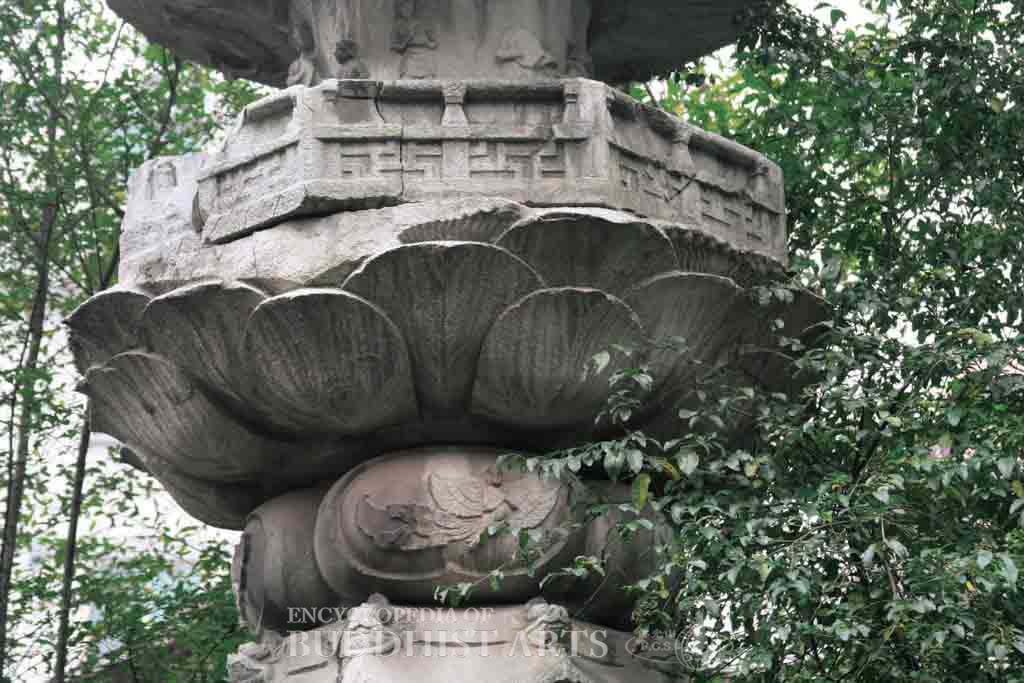
Falong Temple Sutra Pillar (detail)
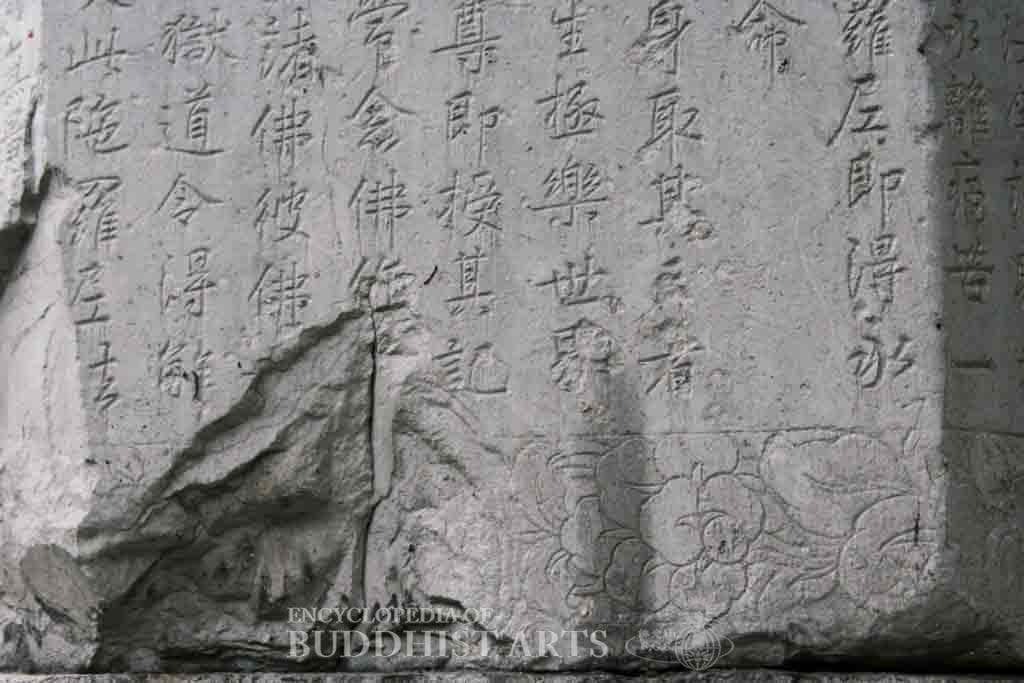
Falong Temple Sutra Pillar (detail)
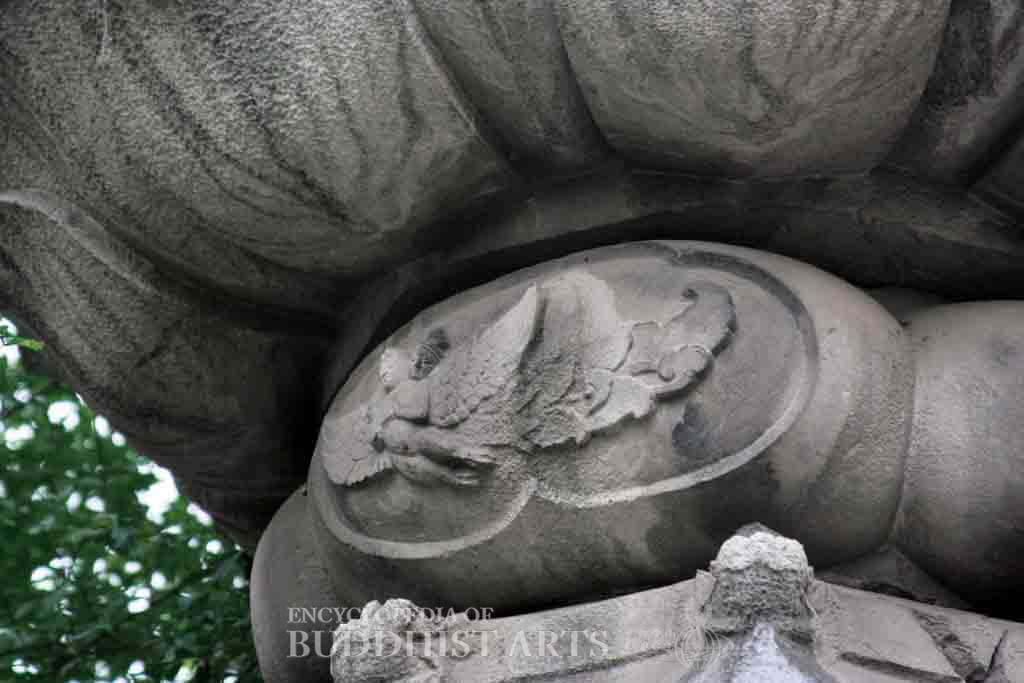
Falong Temple Sutra Pillar (detail)
Falong Temple Sutra Pillar
CHINA, Zhejiang, Jinhua
The pillar used to be sited on the grounds of Falong Temple, which is no longer extant. According to inscriptions on the pillar, it was built in 857 during the Tang dynasty. According to local records, gold coins were found in cracks beneath the pillar and it is therefore also known as Jinqian (Gold Coin) Temple Sutra Pillar. It was listed as a National Cultural Heritage Site in 2006.
The octagonal pillar is 6.3 m high and has a Sumeru base. The pillar body is 1.8 m high and is inscribed with the Usnisavijaya Dharani Sutra in running script. Above the pillar body there are an octagonal canopy, large beads, an upturned lotus, a base with imitation balustrades, a short pillar, a round canopy, a downward facing lotus, a large canopy, a base with imitation balustrades, and an inverted bowl. The octagonal canopy has carvings of heads of beasts on each corner with garlands in between. The beads are each carved with reliefs of kalavinkas and jivajivas. They are depicted with human heads and bird torsos, and having wings and tail feathers, spread out as if in flight. The upturned lotus has three layers of finely carved petals while the base above it has railings carved from a single slab of rock. On the short pillar, there are carvings depicting Buddhist stories. Directly above this and on the underside of the round canopy, there are carvings of apsaras, each in a different pose. The large canopy above this is carved with cloud patterns.
The imitation balustrades on the pillar are exquisitely carved and are believed to be some of the earliest known examples.
For more details, go to the Encyclopedia of Buddhist Arts: Architecture A-F, page 283.
Cite this article:
author = Hsingyun and Youheng and Johnson, Peter and Mankuang and Lancaster, Lewis,
booktitle = {Encyclopedia of Buddhist Arts: Architecture A-F},
pages = 283,
title = {{Falong Temple Sutra Pillar}},
volume = 1,
year = {2016}}