
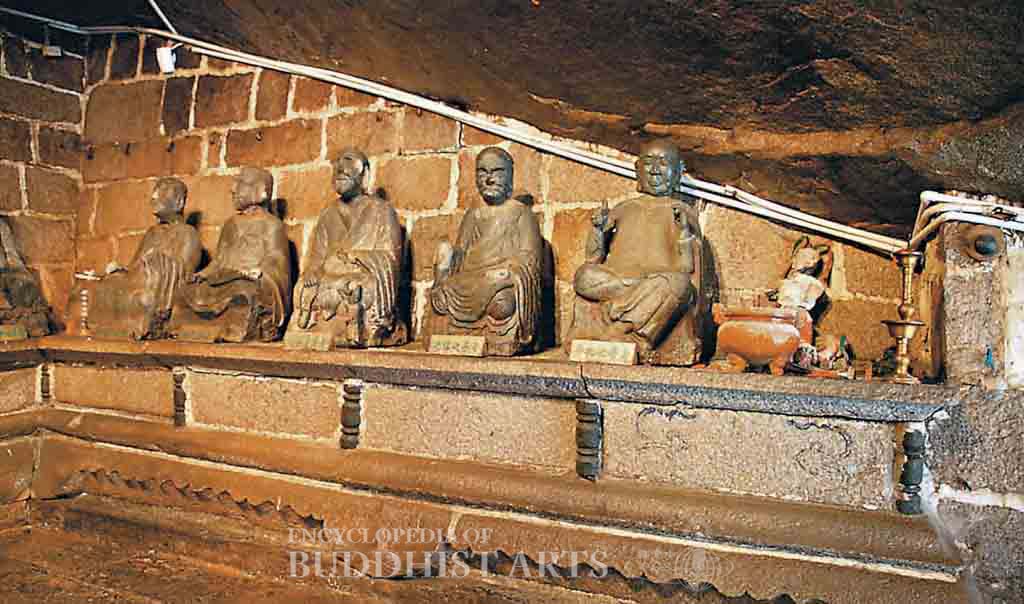
Shengshui Temple Qiyun Cave: Eighteen Arhats
Stone
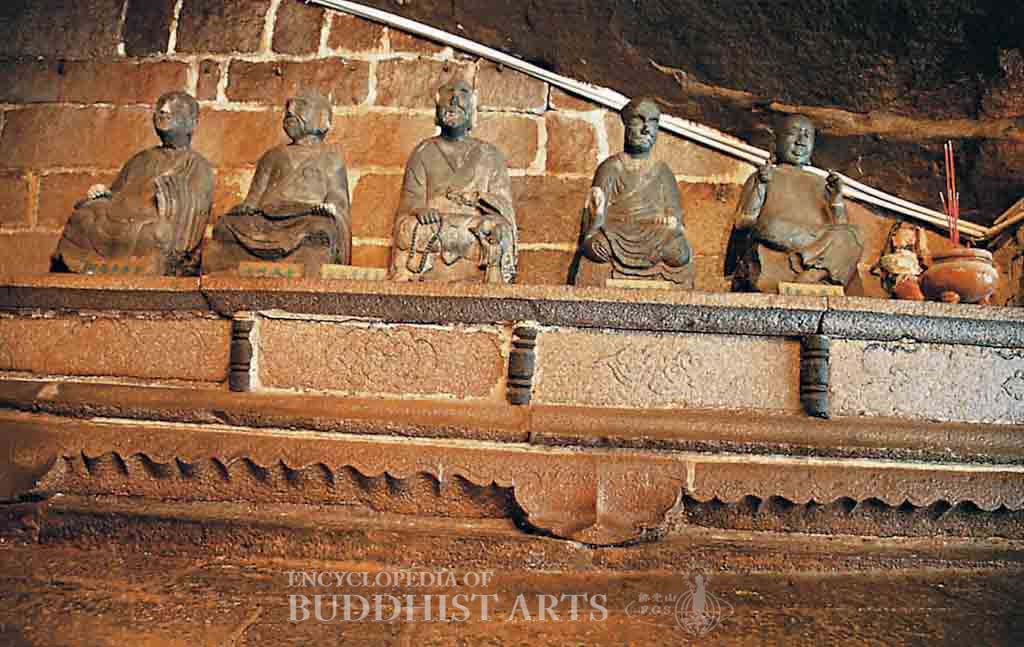
Shengshui Temple Qiyun Cave: Eighteen Arhats
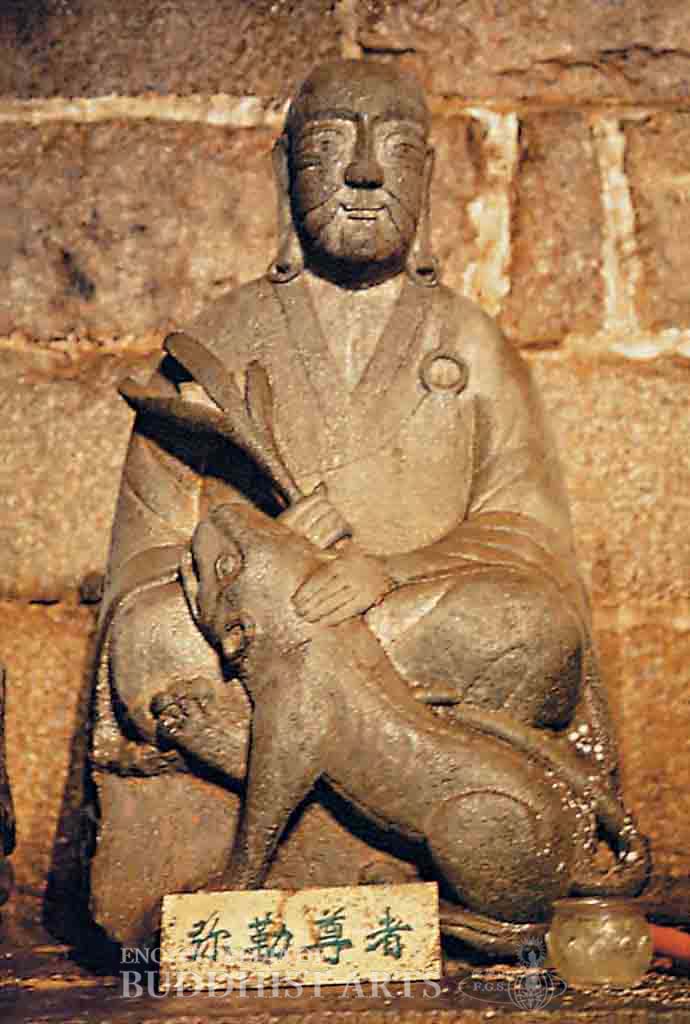
Shengshui Temple Qiyun Cave: Eighteen Arhats
Shengshui Temple Qiyun Cave: Eighteen Arhats
CHINA, Fujian, Fuzhou; Southern Song dynasty
These statues are found within Qiyun Cave, which is to the right of Shengshui Temple in Luoyuan, Fuzhou. The temple was built in 1096 of the Northern Song dynasty. Near the temple are features such as the Xielu Pond, Qiyun Cave, Jinri Platform, Mianhe Stone, and Tingquan Pavilion, with a large number of cliffside sculptures. Among these sculptures, the Eighteen Arhats notably stand out. The site was listed as a National Cultural Heritage Site in 2006.
Qiyun Cave was built within a natural cave. The Arhats are sculpted on three walls. They are mostly seated and measure 74 cm to 84 cm high. Sixteen of these Arhats were created in 1248 of the Southern Song dynasty (1127–1279) by Chen Zengyuan, a stonemason, and are believed to be the earliest stone statues of Arhats in Fujian. The other two Arhats date to the Ming dynasty (1368–1644). The Arhats are seated in various postures and hold different instruments. The bases are embedded with panels that feature carved patterns and Chinese characters. The posts carved between the panels resemble bamboo. The Arhats and the bases are all inscribed with detailed dates and names of the donors and sculptors, making them artifacts of historical value. Unfortunately, Shengshui Temple has experienced numerous robberies, and most of the Arhats are heavily damaged.
A statue of Avalokitesvara can also be found within the cave as well as inscriptions of poems written by literati from the Yuan dynasty (1271–1368) to the modern period.
For more details, go to the Encyclopedia of Buddhist Arts: Caves Mo-S, page 1361.
Cite this article:
author = Hsingyun and Youheng and Johnson, Peter and Mankuang and Huntington, Susan and Edson, Gary and Neather, Robert,
booktitle = {Encyclopedia of Buddhist Arts: Caves Mo-S},
pages = 1361,
title = {{Shengshui Temple Qiyun Cave: Eighteen Arhats}},
volume = 8,
year = {2016}}