
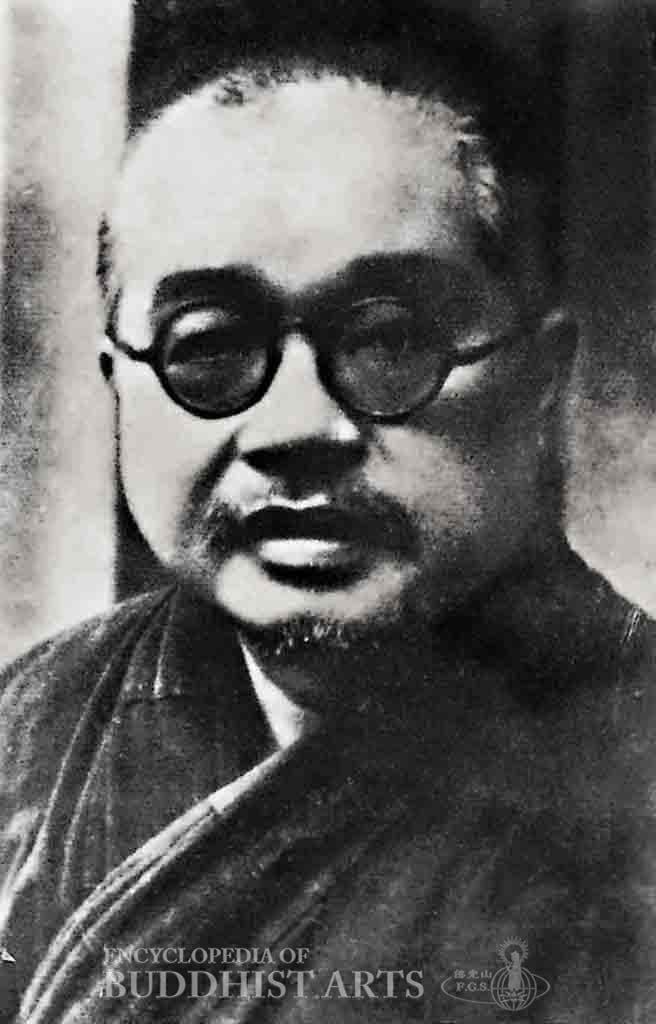
Taixu
Taixu
CHINA, Zhejiang, Jiaxing
Taixu, whose original name was Lu Gansen and Dharma name was Weixin, was a monk, calligrapher, philosopher, and reformist born in Tongxiang, Jiaxing. He was a clever child and fully comprehended the Four Books and Five Classics at a very early age. During his childhood, Taixu often accompanied his grandmother to well-known temples for pilgrimage, and at the age of 16 he renounced and was fully ordained under Chan Master Jing’an at Tiantong Temple in Zhejiang. After reading the influential political works of Kang Youwei, Liang Qichao, Zhang Taiyan, Yanfu and Tan Sitong, Taixu decided to dedicate himself to the reformation of Buddhism.
In 1914, Taixu went into seclusion for three years at Fayu Temple in Zhejiang. During this time, he meditated, studied sutras and Buddhist doctrines, and wrote books. He visited various temples, gave Dharma talks at Lingquan Temple in Taiwan, and went to Japan beginning in 1917.
In 1920, Taixu founded the magazine, Sound of the Tide to promote Humanistic Buddhism. Also during this time, he served as the abbot of Mi’le Yuan Temple and Dafo Temple in Zhejiang. He later set up Buddhist colleges in Hubei, Fujian, and a Buddhist association in Nanjing, Jiangsu. Taixu emphasized the reorganization of the Sangha and set the trend in giving Dharma talks. He was the first Chinese monk to travel to Europe and America to propagate Buddhism, and established the World Buddhist College in Paris. After he passed away, over 300 relics were found within his remains.
Major written works by Taixu include New Consciousness, New Sangha, Doctrine on Consciousness, True Reality Theory, and Reorganization of Sangha System. Books of Master Taixu were edited by his disciple Yinshun.
A stele inscription of his calligraphy, Dharma Words, is engraved on the Stele Wall at Fo Guang Shan Monastery in Kaoshiung, Taiwan. Other works include Poem for Master Shanhui, housed at Lingquan Temple in Taiwan, and Seven-Character Couplet, which is kept at Ho’s Calligraphy Foundation in Taipei, Taiwan.
For more details, go to the Encyclopedia of Buddhist Arts: People, page 250.
Cite this article:
author = Hsingyun and Youheng and Youlu and Pokorski, Stefanie and Yichao and Mankuang and Miaohsi,
booktitle = {Encyclopedia of Buddhist Arts: People },
pages = 250,
title = {{Taixu}},
volume = 19,
year = {2016}}