
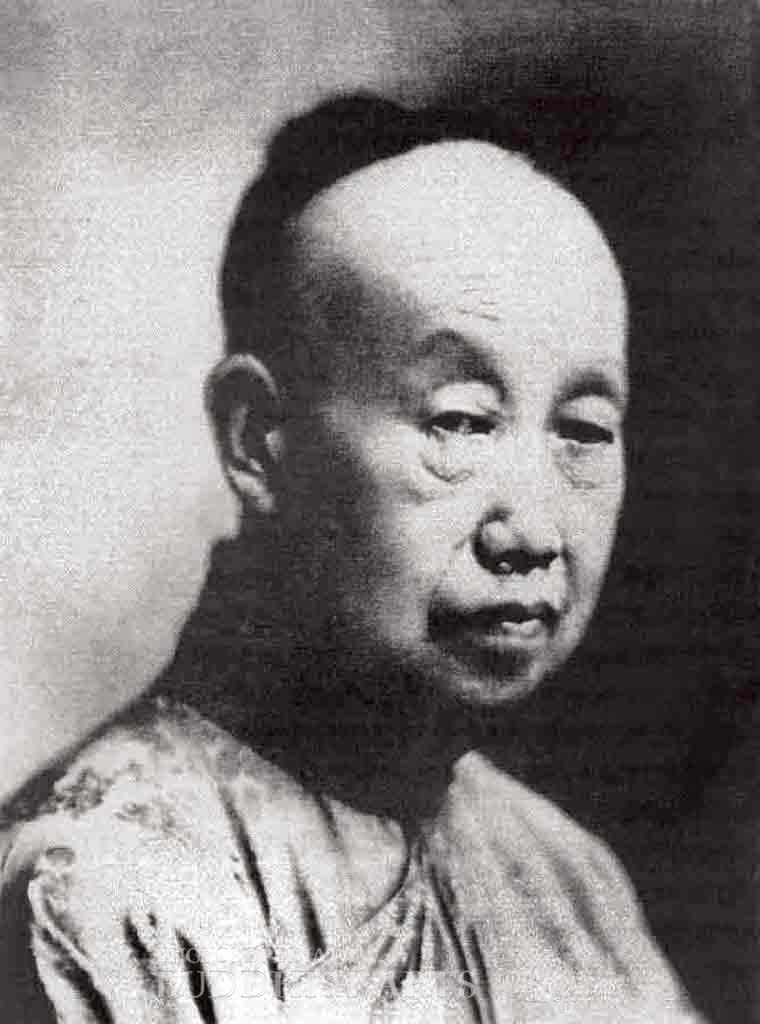
Wu Changshuo

Bodhidharma by Wu Changshuo; Dated 1915
Ink and color on paper
Wu Changshuo
CHINA, Zhejiang, Huzhou; 19th–20th century
Wu Changshuo was a famous calligrapher, painter, and seal engraver from Anji, Huzhou. He served as an official in Jiangsu, but later moved to Shanghai and made a living by selling his artwork. He befriended other well-known artists such as Ren Yi, Zhang Xiong, Pu Hua, and Wang Zhen, and led various arts societies including the Yu Yuan Society of Calligraphy and Painting and the Xiling Society of Seal Arts. He was also recognized as a master of the Shanghai school of painting.
Wu first began practicing calligraphy in the regular script of the Tang dynasty (618–907), then mastered the Han clerical script. Later, he specialized in the greater seal script, also known as Shigu script. His works, many of which are kept at the Palace Museum in Beijing, are regarded as masterpieces of Shigu calligraphy. He applied the techniques of clerical and seal scripts to his usage of cursive script, which resulted in bold, forceful calligraphy. Shen Shiyou invited Wu to script calligraphy onto his treasured ink stones, which were then carved by Zhao Shi. Later, rubbings were made and collected in Rubbings from Shen’s Ink Stones.
Wu learned seal carving from Ding Jing, Deng Shiru, Wu Xizai, and Zhao Zhiqian. He was inspired by the carvings of the Qin (221–207 BCE) and Han (206 BCE–220 CE) dynasties, and developed his own personal style. His carvings appear simple and natural, without undue refinement. His Buddhist seal carvings include My Buddha, Amitabha Buddha, and Letting Things Go According to the Conditions is the Way to Happiness.
Wu focused on painting in his later years. He began by painting flowers, and then moved on to landscapes and Buddhist images. Influenced by the Yangzhou school, he developed an explicit and direct style executed with bright colors, sharp contrasts, and bold brushstrokes. His landscape paintings often convey a sense of vastness and desolation. Much like Ren Yi, his paintings of figures are done in a clear, simple style. His works include Eighteen Arhats, kept at the Tianjin Museum; Standing Buddha, kept at the National Art Museum of China in Beijing; and Bodhidharma, kept at the Chang Foundation Museum in Taipei, Taiwan.
For more details, go to the Encyclopedia of Buddhist Arts: People, page 295.
Cite this article:
author = Hsingyun and Youheng and Youlu and Pokorski, Stefanie and Yichao and Mankuang and Miaohsi,
booktitle = {Encyclopedia of Buddhist Arts: People },
pages = 295,
title = {{Wu Changshuo}},
volume = 19,
year = {2016}}