
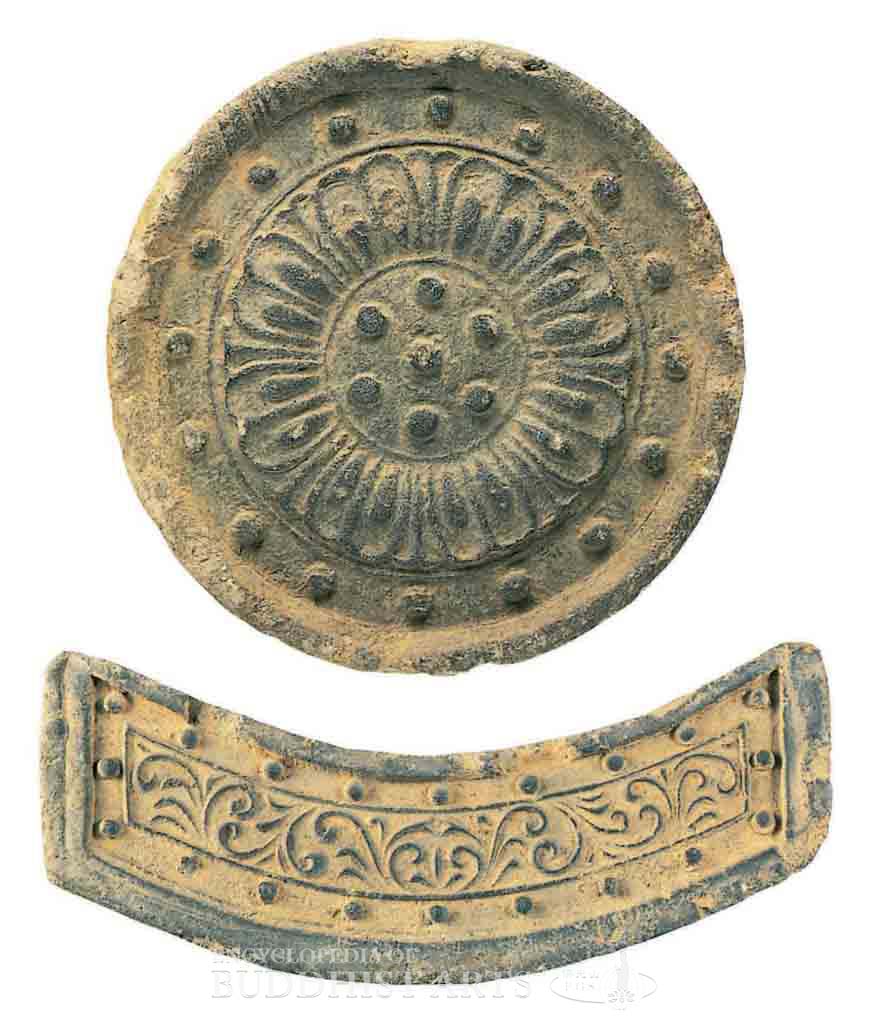
Todaiji Temple: Tile Caps and Drip Tiles; Diameter: 19 cm (tile cap); L: 27.2 cm (drip tile)
Earthenware
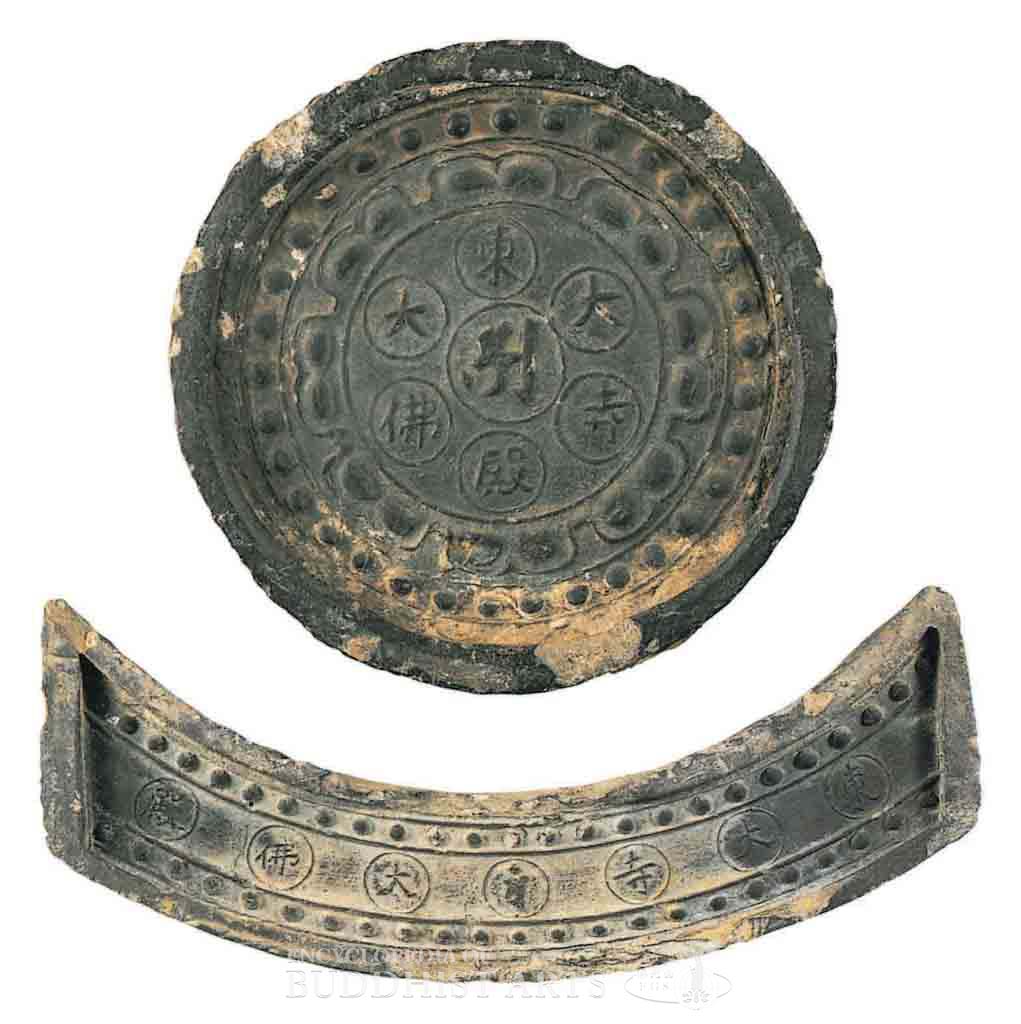
Todaiji Temple: Tile Caps and Drip Tiles; Diameter: 20.3 cm; (tile cap); L: 35.8 cm (drip tile)
Todaiji Temple: Tile Caps and Drip Tiles
JAPAN, Nara; Nara period (710–794), Kamakura period (1185–1333)
These two sets of roof-end tiles were produced at the Mantomi Kiln during the 8th and 12th centuries.
The first set was used in the construction of Todaiji Temple during the Nara period (710–794). The circular tile cap with a lotus design is 19 cm in diameter, while the scroll leaf-patterned drip tile is 27.2 cm wide. Both tiles are outlined with studs.
The second set was made during the Kamakura period (1185–1333) when Todaiji Temple was undergoing reconstruction. The circular tile cap is 20.3 cm in diameter, and the drip tile is 35.8 cm wide. The tile cap is decorated with a ring of lotus petals encircling a Sanskrit seed syllable and characters reading “Todaiji Great Buddha Hall.” The drip tile has the same characters, and both tiles are also outlined with studs.
For more details, go to the Encyclopedia of Buddhist Arts: Artifacts, page 340.
Cite this article:
author = Hsingyun and Youheng and Youji and Pokorski, Stefanie and Mankuang and Fan, Wen,
booktitle = {Encyclopedia of Buddhist Arts: Artifacts },
pages = 340,
title = {{Todaiji Temple: Tile Caps and Drip Tiles}},
volume = 18,
year = {2016}}