
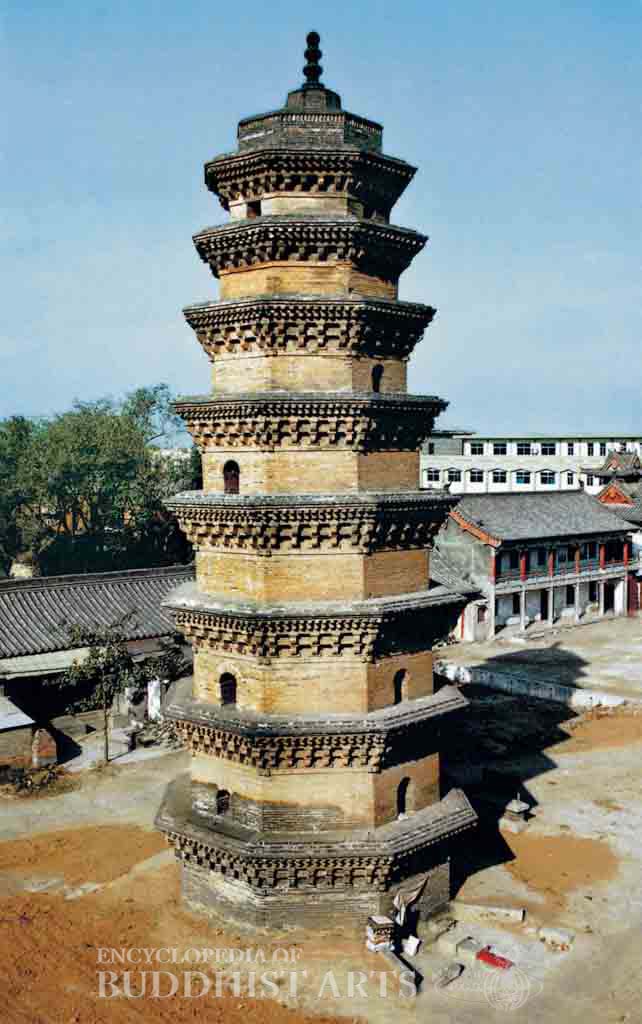
Shengguo Temple Pagoda
Shengguo Temple Pagoda
CHINA, Henan, Jiaozuo
Shengguo Temple was built during the Tang dynasty (618–907), while the pagoda was built in 1096 during the Northern Song dynasty, when the temple was under renovation. The temple has since been destroyed, leaving only the pagoda standing. The records state that the pagoda was repaired in 1617 during the Ming dynasty. The pagoda was listed as a National Cultural Heritage Site in 2006.
The nine-story, octagonal, brick pagoda is 27.3 m high. There is a doorway on the east side leading to a hexagonal chamber. Beneath the eaves from the first to eighth stories there are rafters supported by bracket sets. Above the eaves there are three tiers of reversed corbeling. The ninth story was repaired during the Ming dynasty (1368–1644) and has no bracket sets. The cast iron spire is decorated with the eight trigrams, dragons, and phoenixes, as well as an inscription stating when the pagoda was repaired. The structure is unusual in that it has a hexagonal chamber inside an octagonal pagoda body.
For more details, go to the Encyclopedia of Buddhist Arts: Architecture M-S, page 978.
Cite this article:
author = Hsingyun and Youheng and Johnson, Peter and Mankuang and Lancaster, Lewis,
booktitle = {Encyclopedia of Buddhist Arts: Architecture M-S},
pages = 978,
title = {{Shengguo Temple Pagoda}},
volume = 3,
year = {2016}}