
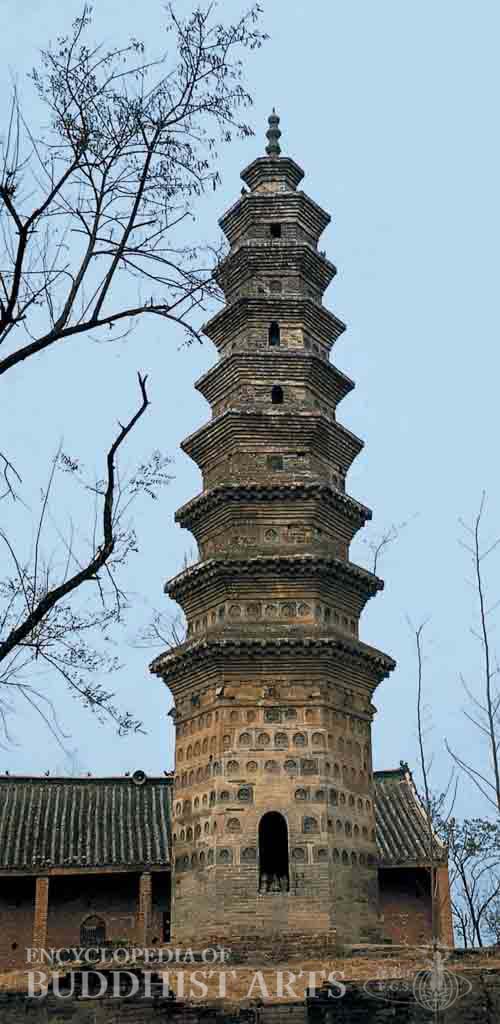
Shengshou Temple Pagoda
Shengshou Temple Pagoda
CHINA, Henan, Shangqiu
The pagoda was built on the grounds of Shengshou Temple, which no longer exists. According to its style and structure, the pagoda was likely built during the Song dynasty (960–1279). It was listed as a National Cultural Heritage Site in 2006.
The nine-tier, hexagonal, brick pagoda is 19.3 m high. An arched doorway on the south side of the first tier leads to a hexagonal chamber. The ceiling inside consists of a hexagonal truncated pyramid composed of brick corbeling. On the exterior of the pagoda, the eaves of the first, second, and third tiers consist of corbeling with two rows of tightly spaced bracket sets at the top. The roofs consist of reverse corbeling. Just below the corbeling on the first tier there are brick imitation tripartite bracket sets. From the fourth tier upwards, there are no brackets sets but only corbeling. Doorways are on the sixth and eighth tiers. The spire consists of an inverted bowl and jewels.
Most of the surface of the pagoda is covered in 281 brick tiles carved with figures representing either Sakyamuni Buddha or Arhats in seated positions. They constitute a valuable source for the study of Song dynasty Buddhist art.
For more details, go to the Encyclopedia of Buddhist Arts: Architecture M-S, page 983.
Cite this article:
author = Hsingyun and Youheng and Johnson, Peter and Mankuang and Lancaster, Lewis,
booktitle = {Encyclopedia of Buddhist Arts: Architecture M-S},
pages = 983,
title = {{Shengshou Temple Pagoda}},
volume = 3,
year = {2016}}