
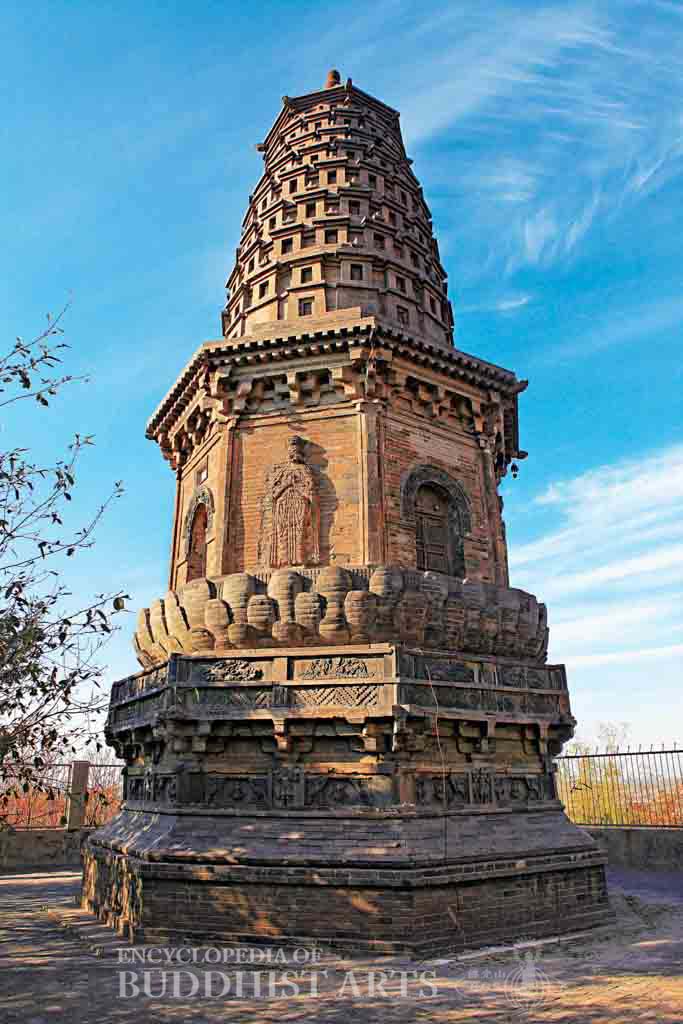
Shoufeng Temple: Medicine Buddha Pagoda
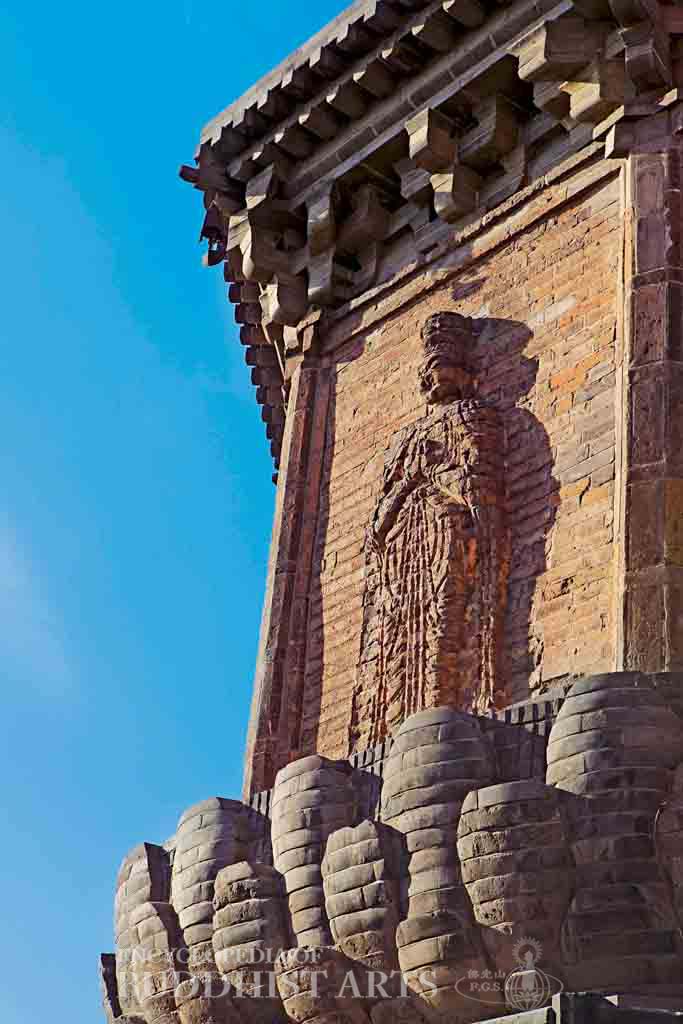
Shoufeng Temple: Medicine Buddha Pagoda (detail)
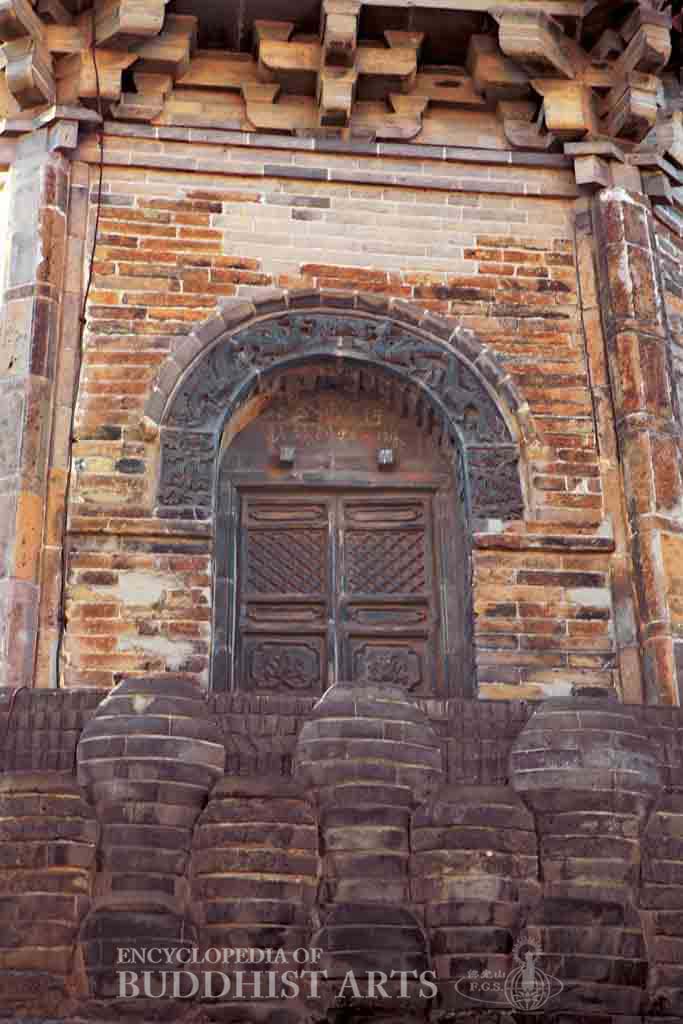
Shoufeng Temple: Medicine Buddha Pagoda (detail)
Shoufeng Temple
CHINA, Hebei, Tangshan
Shoufeng means Longevity Peak, the temple was built in 1032 during the Liao dynasty. The temple was badly damaged in the Tangshan earthquake of 1976. Large scale restoration started in 2000 and completed in 2002. It was listed as a National Cultural Heritage Site in 2006.
Facing south, the surviving buildings include the Beamless Pavilion or Ten Thousand Buddha Pavilion, Medicine Buddha Pagoda, and the Wenchang Pavilion. Their architectural styles are noticeably different. The three-by-three bay Beamless Pavilion is the main building of the temple. It was originally a single-story building and two more stories were added during the rule of Emperor Wanli (reigned 1572–1620) of the Ming dynasty. It has a hip-and-gable roof and the eaves are supported by seven-tier imitation wooden bracket sets made from bricks. The barrel-vaulted ceiling within the first story is decorated with images of clouds, dragons, and phoenixes. Stairs are located on either side of the entrance, within the load-bearing walls, for access to the second story. The ceiling on the second story is constructed from wood. Outside there is a balcony enclosed by white balustrades. The third story also has a barrel-vaulted ceiling.
The Medicine Buddha Pagoda is a flower pagoda constructed in brick. The pagoda stands on a Sumeru base and each side of the concave section has two ogee arches with figures inside. Directly above the concave section there are bracket sets supporting imitation balustrades. The balusters and panels are decorated with carvings of floral and geometric patterns. Above them is a triple-layer upturned lotus supporting the lower section of the octagonal pagoda body. The sides facing the four cardinal directions have false arched doors, while the remaining sides have reliefs of Buddhist figures. Pilasters are located at each corner and are linked by architraves. Above the architraves there are brackets sets supporting the eaves. The upper section of the pagoda has nine tiers filled with niches, in each of which a Buddha image is enshrined. The spire consists of an inverted bowl and two jewels.
The Wenchang Pavilion is three stories high. The first story is a three-by-one bay structure, the second story is one-by-one bay, while the third story has a roof in the form of a finial.
For more details, go to the Encyclopedia of Buddhist Arts: Architecture M-S, page 1003.
Cite this article:
author = Hsingyun and Youheng and Johnson, Peter and Mankuang and Lancaster, Lewis,
booktitle = {Encyclopedia of Buddhist Arts: Architecture M-S},
pages = 1003,
title = {{Shoufeng Temple}},
volume = 3,
year = {2016}}