
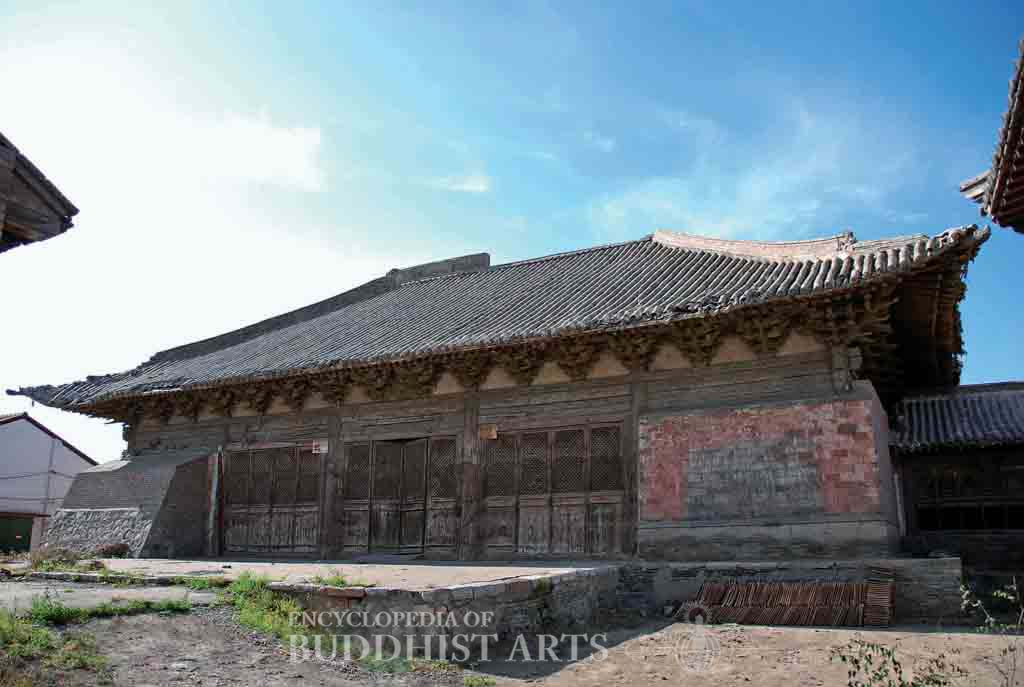
Lingyan Temple: Great Hero Hall
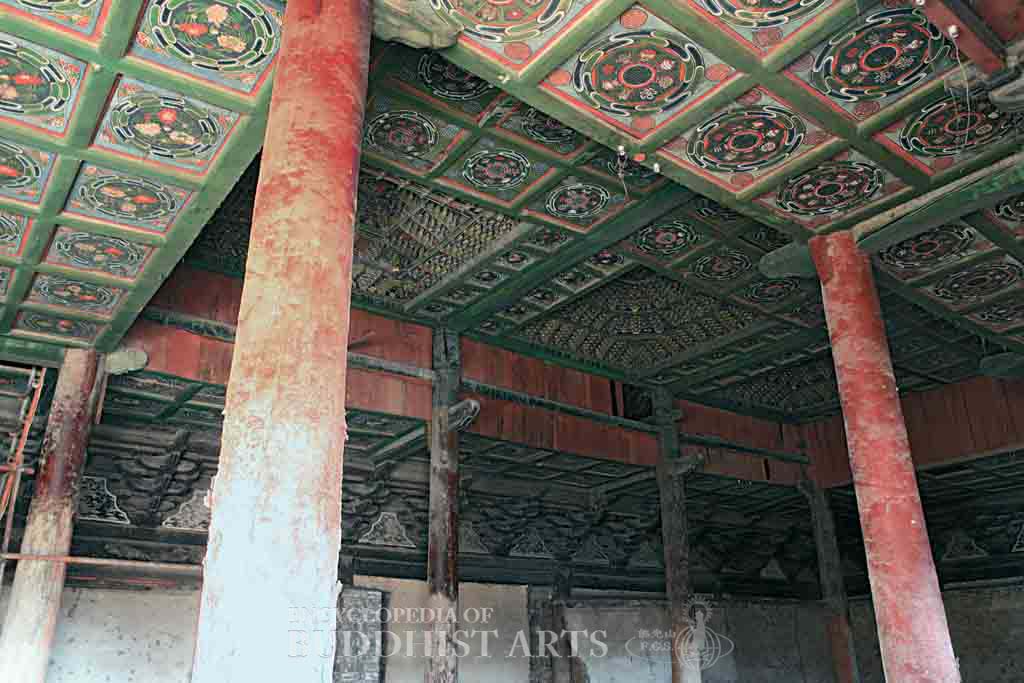
Lingyan Temple: Great Hero Hall (interior)
Lingyan Temple
CHINA, Hebei, Zhangjiakou
Lingyan means Cliff of Spirits. The construction date of the temple is unknown but, according to the records, it was destroyed during the late Yuan dynasty (1271–1368) and rebuilt in 1441 during the Ming dynasty, on the orders of the emperor. It was listed as a National Cultural Heritage Site in 2006.
Facing south, the surviving temple buildings include the Heavenly King Hall, Great Hero Hall, side halls, and meditation halls. The three-by-three bay Heavenly King Hall has a single-eave hip-and-gable roof covered with clay tiles. The eaves are supported by five-tier bracket sets with downward pointing cantilevers. The beams are colorfully painted, while coiling dragons in ink can be found on the boards on either side of the bracket sets.
The five-by-four bay Great Hero Hall has a single-eave hip roof covered with clay tiles. The ridge is completely straight, while the eaves are extended. They are supported by seven-tier bracket sets. On either side of the bracket sets there are decorations of dragons and water motifs, all of which are painted in ink. The three central bays each have four sets of doors. The coffered ceiling is intricately decorated. The interior architraves are decorated with round floral patterns in green and gray. The ceilings and beam structure are typical designs from the Ming dynasty (1368–1644).
For more details, go to the Encyclopedia of Buddhist Arts: Architecture G-L, page 670.
Cite this article:
author = Hsingyun and Youheng and Johnson, Peter and Mankuang and Lancaster, Lewis,
booktitle = {Encyclopedia of Buddhist Arts: Architecture G-L},
pages = 670,
title = {{Lingyan Temple}},
volume = 2,
year = {2016}}