
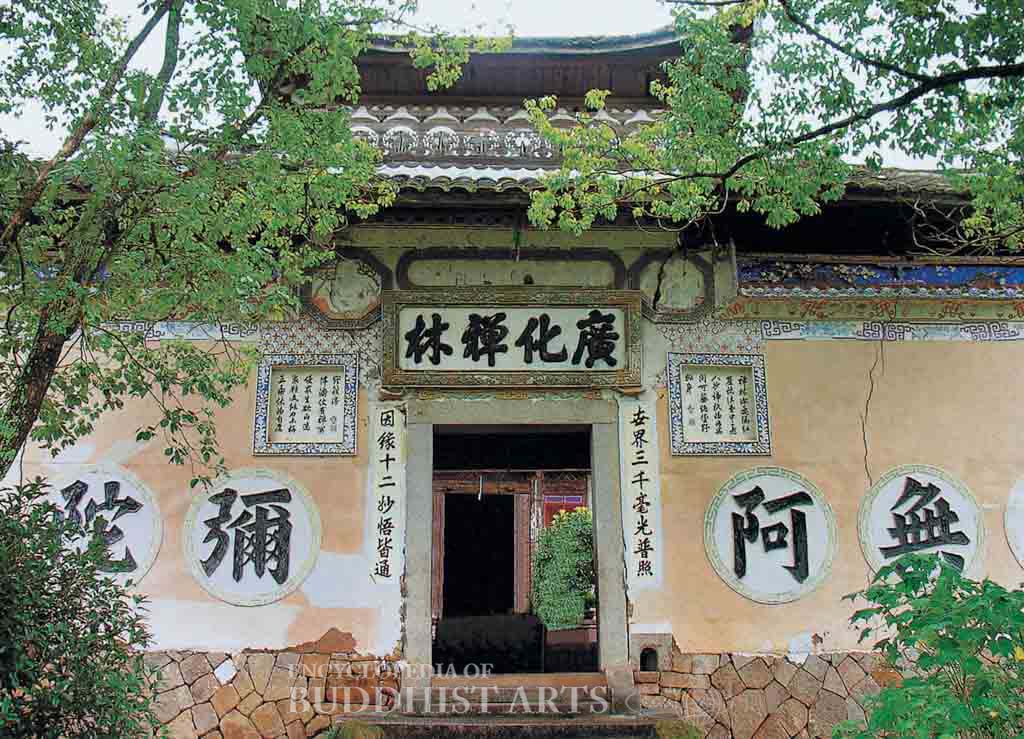
Shifeng Temple: Temple Gate
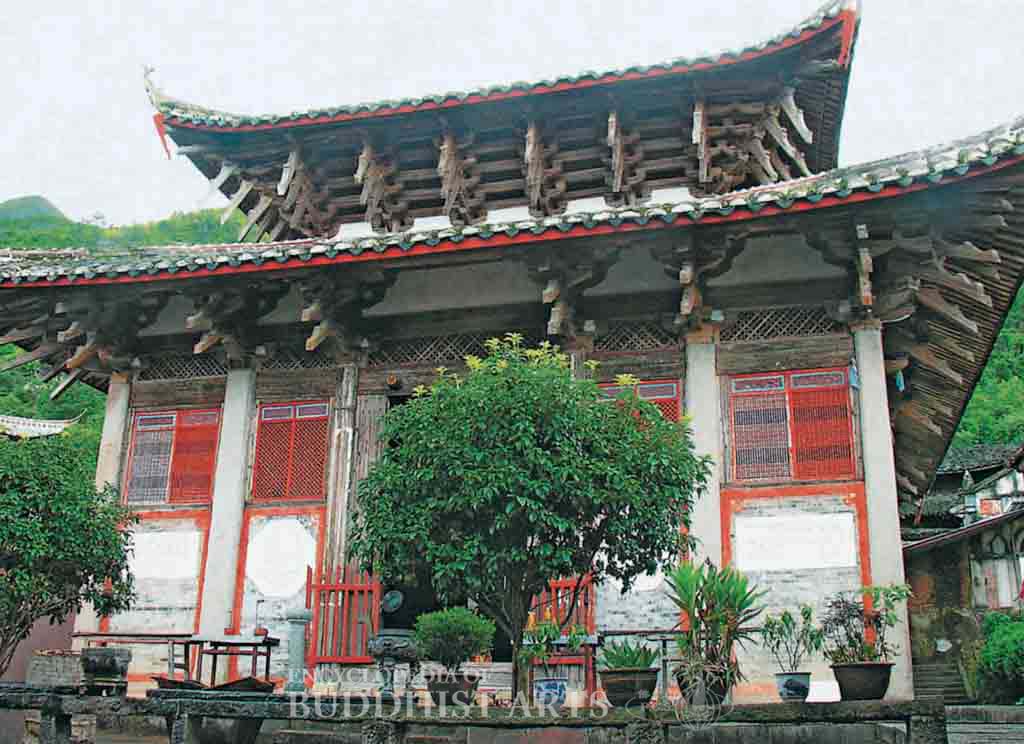
Shifeng Temple: Great Hero Hall
Shifeng Temple
CHINA, Fujian, Fu’an
Shifeng means Lion Peak. The temple is also known as Shifeng Guanghua Chan Monastery and is located at the foot of Lion Peak. It was built in 892 during the Tang dynasty. It was originally built on the peak, but was moved to its present location during the rule of Emperor Yongle (reigned 1402–1424) of the Ming dynasty. The temple was repaired during the rule of Emperor Jiaqing (reigned 1521–1566) of the Qing dynasty. It was listed as a National Cultural Heritage Site in 2006.
The temple faces east and is built on the slope of the mountain. It retains its Ming dynasty (1368–1644) layout. Along the central axis there are the gateway, temple gate, Heavenly King Hall, Great Hero Hall, sutra repository, and Avalokitesvara Pavilion. The three-by-three bay Great Hero Hall was rebuilt in 1612 during the Ming dynasty. It has a double-eave hip-and-gable roof. The upper eaves have two projecting bracket arms and three down-pointing cantilevers, while the lower eaves have a single projecting bracket arm with three down-pointing cantilevers. The window frames and panels on the exterior are decorated with exquisite carvings. Within the building, the original painted decorations are preserved on the wooden structures and bracket sets. The octagonal ceiling is decorated with a vividly drawn dragon and phoenix.
For more details, go to the Encyclopedia of Buddhist Arts: Architecture M-S, page 991.
Cite this article:
author = Hsingyun and Youheng and Johnson, Peter and Mankuang and Lancaster, Lewis,
booktitle = {Encyclopedia of Buddhist Arts: Architecture M-S},
pages = 991,
title = {{Shifeng Temple}},
volume = 3,
year = {2016}}