
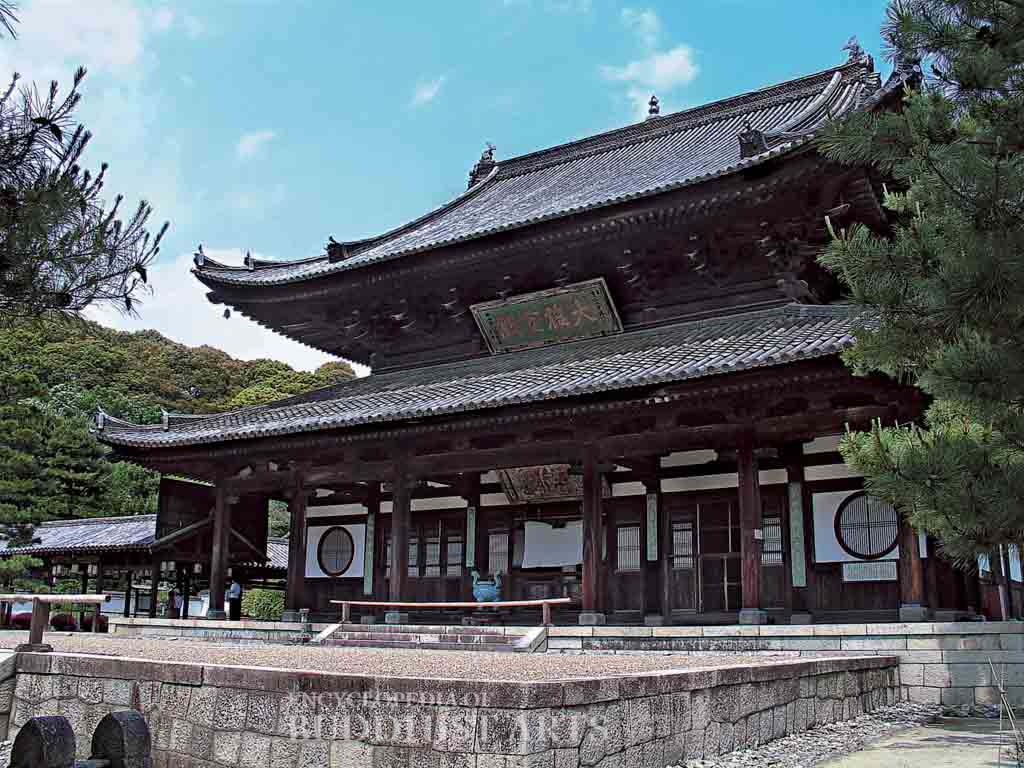
Manpukuji Temple: Great Hero Hall
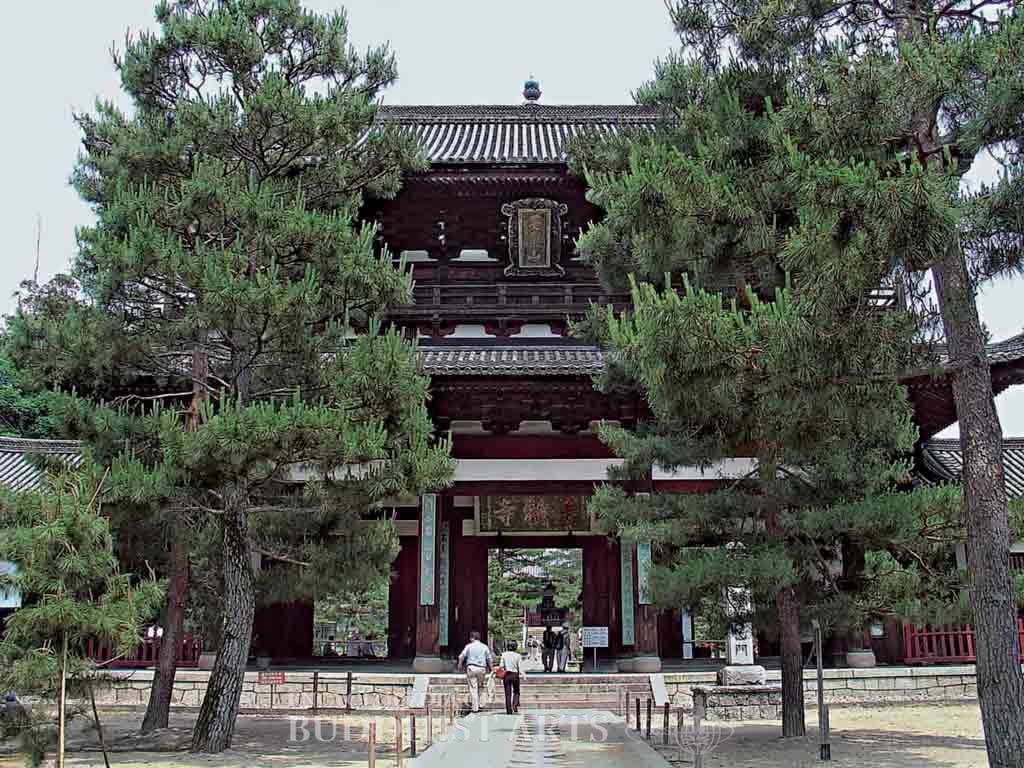
Manpukuji Temple: Temple Gate
Manpukuji Temple
JAPAN, Kyoto
Manpukuji is the head temple of the Obaku school of Japanese Buddhism and was established by Chinese Master Yinyuan Longqi. Construction of the temple began in 1661 during the Edo period, and was completed in 1668. Manpukuji Temple was headed by Chinese abbots until the late Edo period (1615–1868), when Japanese abbots continued the lineage. The temple retains Chinese ceremonies and chanting from the Ming dynasty.
The temple structures include the entrance gate, temple gate, Heavenly King Hall, Great Hero Hall, and Dharma Hall, which were all listed as National Treasures in 1913. The Heavenly King Hall and the Great Hero Hall are connected by a covered walkway flanked on either side by structures, including the bell tower, drum tower, meditation hall, and dining hall, which were all listed as National Treasures in 1913. The founder’s hall was listed as an Important Cultural Property in 1965.
The three-bay wide entrance gate was rebuilt in 1693 during the Edo period. It has two overlapping roofs with representations of makara at the ridge ends. The temple gate has two stories and is 20 m high. The three-by-four bay founder’s hall, completed in 1675 during the Edo period, has a double-eave hip-and-gable roof covered with cylindrical tiles. A jewel is located in the center of the roof ridge. The hall is surrounded by a veranda with balustrades. A statue of Master Yinyuan Longqi is enshrined within the hall.
The five-by-six bay Great Hero Hall has a steep double-eave hip-and-gable roof and is 19.8 m high. It has an expansive upper roof resulting in a large open space inside, a common characteristic of Obaku temples. There is a courtyard surrounded by cloisters in front of the hall. Statues of Sakyamuni Buddha and his attendants, Mahakasyapa and Ananda, are enshrined within the hall. They are flanked by statues of the Eighteen Arhats made by the Chinese sculptor Fan Daosheng.
The temple houses the portraits of Master Yinyuan Longqi and Feiyin Tongrong. There are more than 48,000 wooden sutra blocks carved by Tetsungen Doko during the early Edo period. They have been listed as Important Cultural Properties.
For more details, go to the Encyclopedia of Buddhist Arts: Architecture M-S, page 724.
Cite this article:
author = Hsingyun and Youheng and Johnson, Peter and Mankuang and Lancaster, Lewis,
booktitle = {Encyclopedia of Buddhist Arts: Architecture M-S},
pages = 724,
title = {{Manpukuji Temple}},
volume = 3,
year = {2016}}