
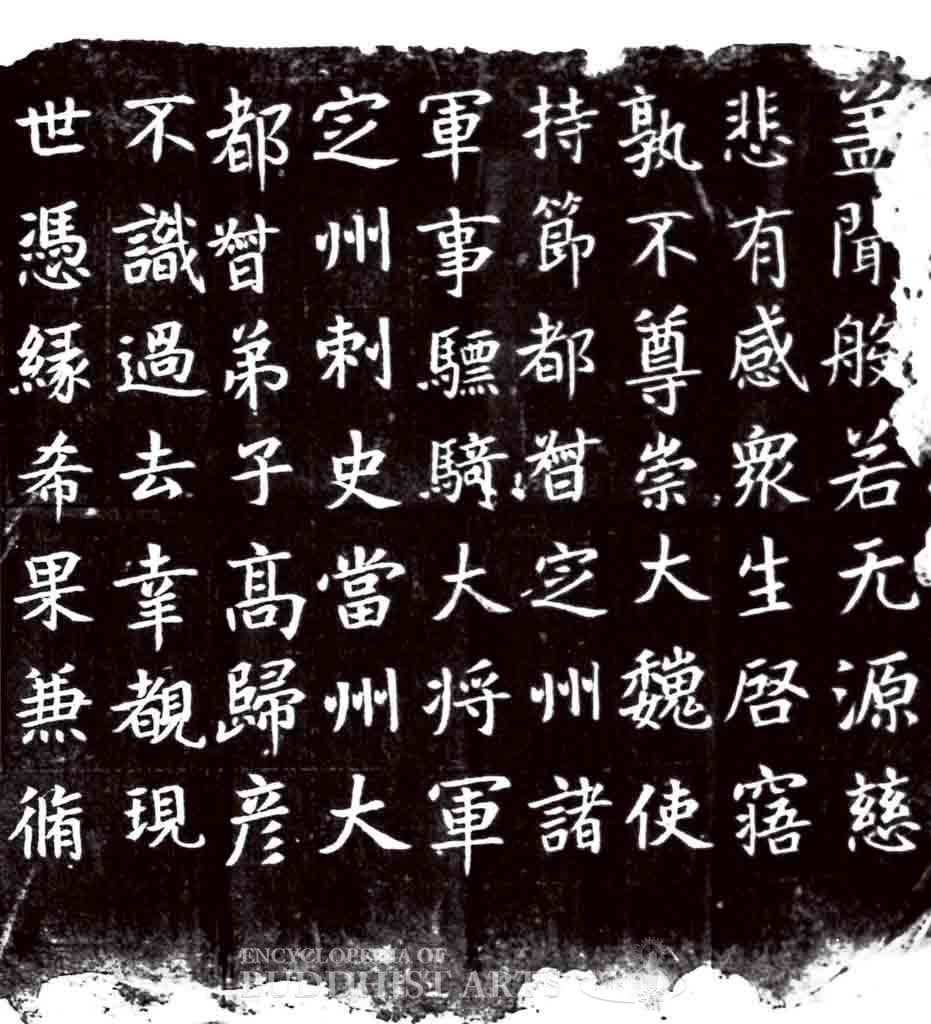
Dingzhou: Record of Sculpture Erected by Gao Guiyan
Rubbing
Dingzhou: Record of Sculpture Erected by Gao Guiyan
CHINA, Hebei, Baoding; Eastern Wei dynasty
Discovered in Dingzhou, Hebei in 1921, this inscription is known in full as Record of the White Jade Sakyamuni Sculpture Erected by Gao Guiyan. The sculpture is missing, however, a white jade throne remains. On the 4 sides of the throne, there are inscriptions arranged in 27 lines of 7 characters, detailing the sculpting process.
Steles from the Northern dynasties (386–581) were known for their sturdy and square character forms and rustic brushstrokes. Since Emperor Wen (reigned 535–551) of the Western Wei dynasty relocated the capital city to Luoyang, the elegant style of the Southern dynasties (420–589) became the preference for calligraphic works. In this inscription, the style is refined and delicate, with negligible semblance to the Northern dynasties steles. Written in a rigorous manner, the characters are broad in composition with rounded, fine brushstrokes. This inscription is considered a rare work of Northern dynasties calligraphy, given the variety of its brushwork and the clarity and completeness of the text.
For more details, go to the Encyclopedia of Buddhist Arts: Calligraphy, page 63.
Cite this article:
author = Hsingyun and Youheng and Youlu and Pokorski, Stefanie and Mankuang and Edson, Gary,
booktitle = {Encyclopedia of Buddhist Arts: Calligraphy },
pages = 63,
title = {{Dingzhou: Record of Sculpture Erected by Gao Guiyan}},
volume = 17,
year = {2016}}