
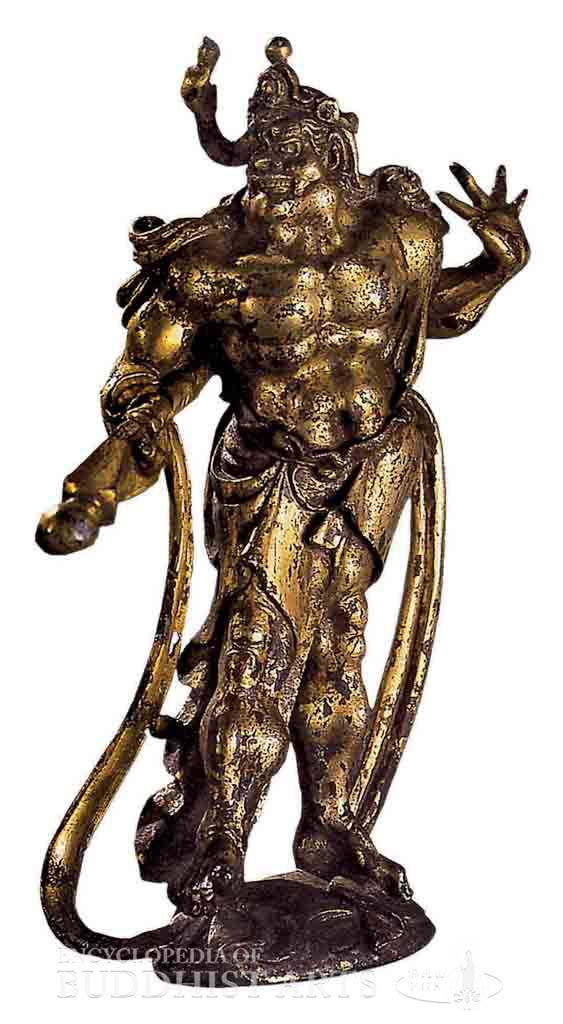
Jingzhi Temple Pagoda: Warrior
Gilt copper alloy
Jingzhi Temple Pagoda: Warrior
CHINA, Hebei, Baoding; Northern Song dynasty
The statue was discovered in the underground palace of the pagoda at Jingzhi Temple in 1969. The warrior turns his frowning face to one side in a movement that sends the ribbons on his headdress flying. The stole cascades about the body and is trampled underfoot. The chest is bared and heavily muscled, as are the arms and legs. The figure brandishes a vajra in his right hand, while the left hand is raised with fingers spread and ready for action. The momentum leaves the right foot slightly raised as the left bears the body’s weight. The size of the sculpture is small but the sense of dramatic movement is skillfully and accurately rendered.
For more details, go to the Encyclopedia of Buddhist Arts: Sculpture G-M, page 498.
Cite this article:
Hsingyun, et al. "Jingzhi Temple Pagoda: Warrior." Encyclopedia of Buddhist Arts: Sculpture G-M, vol. 11, 2016, pp. 498.
Hsingyun, Youheng, Yann Lovelock, Yuan Chou, Susan Huntington, Gary Edson, and Robert Neather. 2016. "Jingzhi Temple Pagoda: Warrior" In Encyclopedia of Buddhist Arts: Sculpture G-M, 11:498.
Hsingyun, Youheng, Lovelock, Y., Chou, Y., Huntington, S., Edson, G., & Neather, R.. (2016). Jingzhi Temple Pagoda: Warrior. In Encyclopedia of Buddhist Arts: Sculpture G-M (Vol. 11, pp. 498).
@misc{Hsingyun2016,
author = Hsingyun and Youheng and Lovelock, Yann and Chou, Yuan and Huntington, Susan and Edson, Gary and Neather, Robert,
booktitle = {Encyclopedia of Buddhist Arts: Sculpture G-M},
pages = 498,
title = {{Jingzhi Temple Pagoda: Warrior}},
volume = 11,
year = {2016}}
author = Hsingyun and Youheng and Lovelock, Yann and Chou, Yuan and Huntington, Susan and Edson, Gary and Neather, Robert,
booktitle = {Encyclopedia of Buddhist Arts: Sculpture G-M},
pages = 498,
title = {{Jingzhi Temple Pagoda: Warrior}},
volume = 11,
year = {2016}}