
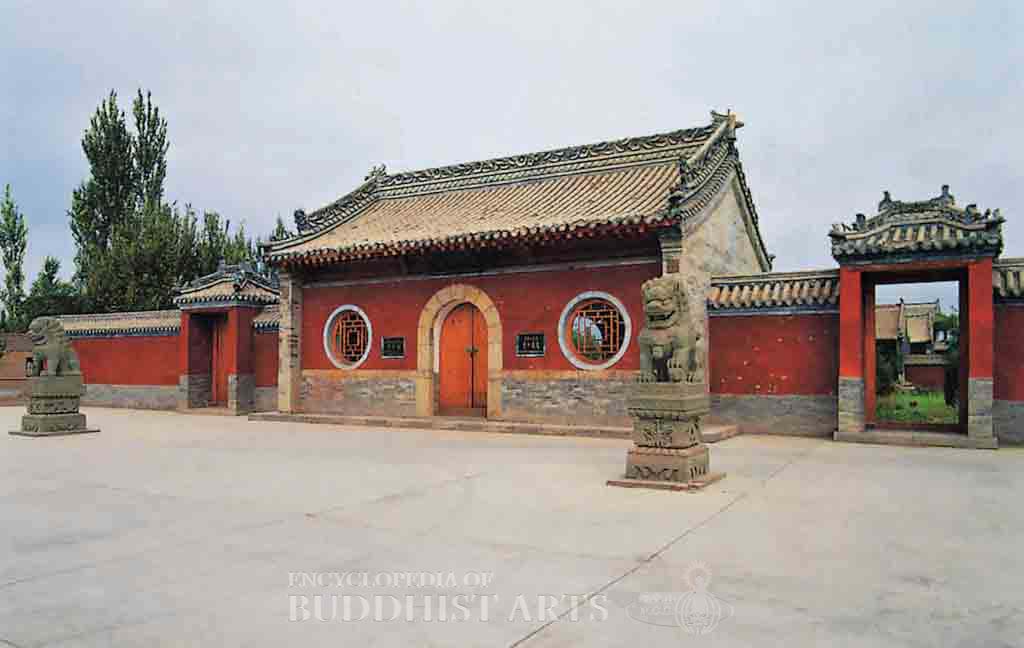
Jingyuan Temple: Main Temple Gate
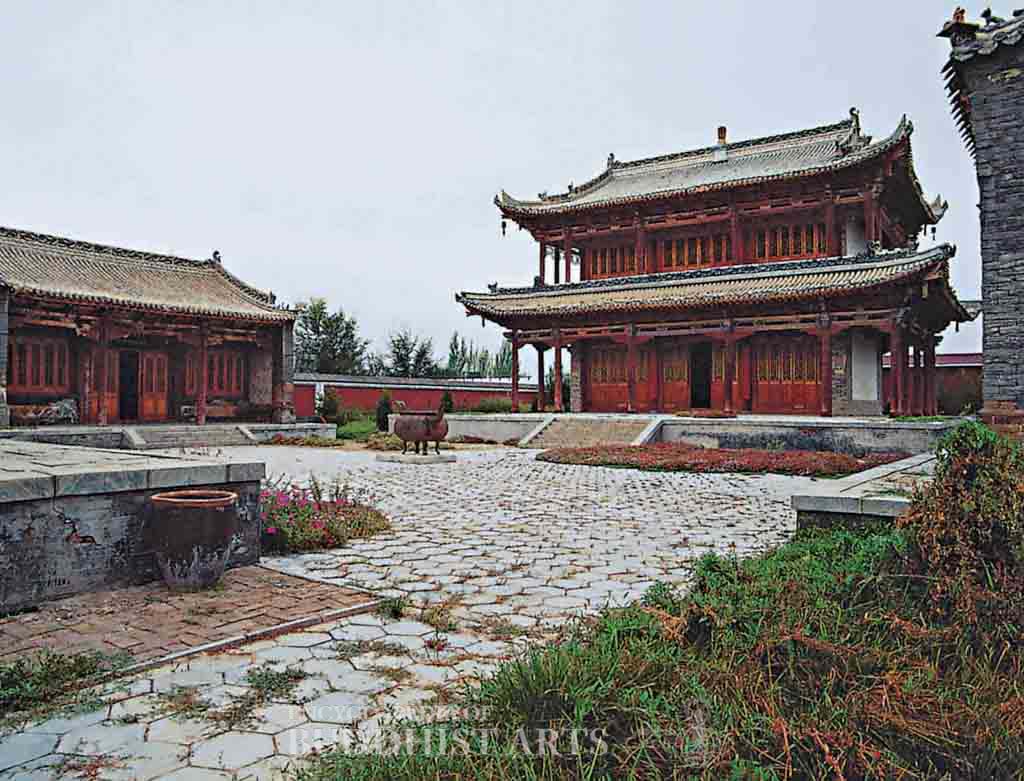
Jingyuan Temple: Hall of the Three Buddhas
Jingyuan Temple
CHINA, Xinjiang, Ili
Jingyuan means Pacify the Outlying Territories. The temple was built between 1888 and 1891 during the Qing dynasty by the Xibe tribe, who migrated westward from their homeland in the Hulunbuir grasslands and the Nenjiang valleys. It was the second temple that they built after their arrival. It was listed as a National Cultural Heritage Site in 2006.
The temple faces south and is surrounded by a high wall. The structures are built symmetrically on two sides of the central axis. They include the screen wall, the main temple gate, Heavenly King Hall, Great Hero Hall, Hall of the Three Buddhas, east and west side halls, and bell and drum towers. The main temple gate has a single-eave flush gable roof with an arched gateway in the center and two circular windows on either side. A pair of stone lions guards the gate. The three-bay wide Great Hero Hall has a single-eave flush gable roof. At the center of the main ridge there is a green vase. A statue of Sakyamuni Buddha is enshrined within the hall, while on the sides there are niches containing statues of the Eighteen Arhats. The Hall of the Buddhas of the Past, Present, and Future is built on a 1 m high platform. The two-story hall has a single-eave hip-and-gable roof. The first story houses the Buddhas of the Past, Present, and Future: Sakyamuni Buddha, Kasyapa Buddha, and Maitreya Buddha. The second story contains the sutra repository.
The temple has many carvings in brick, wood, and stone, as well as paintings and clay sculptures. The temple is a physical record of the architecture, sculpture, painting, and religion of the Xibe tribe after they migrated westward.
For more details, go to the Encyclopedia of Buddhist Arts: Architecture G-L, page 532.
Cite this article:
author = Hsingyun and Youheng and Johnson, Peter and Mankuang and Lancaster, Lewis,
booktitle = {Encyclopedia of Buddhist Arts: Architecture G-L},
pages = 532,
title = {{Jingyuan Temple}},
volume = 2,
year = {2016}}