
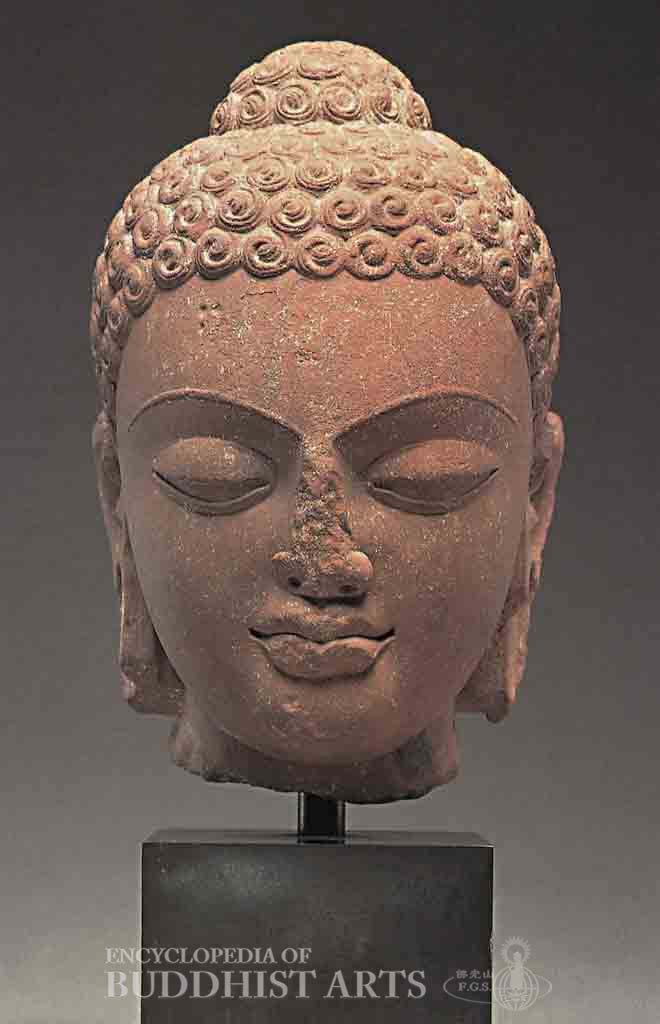
Mathura: Head of a Buddha
Red sandstone
Mathura: Head of a Buddha
INDIA, Uttar Pradesh, Mathura
The sculpture was unearthed from Mathura. After the fall of the Kushan period (circa 1st–3rd century), Mathura continued as an artistic center and the style associated with it matured during the succeeding Gupta period (circa 320–550). This head epitomizes the characteristics of that period in features that include tightly curled hair that builds to a high usnisa; elongated earlobes that hang to neck level; a smooth, oval face with arched eyebrows that connect directly to the bridge of a prominent nose. Here the almond-shaped eyes are slightly tilted downwards and the lips are thick and tightly closed, suggesting a deep meditative state.
For more details, go to the Encyclopedia of Buddhist Arts: Sculpture G-M, page 694.
Cite this article:
Hsingyun, et al. "Mathura: Head of a Buddha." Encyclopedia of Buddhist Arts: Sculpture G-M, vol. 11, 2016, pp. 694.
Hsingyun, Youheng, Yann Lovelock, Yuan Chou, Susan Huntington, Gary Edson, and Robert Neather. 2016. "Mathura: Head of a Buddha" In Encyclopedia of Buddhist Arts: Sculpture G-M, 11:694.
Hsingyun, Youheng, Lovelock, Y., Chou, Y., Huntington, S., Edson, G., & Neather, R.. (2016). Mathura: Head of a Buddha. In Encyclopedia of Buddhist Arts: Sculpture G-M (Vol. 11, pp. 694).
@misc{Hsingyun2016,
author = Hsingyun and Youheng and Lovelock, Yann and Chou, Yuan and Huntington, Susan and Edson, Gary and Neather, Robert,
booktitle = {Encyclopedia of Buddhist Arts: Sculpture G-M},
pages = 694,
title = {{Mathura: Head of a Buddha}},
volume = 11,
year = {2016}}
author = Hsingyun and Youheng and Lovelock, Yann and Chou, Yuan and Huntington, Susan and Edson, Gary and Neather, Robert,
booktitle = {Encyclopedia of Buddhist Arts: Sculpture G-M},
pages = 694,
title = {{Mathura: Head of a Buddha}},
volume = 11,
year = {2016}}