
Bihar: Crowned Buddha
Schist
Bihar: Crowned Buddha
INDIA, Bihar
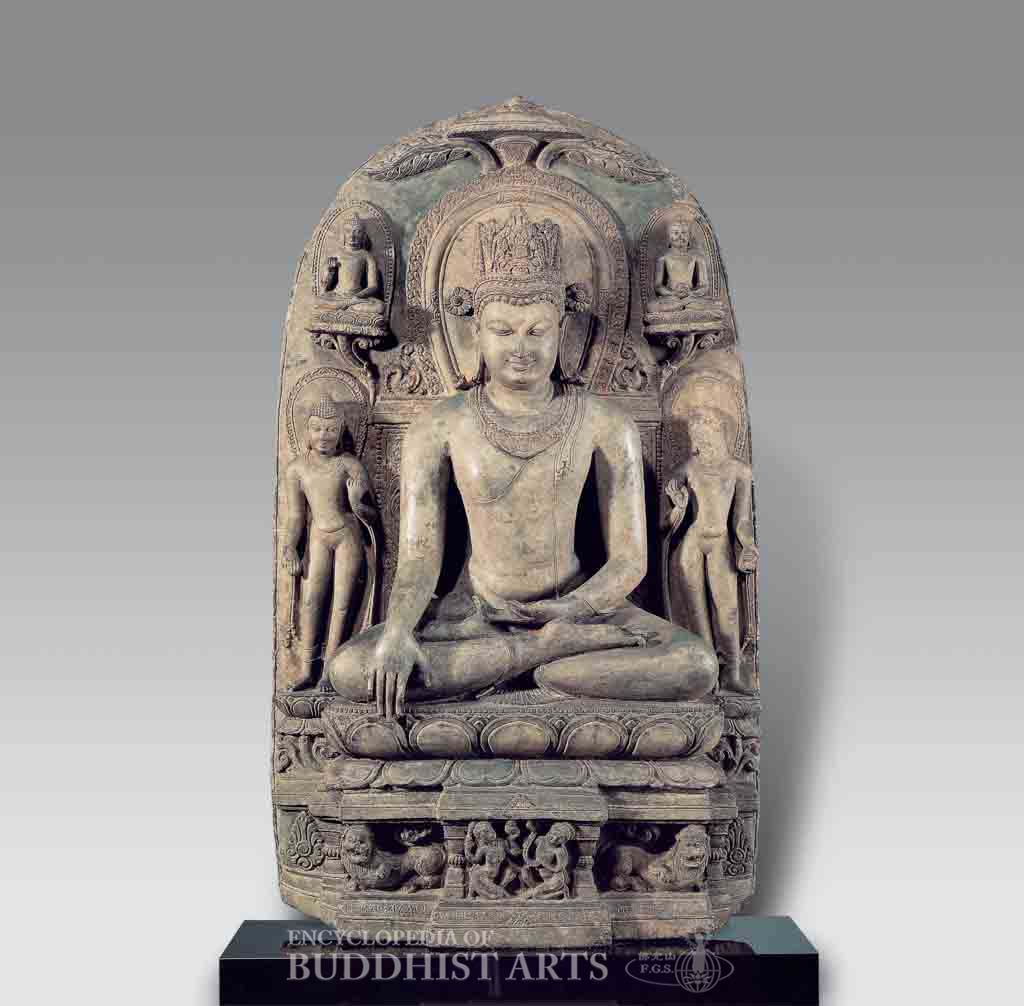
This sculpture was unearthed in Bihar. This method of representing the Buddha was popular during the Pala period (circa 8th–12th century), and such sculptures were usually found in memorial buildings or niches of temples.
The figure in the center is Sakyamuni Buddha and wears an elaborate crown and necklace. Seated in the full lotus posture, Sakyamuni forms the bhumisparsa (earth-touching) mudra with the right hand. Edged with flowers, the Buddha’s nimbus is lotus-shaped. The hem of the diaphanous robe is carefully folded to create a strip that drapes down over the shoulder and is spread out on the lotus throne in a fan shape near the ankles. The lower register protrudes to form three reliefs. The central relief features two kneeling figures: the figure holding the vase is Bhumi, and the figure holding the garland of flowers is the sponsor. Lions make up the two other reliefs. The inscription along the bottom is a traditional Buddhist offering phrase.
Two seated and two standing Buddhas are located on either side of the central figure and together they represent the five stages of the Buddha’s life.
For more details, go to the Encyclopedia of Buddhist Arts: Sculpture A-F, page 146.
Cite this article:
author = Hsingyun and Youheng and Lovelock, Yann and Chou, Yuan and Huntington, Susan and Edson, Gary and Neather, Robert,
booktitle = {Encyclopedia of Buddhist Arts: Sculpture A-F},
pages = 146,
title = {{Bihar: Crowned Buddha}},
volume = 10,
year = {2016}}