

Kesariya Stupa
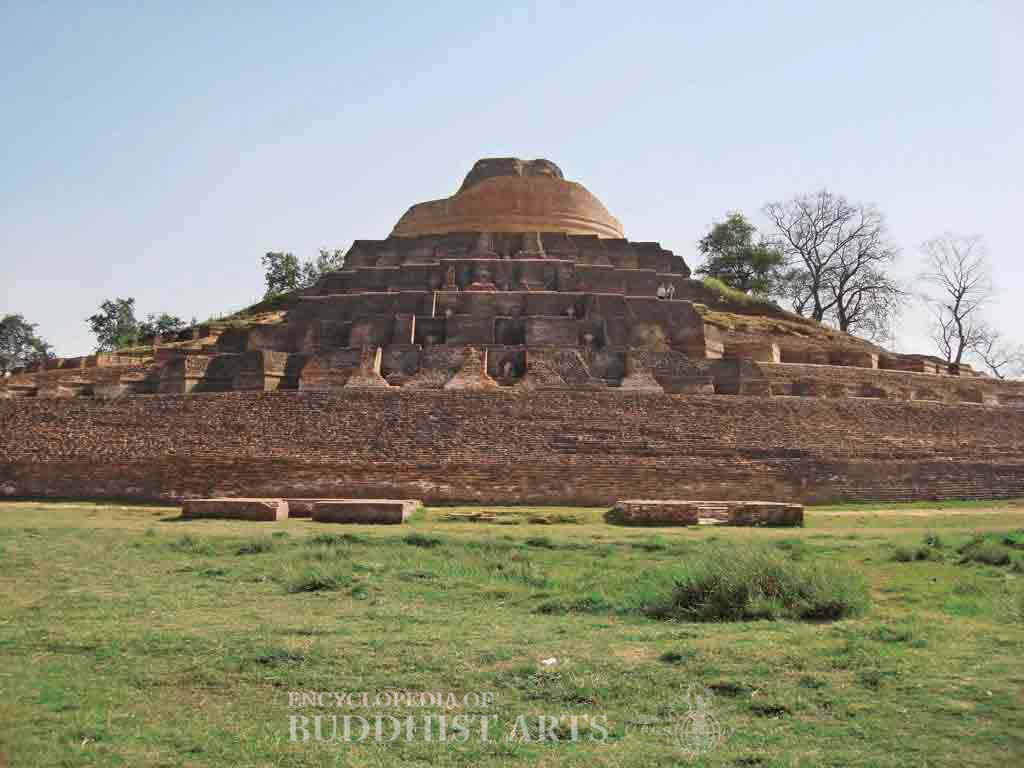
Kesariya Stupa

Kesariya Stupa (detail)
Kesariya Stupa
INDIA, Bihar, Kesariya
Kesariya is a town in Bihar located 55 km northwest of Vaishali. It is the site of one of the largest stupas in the world. It is said that the stupa was originally built in the form of an earth mound to commemorate the incident when the Buddha gave his alms bowl to the Lichhavis before he entered parinirvana. On the basis of archaeological findings, the structure can be dated between the 3rd and mid-8th centuries, and was renovated and expanded by kings and wealthy merchants from different dynasties. Chinese pilgrim Master Xuanzang gave a brief account of this stupa when he traveled to India in the 7th century. The stupa was discovered and partially excavated by British colonel Mackenzie as early as 1814 and further excavations were conducted by the Archaeological Survey of India in 1998.
Currently the stupa stands 31.7 m high with a circumference of about 425 m. It has a conical shape. It is believed that its original height was approximately 45 m; but due to earthquakes, it has sunk into the ground. Only half of the stupa has been fully excavated, while the other half consists of an earth mound that is dotted with trees. The exposed part of the stupa consists of a large base, five terraces, and a cylindrical shaped top. The five terraces contain square niches, each of which enshrines a life-size seated Buddha statue. Most of the statues are severely damaged, but it can be seen that some of them form the bhumysparsa (earth-touching) mudra or the dhyana (meditation) mudra. The cylindrical structure at the top has partially collapsed; the remaining part is dotted with rows of holes. The entire stupa has a distinctive shape representing a mandala.
According to the Great Tang Records on the Western Regions by Master Xuanzang, after the Buddha announced his parinirvana at Vaishali and was on his way to Kushinagar, the Licchavis followed and did not want to leave him. The Buddha then gave them his alms bowl as a memento. A stupa located 50 to 60 km northwest of Vaishali was erected to commemorate this event. This description by Master Xuanzang explains the origin of this Kesariya Stupa. In addition, the Kalama Sutra in both Sanskrit and Pali stated that the Buddha once taught the Dharma to the Kalamas at Kesapputa, which is present day Kesariya, further supporting this tale.
For more details, go to the Encyclopedia of Buddhist Arts: Architecture G-L, page 601.
Cite this article:
author = Hsingyun and Youheng and Johnson, Peter and Mankuang and Lancaster, Lewis,
booktitle = {Encyclopedia of Buddhist Arts: Architecture G-L},
pages = 601,
title = {{Kesariya Stupa}},
volume = 2,
year = {2016}}