
Seated Buddha
Gilt copper alloy
Seated Buddha
MYANMAR
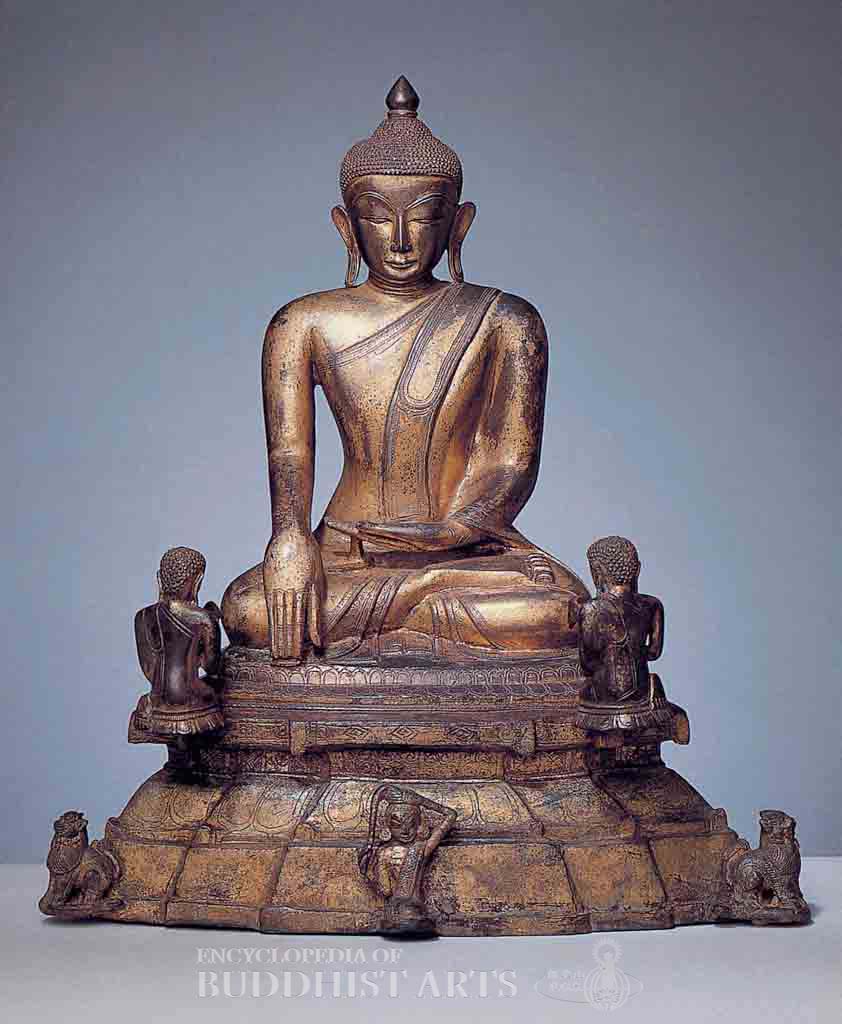
The Buddha sits in the lotus position with his hands in bhumisparsa (earth-touching) mudra as Prthivi, the Earth Goddess, surges up from below to witness to his attainment. The monastic robe leaves the right shoulder bare, accentuating the broad shoulders, and has the loose end neatly arranged over the left shoulder.
A large jewel decorates the Buddha’s low usnisa. Elongated earlobes curve outward and touch the shoulders. The shortened neck shows the three lines of a great person. The figure’s fingers and toes are of equal length, a characteristic that is seen in Burmese statues after the Bagan Empire (circa 849–1287). The above mentioned characteristics are all part of the Thirty-Two Marks of Excellence found on a Buddha.
The top of the throne is incised with a simple petaled pattern, under which is a Sumeru base resting on a reversed lotus with lions crouching on either side. Kneeling before the Buddha are his disciples Sariputra and Maudgalyayana.
For more details, go to the Encyclopedia of Buddhist Arts: Sculpture N-Sr, page 1024.
Cite this article:
author = Hsingyun and Youheng and Lovelock, Yann and Chou, Yuan and Huntington, Susan and Edson, Gary and Neather, Robert,
booktitle = {Encyclopedia of Buddhist Arts: Sculpture N-Sr},
pages = 1024,
title = {{Seated Buddha}},
volume = 12,
year = {2016}}