
Puxian Pagoda

Puxian Pagoda: Xiangbishan
Puxian Pagoda
CHINA, Guangxi, Guilin
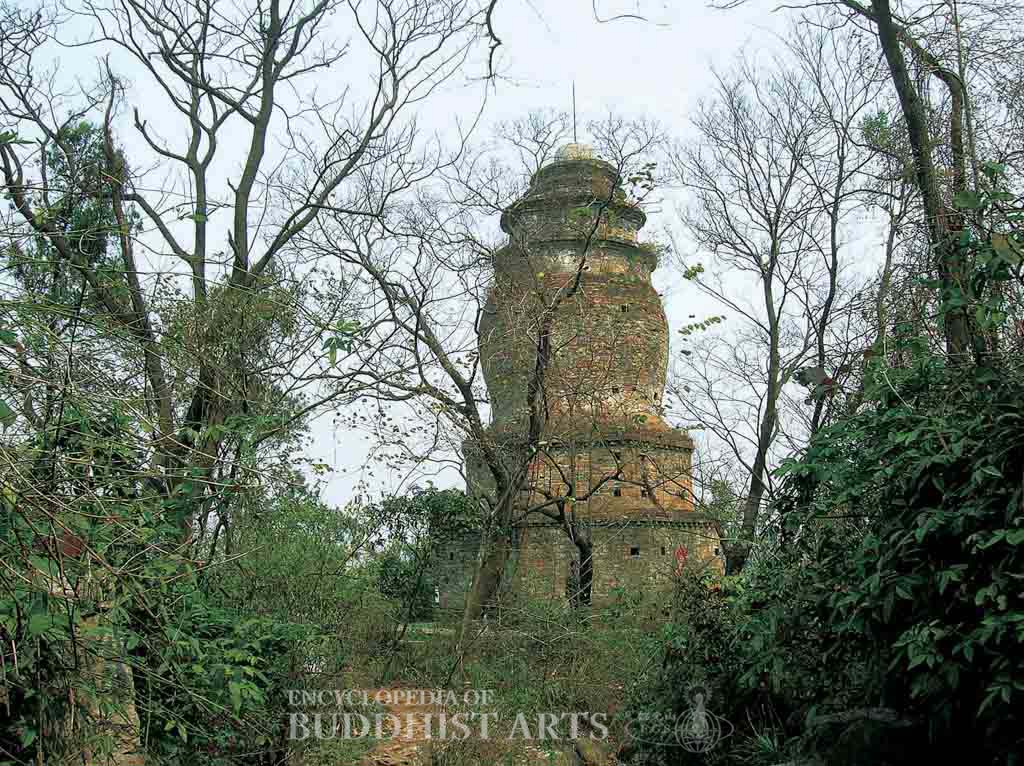
The pagoda stands on top of Xiangbishan (Elephant Trunk Hill). It was built during the early Ming dynasty (1368–1644) and is dedicated to Samantabhadra Bodhisattva. Both the pagoda and the hill are prominent local landmarks.
The pagoda is 13.6 m high and stands on a two-layer, octagonal base with slight eaves in the middle and at the top. The square holes were used to insert poles during construction. Above the base the pagoda body is in the form of an elongated inverted bowl. Above the body there are three more levels, which form the base of the spire.
For more details, go to the Encyclopedia of Buddhist Arts: Architecture M-S, page 863.
Cite this article:
Hsingyun, et al. "Puxian Pagoda." Encyclopedia of Buddhist Arts: Architecture M-S, vol. 3, 2016, pp. 863.
Hsingyun, Youheng, Peter Johnson, Mankuang and Lewis Lancaster. 2016. "Puxian Pagoda" In Encyclopedia of Buddhist Arts: Architecture M-S, 3:863.
Hsingyun, Youheng, Johnson, P., Mankuang, & Lancaster, L. (2016). Puxian Pagoda. In Encyclopedia of Buddhist Arts: Architecture M-S (Vol. 3, pp. 863).
@misc{Hsingyun2016,
author = Hsingyun and Youheng and Johnson, Peter and Mankuang and Lancaster, Lewis,
booktitle = {Encyclopedia of Buddhist Arts: Architecture M-S},
pages = 863,
title = {{Puxian Pagoda}},
volume = 3,
year = {2016}}
author = Hsingyun and Youheng and Johnson, Peter and Mankuang and Lancaster, Lewis,
booktitle = {Encyclopedia of Buddhist Arts: Architecture M-S},
pages = 863,
title = {{Puxian Pagoda}},
volume = 3,
year = {2016}}