

Leifeng Pagoda: Underground Palace
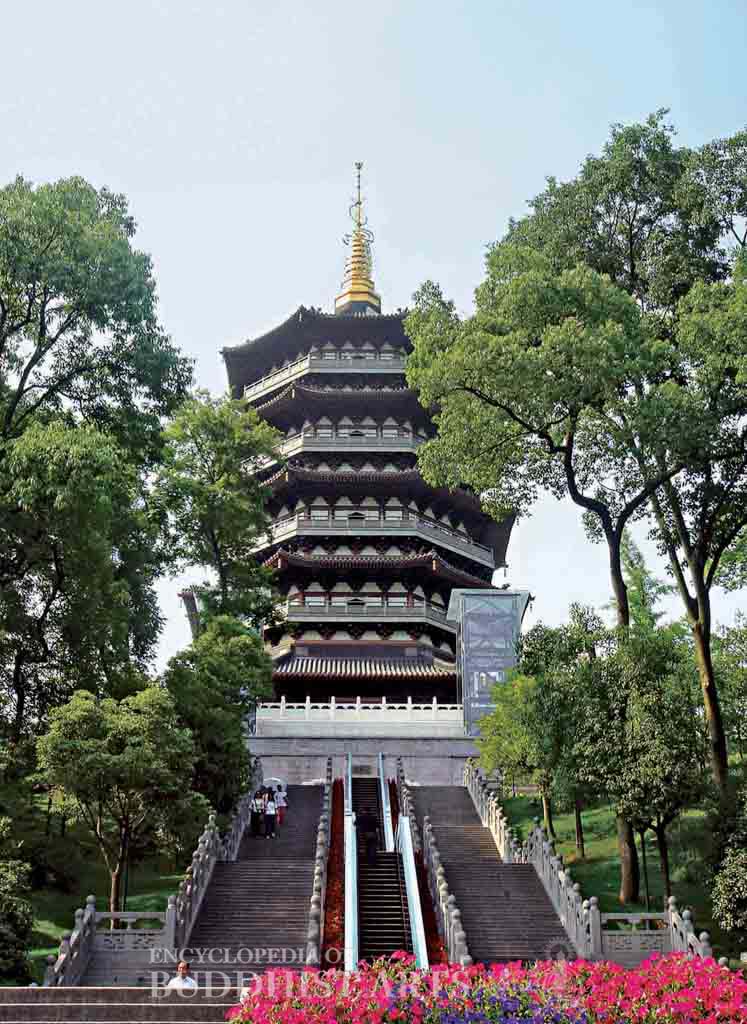
Leifeng Pagoda
Leifeng Pagoda
CHINA, Zhejiang, Hangzhou
Leifeng Pagoda was built in 975 during the Northern Song dynasty, but was destroyed by fire during the rule of Emperor Jiajing (reigned 1521–1566) of the Ming dynasty, with only the brick part of the pagoda body surviving. It was rumored that the bricks could cure illness and prevent miscarriages, so the pagoda suffered severe damage from looters and eventually collapsed in 1924. The pagoda was reconstructed between 1999 and 2002. The underground palace was discovered in 2001.
According to archaeologists, it was originally a five-story, octagonal, brick and timber pagoda, similar to the Huqiu and Liuhe Pagodas. There are inscriptions of the Avatamsaka Sutra on the walls and numerous sutra bricks can be found on the top level of the pagoda. Altogether the sutra bricks constitute around 84,000 fascicles of sutras. Located beneath the pagoda base, the underground palace housed artifacts such as a gilt-bronze statue of a seated Buddha, a gilt-bronze figurine of Vaisravana, jade figurines of Avalokitesvara Bodhisattva and Sudhana, a 35.6 cm high gilt-silver Casket Seal Dharani Pagoda, a frontispiece of the Casket Seal Dharani Sutra, and tile caps with lotus design. These artifacts provide valuable sources of information about the Wuyue Kingdom (907–978).
The current pagoda has five stories and is 71 m high. It is the first Buddhist pagoda in China to have a steel frame with copper components. It is also the first multi-colored pagoda with engravings in copper. Beneath the pagoda it is possible to view the remains of the original base.
For more details, go to the Encyclopedia of Buddhist Arts: Architecture G-L, page 653.
Cite this article:
author = Hsingyun and Youheng and Johnson, Peter and Mankuang and Lancaster, Lewis,
booktitle = {Encyclopedia of Buddhist Arts: Architecture G-L},
pages = 653,
title = {{Leifeng Pagoda}},
volume = 2,
year = {2016}}