
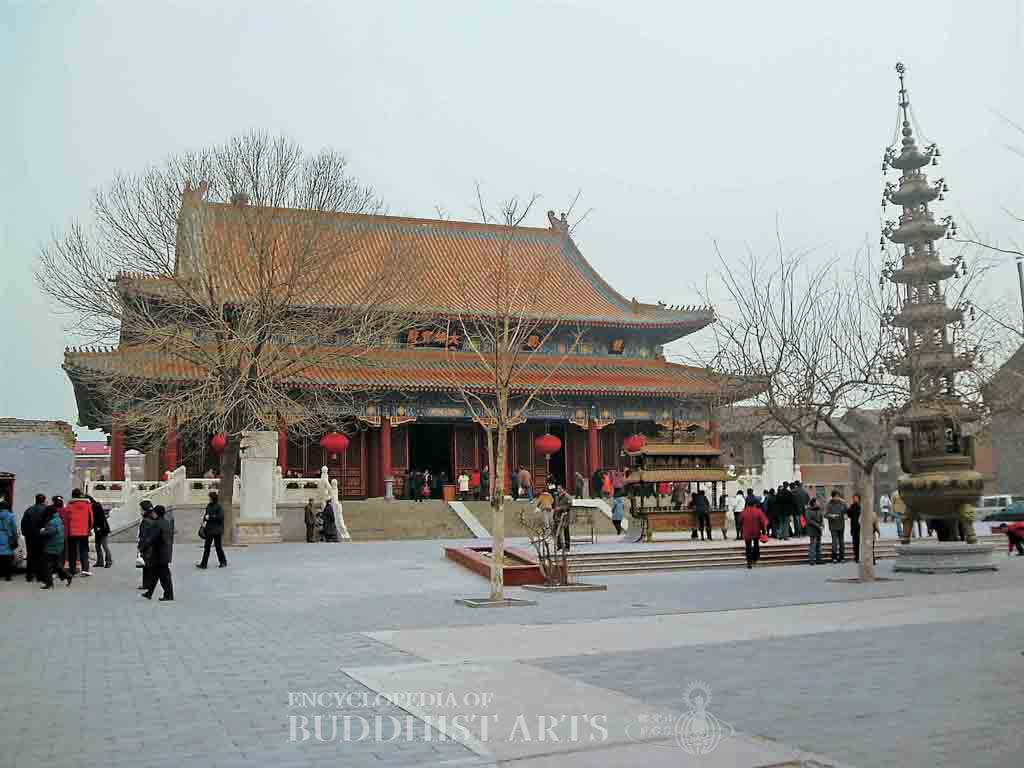
Dabei Yuan Temple: Great Hero Hall
Dabei Yuan Temple
CHINA, Tianjin
Dabei means Great Compassion. According to the temple records, it was built by monk Shigao between 1657 and 1669 during the Qing dynasty. Initially it was built on a small scale and consisted of the present west courtyard. However, in 1940 Master Tanxu added buildings to the east to form the east courtyard. The temple was badly damaged during the Cultural Revolution (1966–1976). In 1980 it was completely renovated in its present form. It was listed as a key Buddhist temple in the Han region of China in 1983.
The main part of the temple is the east courtyard with buildings including the Heavenly King Hall, Great Hero Hall, Great Compassion Hall, Ksitigarbha Hall, lecture hall, Hongyi Memorial Hall, and Xuanzang Memorial Hall.
The five-by-three bay Great Hero Hall, which stands on a platform made from gray bricks, is the most magnificent building of the temple. It has a double-eave hip-and-gable roof covered in yellow glazed tiles framed with green tiles. A 5.2 m high gilt bronze statue of Sakyamuni Buddha from the Ming dynasty (1368–1644) is enshrined within the hall. On either side there are seated statues of the Eighteen Arhats with various expressions.
The five-by-three bay Great Compassion Hall houses a gilt clay statue of the Thousand-Armed Avalokitesvara Bodhisattva molded in 1984. Murals depicting the Life of the Buddha cover 275 sq m. The relics of Master Xuanzang from the Tang dynasty (618–907) were once enshrined here but were given to Nalanda Monastery in India in 1956.
For more details, go to the Encyclopedia of Buddhist Arts: Architecture A-F, page 183.
Cite this article:
author = Hsingyun and Youheng and Johnson, Peter and Mankuang and Lancaster, Lewis,
booktitle = {Encyclopedia of Buddhist Arts: Architecture A-F},
pages = 183,
title = {{Dabei Yuan Temple}},
volume = 1,
year = {2016}}