
Aay Grotto
Aay Grotto
Aay Grotto
CHINA, Xinjiang, Aksu
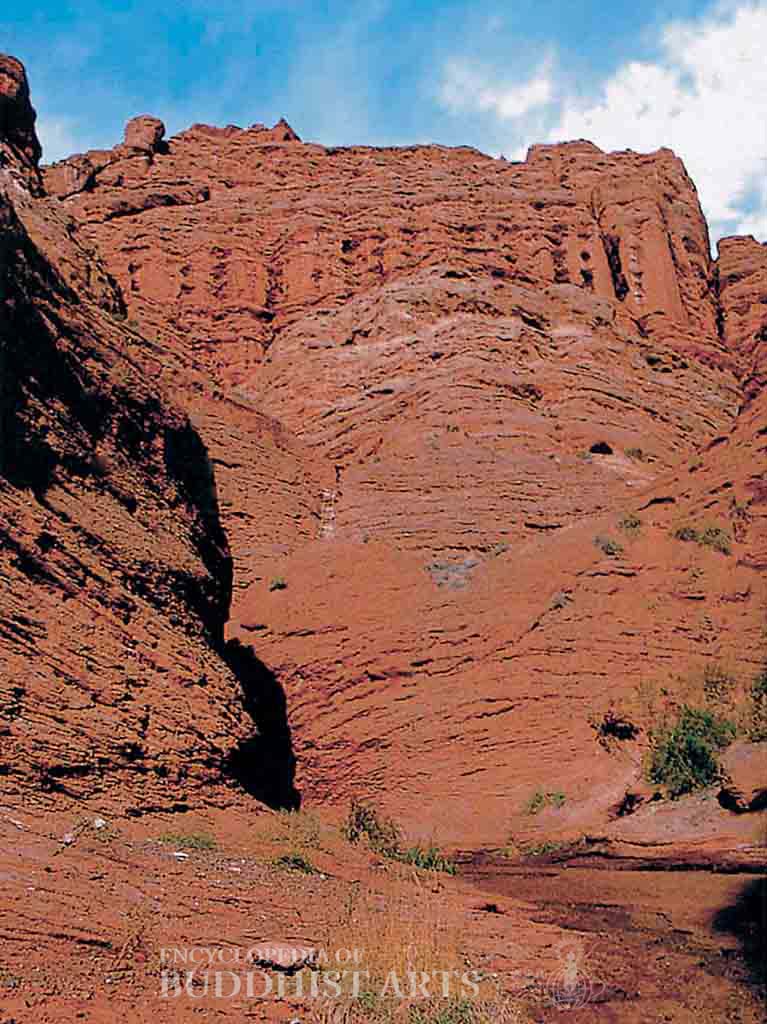
This single grotto was built into a cliff face over 30 m above the ground sometime during the 8th century. It was listed as a National Cultural Heritage Site in 2006 as part of the Buddhist temple ruins of Subashi.
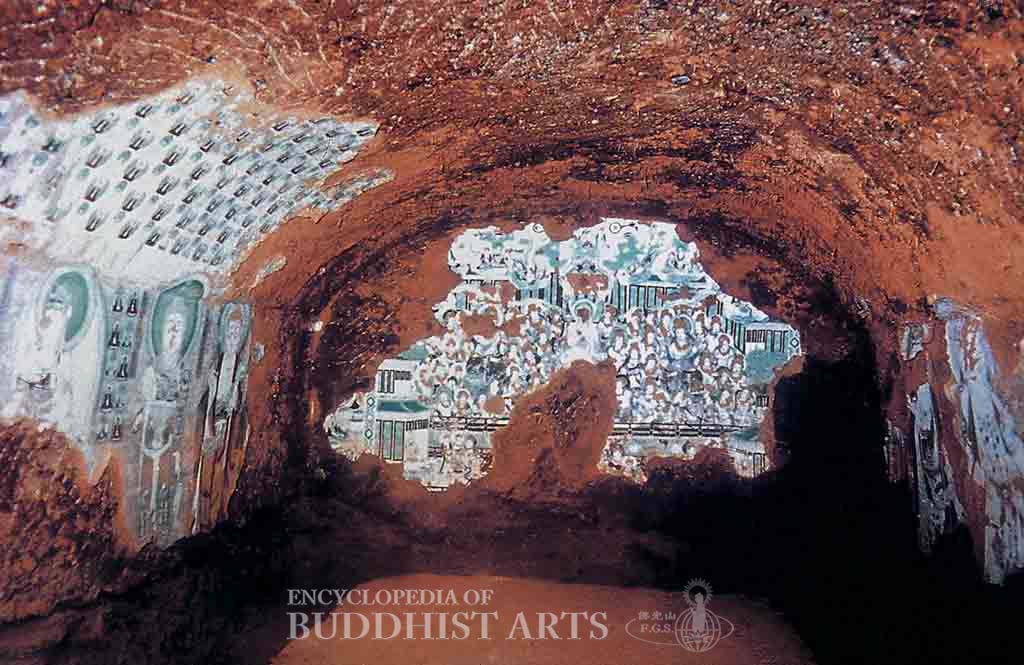
The grotto is rectangular and measures 3.4 m wide, 2.5 m high, and 4.6 m deep. It has a barrel-vaulted ceiling, and there is a square platform in the center of the floor. The murals on the walls have mostly peeled off. However, an illustration of the Amitayurdhyana Sutra on the back wall is still preserved. On the left wall, from right to left, images of the Medicine Buddha, Vairocana Buddha, Manjusri Bodhisattva, another Medicine Buddha, and a seated Buddha are still visible. Beside the Buddhas and Bodhisattvas are cartouches listing the names of the devotees who commissioned the artwork. A seated Buddha and three Bodhisattvas are featured on the right wall. There are rows of Thousand Buddhas and inscriptions of the names of devotees on the left side of the vaulted ceiling.
Twenty-three Chinese inscriptions are preserved in this grotto, the most numerous within any of the Kuchean caves. The Aay Grotto is similar in style to the Kumtura Caves from the High Tang period (712–756). It is a rarity among the caves of western China.
For more details, go to the Encyclopedia of Buddhist Arts: Caves A-E, page 1.
Cite this article:
author = Hsingyun and Youheng and Johnson, Peter and Mankuang and Huntington, Susan and Edson, Gary and Neather, Robert,
booktitle = {Encyclopedia of Buddhist Arts: Caves A-E},
pages = 1,
title = {{Aay Grotto}},
volume = 5,
year = {2016}}