
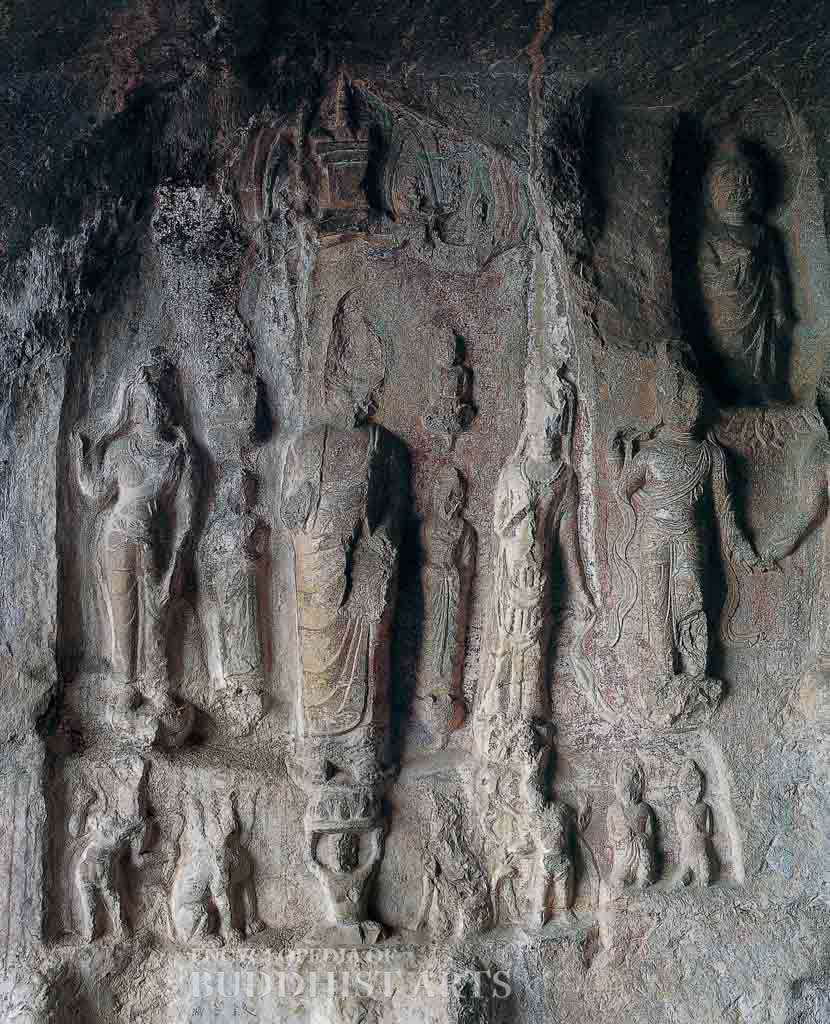
Tuoshan Grottoes: Grotto 1 - Sculptures (south wall)
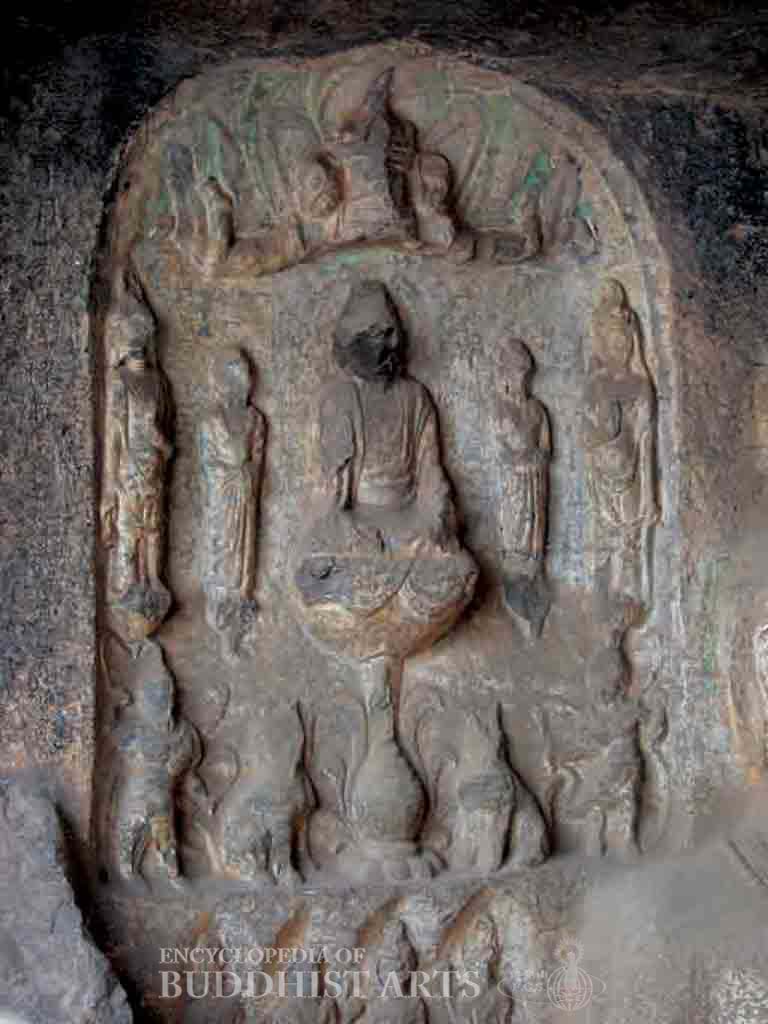
Tuoshan Grottoes: Grotto 1 - Niche Sculpture
Tuoshan Grottoes
CHINA, Shandong, Weifang
Located approximately 4 km southwest of Qingzhou in Weifang, a group of mountain peaks stand together to form a shape similar to the hump of a camel, thereby earning the name Tuoshan (Camel Mountain). According to an inscription on the right wall of Grotto 1, which dates from 702 of the Tang dynasty, there was already a Tuoshan Temple as early as the rule of Empress Wu Zetian (reigned 684–705). The Tuoshan Grottoes were carved into the limestone cliffside on the eastern edge of the mountain, close to the summit. There are five numbered grottoes from north to south, along with a group of cliff sculptures. The Tuoshan Grottoes were listed as a National Cultural Heritage Site in 1988.
Grotto 1 is rectangular with a flat roof. A Buddha, two disciples, and two Bodhisattvas can be found on the platform against the back wall. The Buddha wears a necklace and a robe covering the right shoulder, with both hands forming the dhyana (meditation) mudra. Niche statues carved between 701 and 704 indicate this grotto most likely dates before the Wu Zhou period (684–705) and thus could have originated in the Early Tang period (618–712).
Grotto 2 is square with platforms against three of the walls. A Buddha and two Bodhisattvas can be found on each platform. Above the Buddha’s head there is an inscription in Chinese dating from 590. Judging by the sculpting techniques, the statues were carved during the Sui dynasty (581–618). Grotto 3 was the first to be carved and the largest of the group. Carved into the slope of the cliff, a paved passage leads to the front of the grotto. A high altar enshrining one Buddha and two Bodhisattvas is found against the back wall. An inscription states that the grotto was donated by Lord Pingsang and a monk from Le’an from 581 to 583.
Grottoes 4 and 5 are located on the less prominent cliffside. Excavation most likely began slightly later than on Grottoes 2 and 3, which were started at approximately the end of Sui dynasty or beginning of the Tang dynasty. The main statue in Grotto 4 cannot be clearly identified but would appear to be Maitreya Buddha.
For more details, go to the Encyclopedia of Buddhist Arts: Caves T-Z, page 1465.
Cite this article:
author = Hsingyun and Youheng and Johnson, Peter and Mankuang and Huntington, Susan and Edson, Gary and Neather, Robert,
booktitle = {Encyclopedia of Buddhist Arts: Caves T-Z},
pages = 1465,
title = {{Tuoshan Grottoes}},
volume = 9,
year = {2016}}