
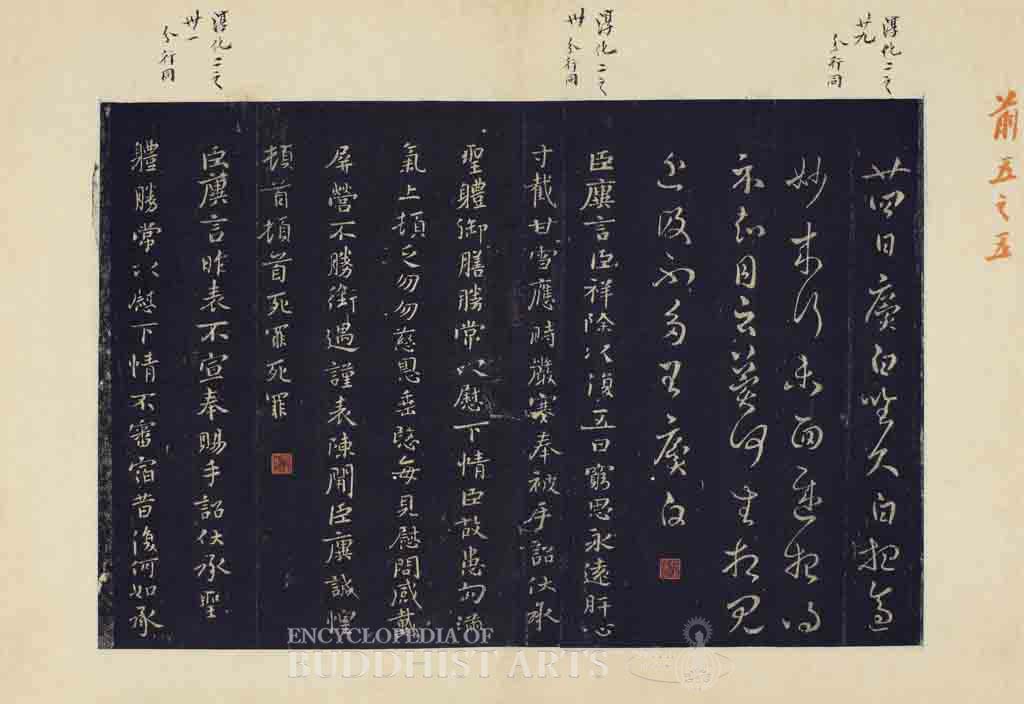
Twenty-Four Days by Wang Yi; Jin dynasty
Rubbing
Wang Yi
CHINA, Shangdong, Linyi; Jin dynasty (265–420)
Also known as Shijiang, Wang Yi was a renowned calligrapher, painter, writer, and musician from Langya (present day Linyi, Shandong). He was the teacher of Emperor Ming (reigned 322–325) of the Eastern Jin dynasty, as well as his nephew, the famous calligrapher Wang Xizhi.
Proficient in painting figures, fish, dragons, animals, and Buddhist images, Wang painted the Ten Disciples of Confucius to inspire Wang Xizhi to be more innovative and to create his own path built on the traditional foundations of calligraphy and painting. According to Famous Paintings in History, he painted the murals in Changle Temple in Hebei. In calligraphy, he was adept in regular script, of which he acquired spirit and style from Zhong Yao. He was also particularly good at the “flying white” cursive script.
Wang’s paintings include Mythical Creature, Women Teaching Benevolence and Wisdom, and more. His calligraphic works, A Note on Presentations of the Past, A Note for Official Xian Chu, Twenty-Four Days, A Note to Sister-in-Law He Ru, and more, were compiled in Calligraphy Collection of Chunhua Pavilion.
For more details, go to the Encyclopedia of Buddhist Arts: People, page 287.
Cite this article:
author = Hsingyun and Youheng and Youlu and Pokorski, Stefanie and Yichao and Mankuang and Miaohsi,
booktitle = {Encyclopedia of Buddhist Arts: People },
pages = 287,
title = {{Wang Yi}},
volume = 19,
year = {2016}}