
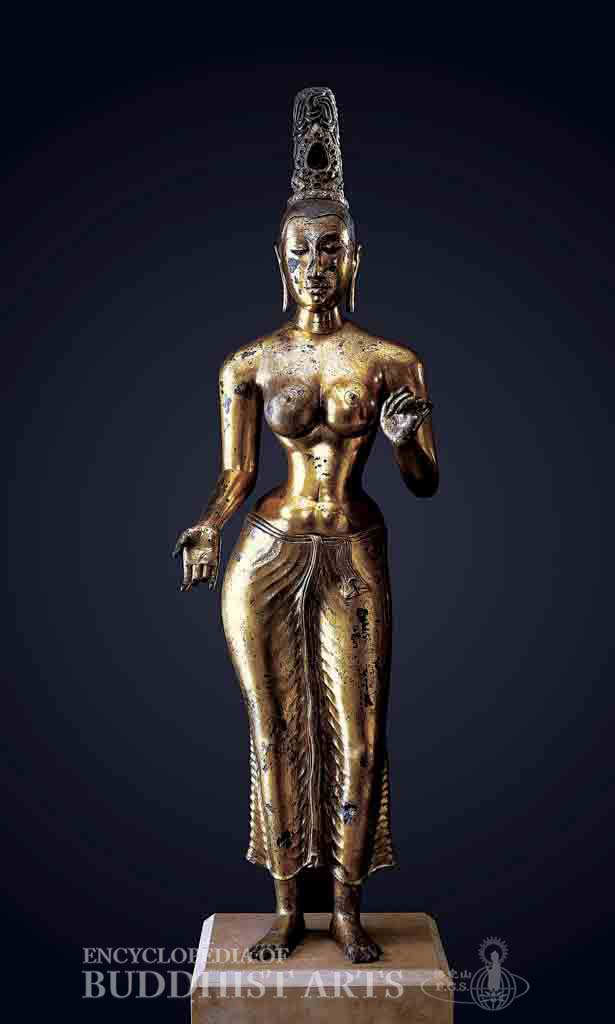
Trincomalee-Batticaloa: Tara
Gilt bronze
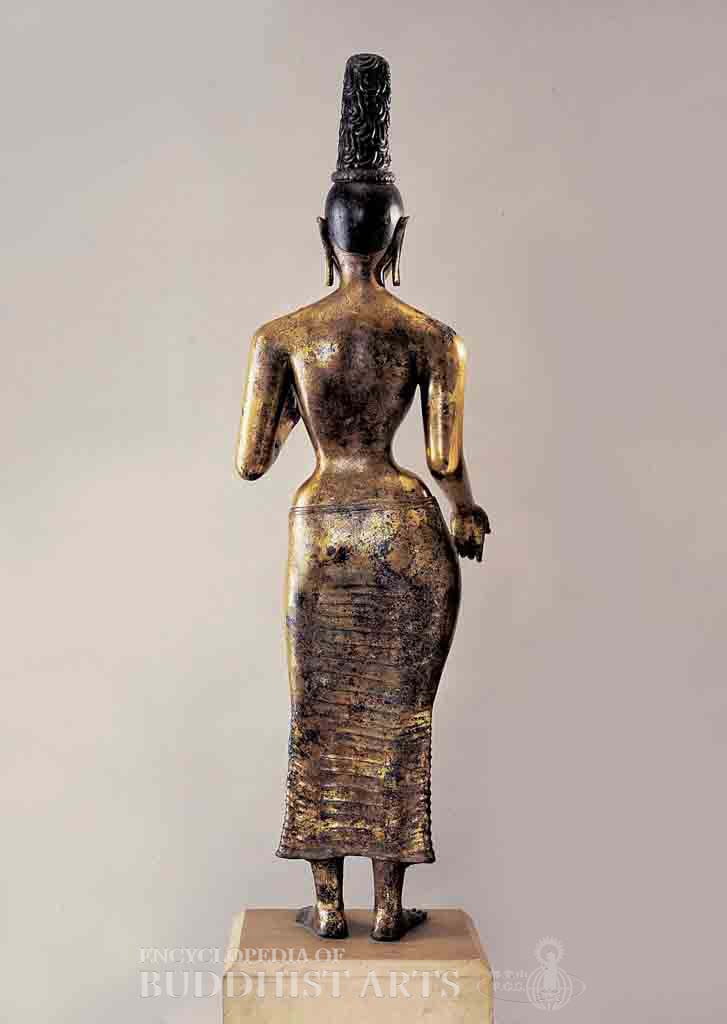
Trincomalee-Batticaloa: Tara (back)
Trincomalee-Batticaloa: Tara
SRI LANKA, Eastern Province; Anuradhapura Kingdom
The statue was discovered in the area between Trincomalee and Batticaloa. Similar bronze statues have been found dating to the Anuradhapura Kingdom (circa 4th century BCE–10th century CE), at a time when Vajrayana Buddhism had a strong presence in Sri Lanka.
The figure of Tara is almost life size but the proportions of the body, particularly the slim waist and swelling hips, fall short of being lifelike and are more for visual effect. Tara stands with left knee bent and the weight on the other foot, causing a displacement of the waist to the left. The hand gestures appear more rhetorical than serving a religious purpose, although the right hand might be in a form of varada (wish-granting) mudra, and the left hand could once have held a flower. The long head has extended earlobes and the three lines on visible on the neck. There is a tall cylindrical topknot fronted by a small niche that could once have held either a Buddha image or a gem in place of the usual usnisa. Flames with smaller holes that were originally inlaid with precious stones surround the niche.
For more details, go to the Encyclopedia of Buddhist Arts: Sculpture St-Z, page 1255.
Cite this article:
author = Hsingyun and Youheng and Lovelock, Yann and Chou, Yuan and Huntington, Susan and Edson, Gary and Neather, Robert,
booktitle = {Encyclopedia of Buddhist Arts: Sculpture St-Z},
pages = 1255,
title = {{Trincomalee-Batticaloa: Tara}},
volume = 13,
year = {2016}}