
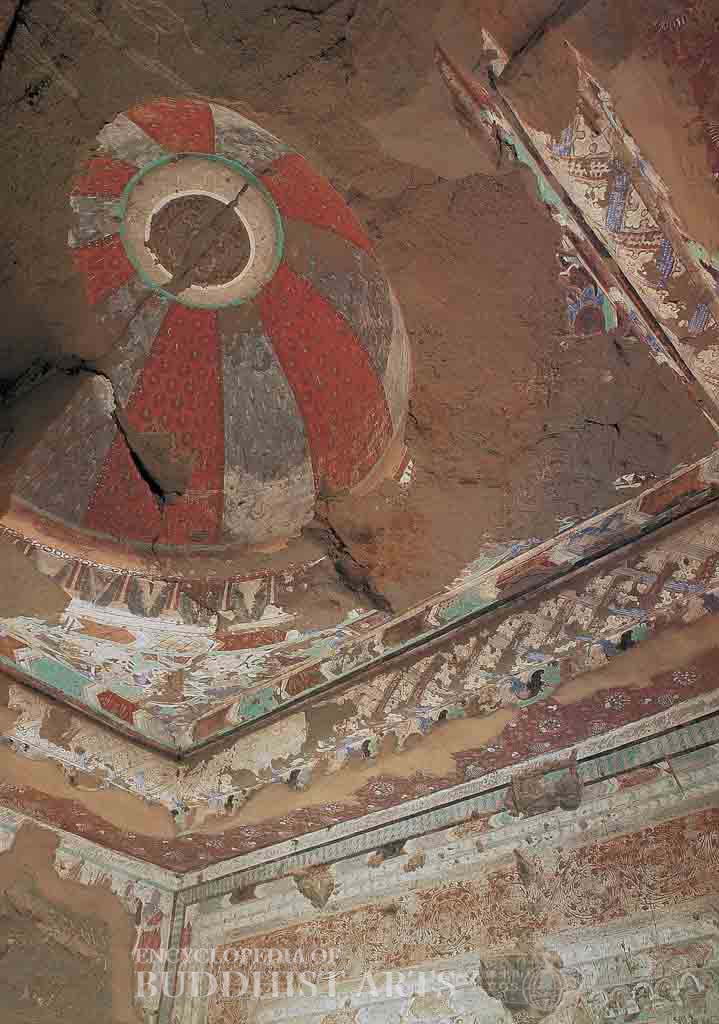
Kizil Cave 67: Ceiling
Kizil Cave 67
CHINA, Xinjiang, Aksu
This cave is situated in the west valley and was built during the 6th and 7th centuries. It is square with a domed ceiling and measures 4.75 m wide, 4.64 m high, and 5.01 m deep. There are three layers of corbels supporting the ceiling. The cave is characteristic of the style of Kizil Caves which developed during the 6th century.
Much of the ceiling is damaged, but, that which is intact depicts a round lotus in the center, with the surrounding dome divided vertically into 12 portions, alternately colored in red and white with peacock feather motifs. The four corners of the ceiling are illustrated with Heavenly Kings and Naga Kings, and the surrounding corbels are decorated with colorful patterns.
The large scale mural that was on the back wall has not survived. All that remains are nine layers of decorations, which include honeysuckle, foliage, and wave patterns. The left wall is partially damaged and only four monks remain. What survives of the right wall depicts a landscape scene with mountains, water, people, animals, and decorative motifs. The areas above and below this mural are missing. German archaeologists discovered a collection of ancient Kuchean scriptures within this cave, which are a vital resource in research of Kuchean script and history of the region.
For more details, go to the Encyclopedia of Buddhist Arts: Caves R-L, page 514.
Cite this article:
author = Hsingyun and Youheng and Johnson, Peter and Mankuang and Huntington, Susan and Edson, Gary and Neather, Robert,
booktitle = {Encyclopedia of Buddhist Arts: Caves R-L},
pages = 514,
title = {{Kizil Cave 67}},
volume = 6,
year = {2016}}