

Robe of Rinzai School Masters
Silk and gold

Robe of Rinzai School Masters (detail)
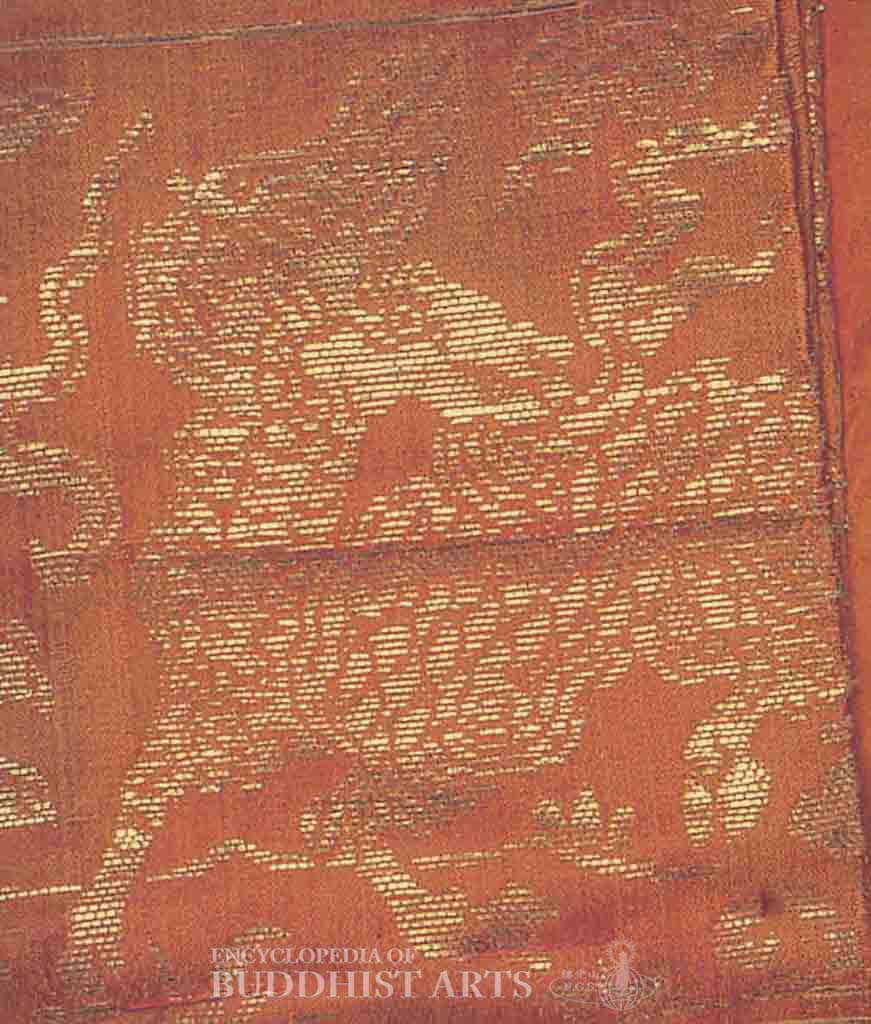
Robe of Rinzai School Masters (detail)
Robe of Rinzai School Masters
CHINA; Ming dynasty
During the Muromachi period (1392–1573), the Japanese Zen monk Zekkai Chushin, who studied in China for several years, visited Emperor Taizu (reigned 1368–1398) of the Ming dynasty. The emperor gave him this robe, and it was taken back to Japan. Zekkai Chushin became highly respected by the Japanese emperor and was recognized as a Master of the Rinzai school of Japanese Zen Buddhism. Later, Master Zekkai Chushin passed this robe down to Master Gakuin Ekatsu when he succeeded his teachings.
This 25-strip robe was worn when visiting the royal palace or begging outside the temple. Each panel is formed by sewing together four long and one short panel longitudinally.
The fabric was made by weaving silk and gold thread. Patterns of clouds, peonies, scrolling leaves, and the eight auspicious symbols are arranged throughout the robe. Bits of gold thread are glued to the surface of the fabric with red lacquer, and the clasp is made of turtle shell. The layout of the patterns is well-balanced and the fabric is fine and delicate. The coordination of the gold and red colors creates a sense of wealth and elegance.
For more details, go to the Encyclopedia of Buddhist Arts: Artifacts, page 287.
Cite this article:
author = Hsingyun and Youheng and Youji and Pokorski, Stefanie and Mankuang and Fan, Wen,
booktitle = {Encyclopedia of Buddhist Arts: Artifacts },
pages = 287,
title = {{Robe of Rinzai School Masters}},
volume = 18,
year = {2016}}