
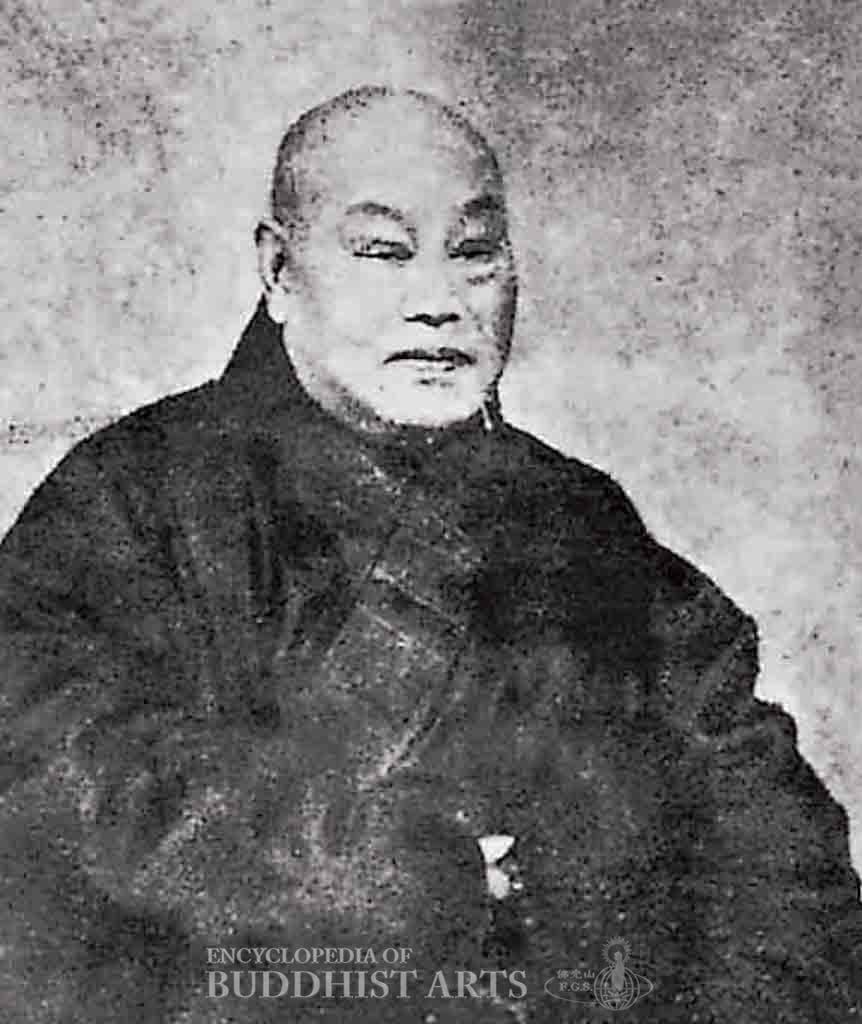
Yuanying
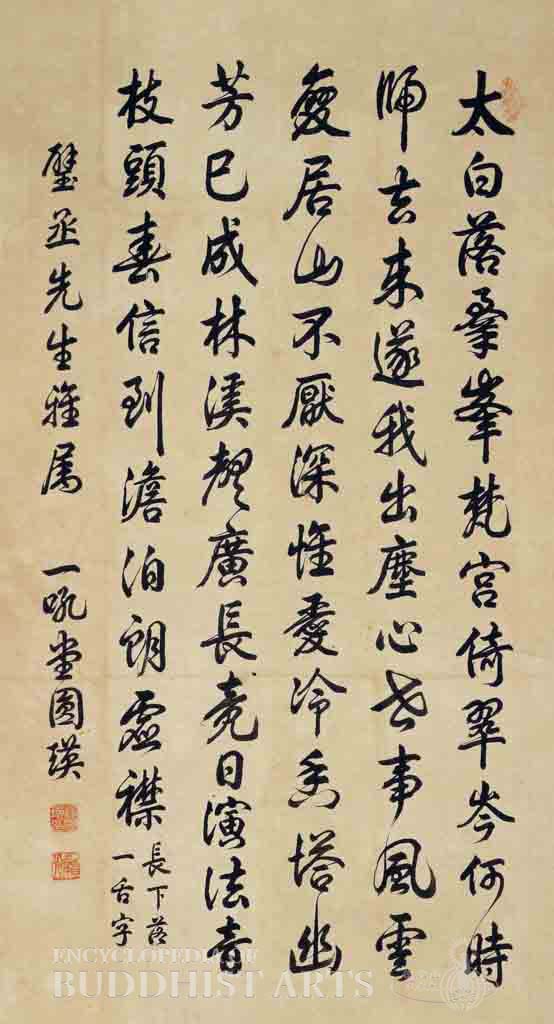
Five-Character Poem by Yuanying; 20th century
Ink on paper
Yuanying
CHINA, Fujian, Ningde; Qing dynasty
Yuanying, born with a family name of Wu, and was a Chan monk and calligrapher from Gutian county in Ningde. At the age of 19, he renounced under monk Zengxi at Yongquan Temple in Fujian. He was fully ordained in the following year. He studied the Tiantai school teachings and meditation at Tianning Temple in Zhejiang and later gave teachings in several places such as Fujian, Zhejiang, Taiwan, and Southeast Asia. He became the Dharma heir of monk Ciyun at Qita Temple and is regarded as the 40th successor of the Linji school of Chan Buddhism. In addition, he succeeded monk Daben at Daxuefeng Temple in Fujian as the 46th abbot.
In 1906, Yuanying befriended the revolutionary monk Master Taixu. At the end of the Qing dynasty (1644–1911), he became the head of Jiedai Temple in Zhejiang and established a Buddhism Research Center. He later joined the Chinese Buddhism Association in 1914 with the aim to preserve the nation’s temples and its properties. He also encouraged temples to set up Buddhist children’s homes, hospitals, and factories to promote cooperation in charity. He also inaugurated Buddhist institutions and monasteries. Yuanying expended his life to Buddhist teachings and specialized in the Surangama Sutra.
Skilled in poetry and calligraphy, Yuanying’s calligraphic works are kept in several temples around Taiwan. His works Five-Character Poem and Seven-Character Couplet are kept at Ho’s Calligraphy Foundation in Taipei, Taiwan. In addition, he authored over 20 written works that were later compiled into Dharma Words of Yuanying.
For more details, go to the Encyclopedia of Buddhist Arts: People, page 328.
Cite this article:
author = Hsingyun and Youheng and Youlu and Pokorski, Stefanie and Yichao and Mankuang and Miaohsi,
booktitle = {Encyclopedia of Buddhist Arts: People },
pages = 328,
title = {{Yuanying}},
volume = 19,
year = {2016}}