
Longxing Temple: Standing Buddha
Limestone
Longxing Temple: Standing Buddha
CHINA, Shandong, Qingzhou; Northern Qi dynasty
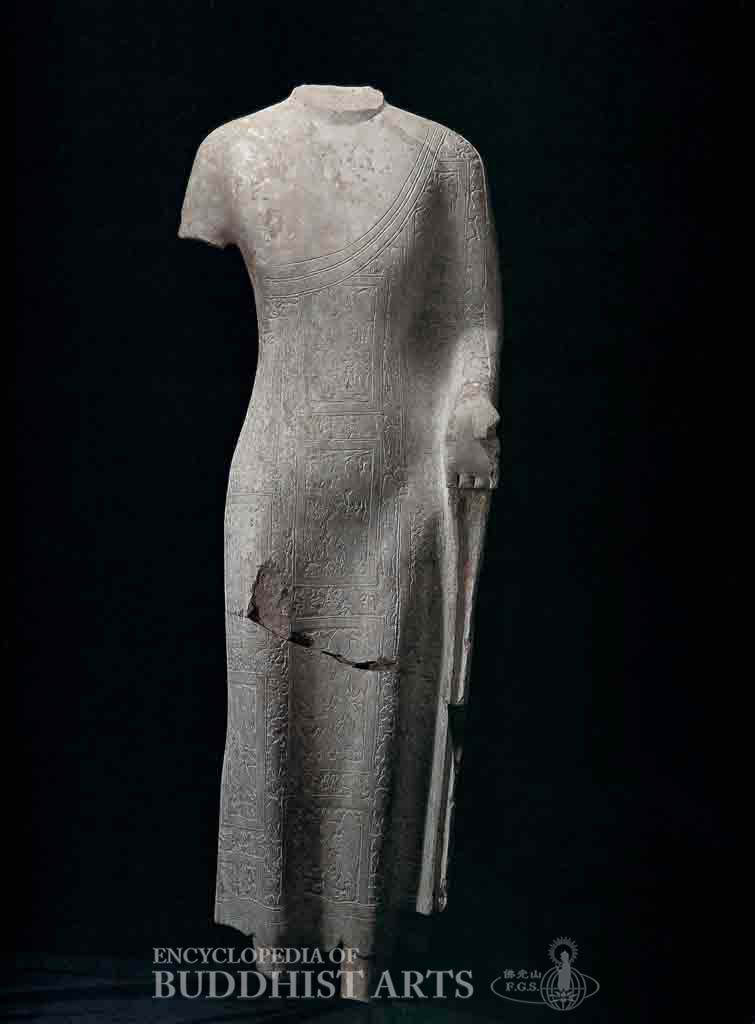
This long-bodied statue lacks a head, feet, and right arm. Enough of the left hand remains to suggest that it was held downwards most likely in varada (wish-granting) mudra. The monastic robe leaves the right shoulder bare and is so indistinct that only certain elements such as the hemline, incised designs and the folds over the wrist make it apparent. It is cut in the field-pattern style and each oblong segment depict images of mountains, palace buildings, human figures, and animals. Artwork from the Qingzhou region is normally painted, as was this example, but little remains of the paint.
For more details, go to the Encyclopedia of Buddhist Arts: Sculpture G-M, page 638.
Cite this article:
Hsingyun, et al. "Longxing Temple: Standing Buddha." Encyclopedia of Buddhist Arts: Sculpture G-M, vol. 11, 2016, pp. 638.
Hsingyun, Youheng, Yann Lovelock, Yuan Chou, Susan Huntington, Gary Edson, and Robert Neather. 2016. "Longxing Temple: Standing Buddha" In Encyclopedia of Buddhist Arts: Sculpture G-M, 11:638.
Hsingyun, Youheng, Lovelock, Y., Chou, Y., Huntington, S., Edson, G., & Neather, R.. (2016). Longxing Temple: Standing Buddha. In Encyclopedia of Buddhist Arts: Sculpture G-M (Vol. 11, pp. 638).
@misc{Hsingyun2016,
author = Hsingyun and Youheng and Lovelock, Yann and Chou, Yuan and Huntington, Susan and Edson, Gary and Neather, Robert,
booktitle = {Encyclopedia of Buddhist Arts: Sculpture G-M},
pages = 638,
title = {{Longxing Temple: Standing Buddha}},
volume = 11,
year = {2016}}
author = Hsingyun and Youheng and Lovelock, Yann and Chou, Yuan and Huntington, Susan and Edson, Gary and Neather, Robert,
booktitle = {Encyclopedia of Buddhist Arts: Sculpture G-M},
pages = 638,
title = {{Longxing Temple: Standing Buddha}},
volume = 11,
year = {2016}}