
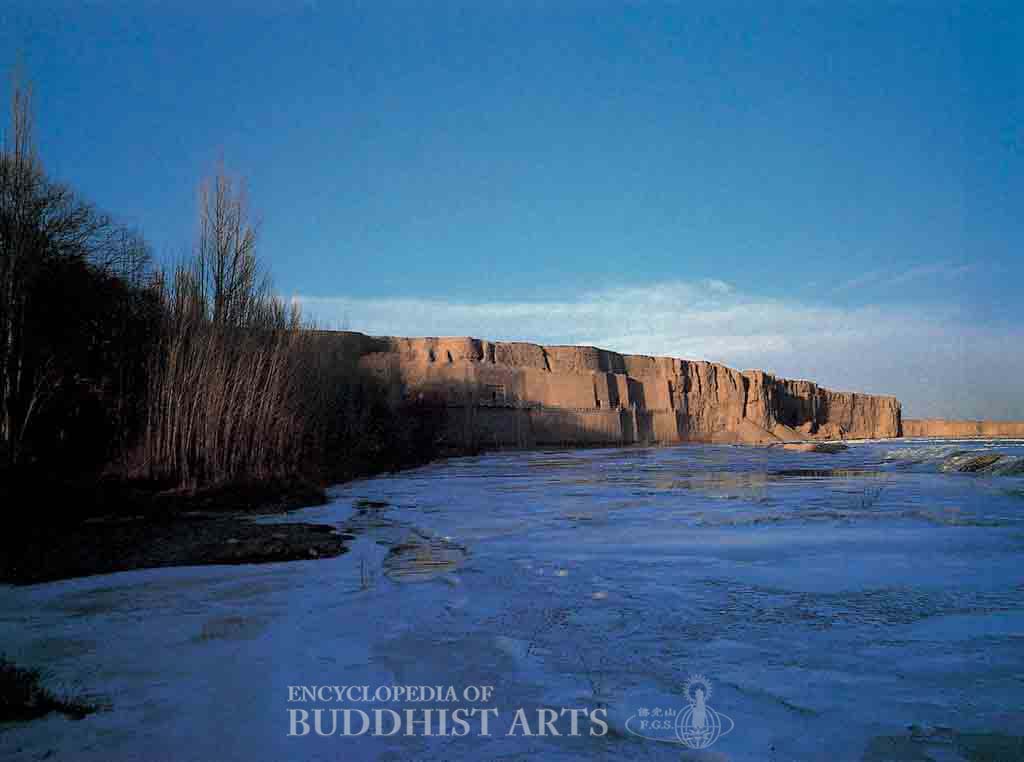
Western Thousand Buddha Caves
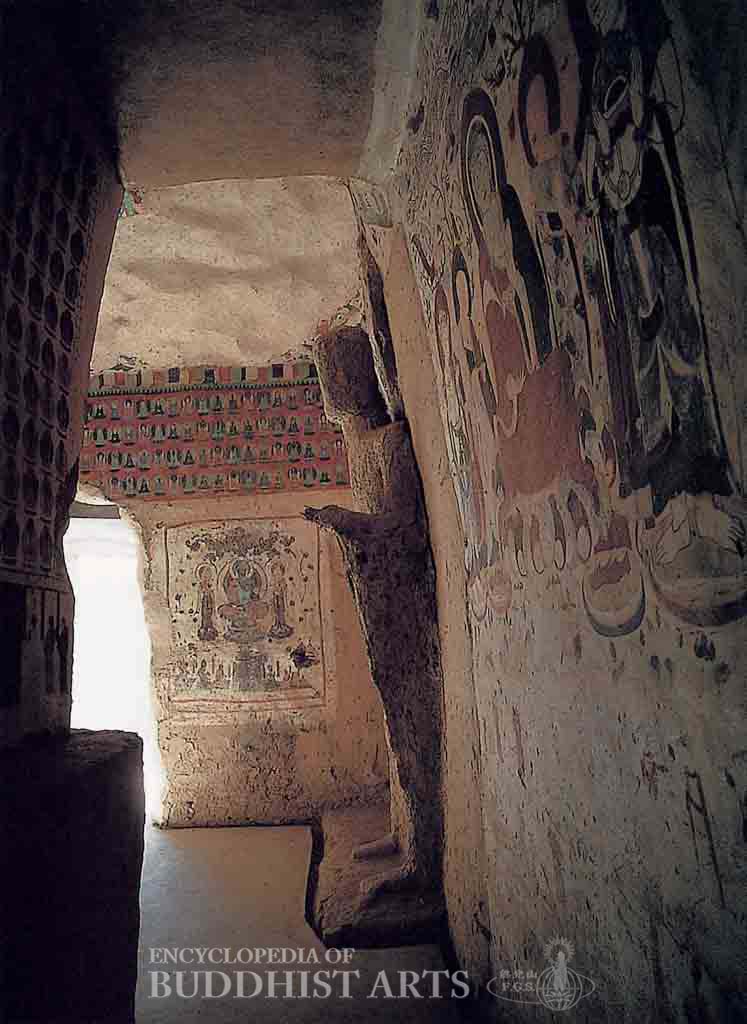
Western Thousand Buddha Caves: Cave 9
Western Thousand Buddha Caves
CHINA, Gansu, Dunhuang
The name of this site is derived from the fact that the caves lie 30 km southwest of Dunhuang city and that the Mogao Caves are known locally as the Thousand Buddha Caves. The site consists of 22 caves set into a 20 m high cliff on the northern bank of the Dang River. The caves were constructed and repaired throughout the late Northern Wei dynasty (386–534) to the Yuan dynasty (1271–1368). The caves are distributed in three general areas: Caves 1 to 19 are situated in the western area, Cave 20 in the center, and Caves 21 and 22 in the eastern area. There are four general types of caves at the site: central pillar caves, caves with truncated pyramidal ceilings, flat-topped rectangular caves, and open vertical niche caves. There are a total of 34 painted statues and over 800 sq m of murals in these caves. Together with the Mogao Caves, they were listed as a National Cultural Heritage Site in 1961.
The oldest preserved cave at the site is Cave 7, built during the late Northern Wei dynasty. This central pillar cave is similar in structure to caves at Mogao which date to the same period, except for the higher base of the pillar. The second oldest cave, and the only cave dated to the Western Wei dynasty (535–556), is Cave 9. This cave has been repeatedly repaired, so the carvings and murals preserved within the cave vary in age.
Caves 8, 11, 12, and 13 were constructed during the Northern Zhou dynasty (557–581). Caves 8 and 12 are central pillar caves with gable ceilings. One particularly unique mural, featured on the south wall of Cave 12, portrays the battle between Sariputra and Raudraksa as described in the Sutra of the Wise and the Foolish. This is the oldest wall painting of its kind in China, as well as the only preserved Northern Zhou dynasty (386–581) painting with this theme.
Caves 3, 5, 14, 16, and 18 were created during the Tang dynasty (618–907). Cave 18, carved with a truncated pyramidal ceiling and a lotus plafond, is an exemplar of Tang dynasty painting techniques and cave structures. The sloped sides of the ceiling are painted with Thousand Buddha motifs and a Buddha teaching the Dharma is at the center. A niche is cut into the north wall, but there is no longer a statue inside. An illustration of the Amitayurdhyana Sutra is depicted on the west wall, while the east wall features an illustration of the Medicine Buddha Sutra. Paintings around a doorway on the south wall include Amoghapasa Avalokitesvara and an illustration of the Defeat of Mara.
The only cave that dates to the Five Dynasties (907–960) period is Cave 19. One of the distinguishing features of this cave is its clay Arhat statues, although many of the original figures no longer exist. In addition, the combination of painting and molding techniques used in this cave is rarely seen in this region of China. Although the exact construction date of Cave 20 is unknown, the numerous Vajrayana Buddhist images proves that it was repaired during the Yuan dynasty (1271–1368). Many of the murals were also repaired during the Uighur period (9th century–1209), and are noticeable due to their coarseness and simplicity.
For more details, go to the Encyclopedia of Buddhist Arts: Caves T-Z, page 1492.
Cite this article:
author = Hsingyun and Youheng and Johnson, Peter and Mankuang and Huntington, Susan and Edson, Gary and Neather, Robert,
booktitle = {Encyclopedia of Buddhist Arts: Caves T-Z},
pages = 1492,
title = {{Western Thousand Buddha Caves}},
volume = 9,
year = {2016}}