
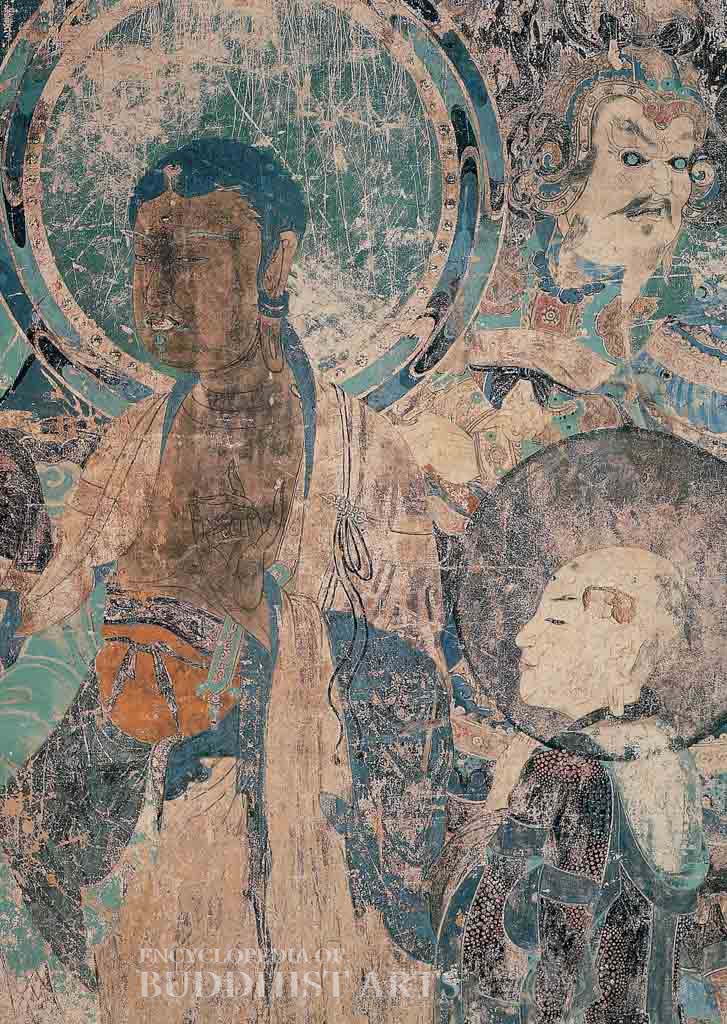
Eastern Thousand Buddha Cave 7: Buddha Welcoming the Deceased (detail)
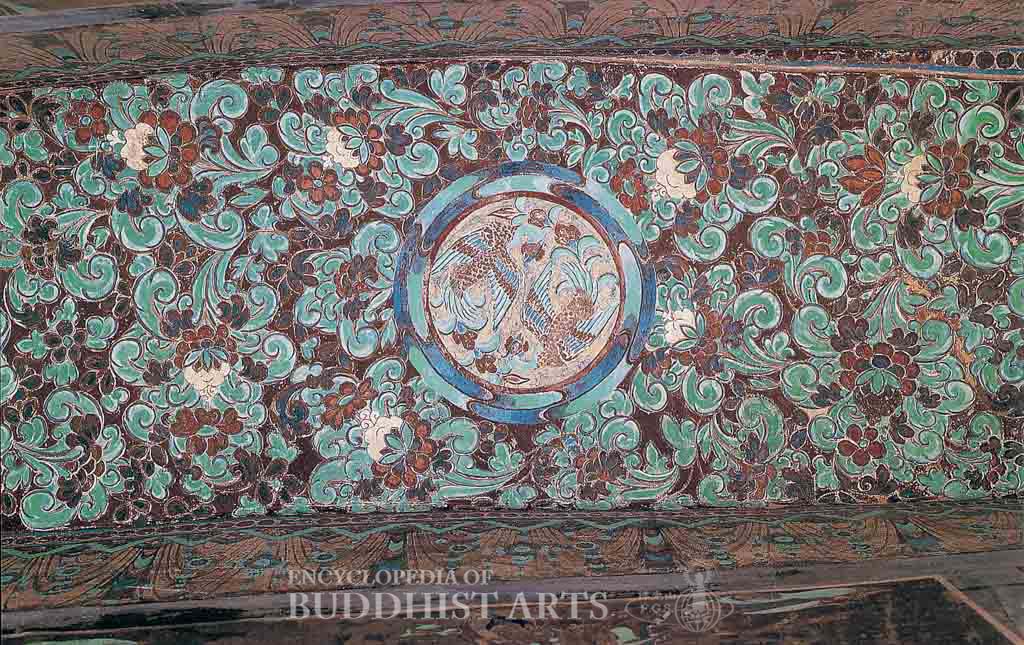
Eastern Thousand Buddha Cave 7: Rear Corridor - Ceiling
Eastern Thousand Buddha Cave 7
CHINA, Gansu, Guazhou
This west-facing rectangular central pillar cave is located in the center of the east cliff. Construction of the cave started during the Western Xia period (1032–1227), and repairs were made during the Qing dynasty (1644–1911). It is 4.4 m wide and 7.8 m deep, with a vaulted ceiling in the front section of the cave and flat ceilings along the corridors around the central pillar.
The niche in the west side of the central pillar was repaired during the Qing dynasty. In contrast to the other artwork in the cave, the quality of work within this niche is not of the highest value. The north and south sides of the pillar have draperies painted at the top above murals of Eight-Armed Avalokitesvara Bodhisattvas. An illustration of a scene from the Mahaparinirvana Sutra can be found on the east side of the pillar.
In the middle register, on the outer wall of the rear corridor, is an illustration of the Buddha Teaching the Dharma. Avalokitesvara and Mahasthamaprapta Bodhisattvas are located on the two sides of the outer wall. The ceiling of the rear corridor is decorated with an image of two phoenixes surrounded by brightly colored flowers and leaves. This mural displays a high level of skill and is considered to have great artistic value. The north and south walls of the cave are both painted with Vajrayana Buddhist figures, an illustration of the Pure Land, and Buddha Welcoming the Deceased. On the front (west) wall, there are murals on either side of the entrance.
For more details, go to the Encyclopedia of Buddhist Arts: Caves A-E, page 337.
Cite this article:
author = Hsingyun and Youheng and Johnson, Peter and Mankuang and Huntington, Susan and Edson, Gary and Neather, Robert,
booktitle = {Encyclopedia of Buddhist Arts: Caves A-E},
pages = 337,
title = {{Eastern Thousand Buddha Cave 7}},
volume = 5,
year = {2016}}