
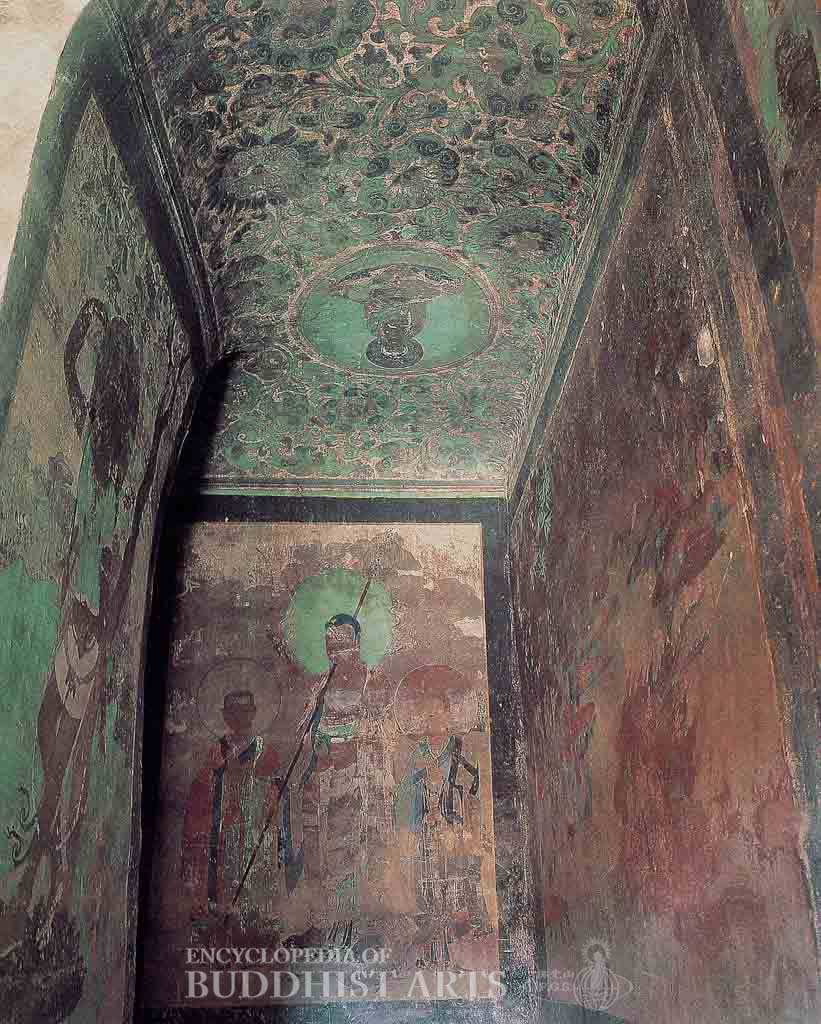
Eastern Thousand Buddha Cave 2: Rear Corridor
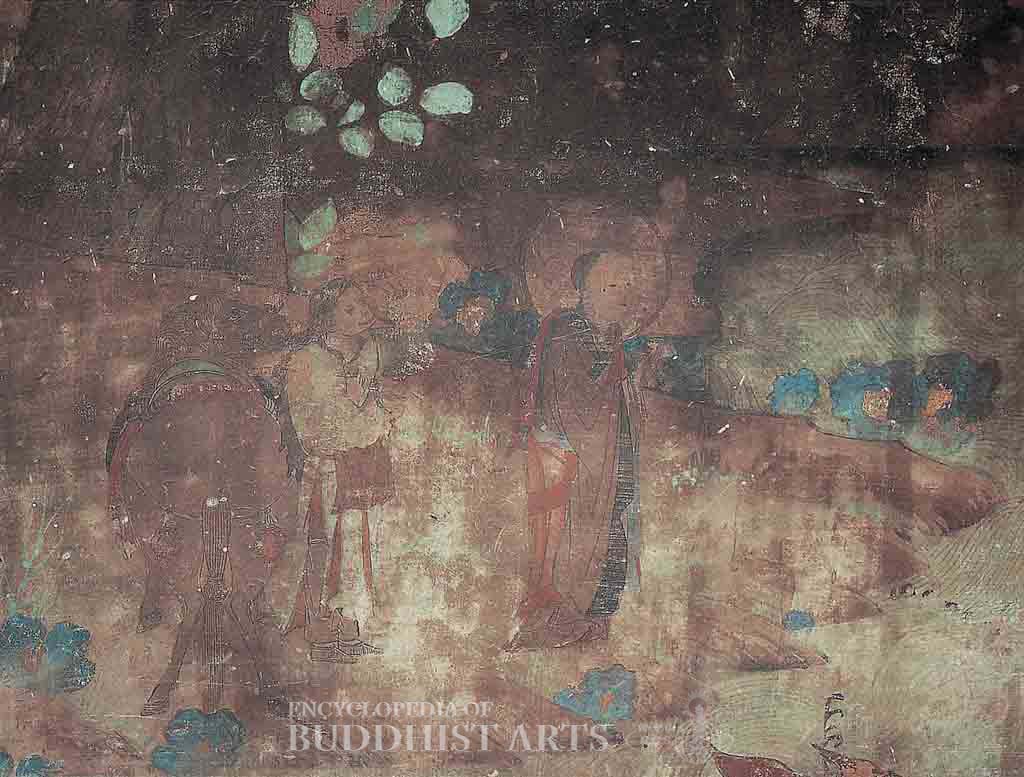
Eastern Thousand Buddha Cave 2: Water-Moon Avalokitesvara - Master Xuanzang’s Journey to Obtain the Sutras (rear corridor, south wall)
Eastern Thousand Buddha Cave 2
CHINA, Gansu, Guazhou
This east-facing central pillar cave on the lower level of the west cliff face was first excavated during the Western Xia period (1032–1227). The interior is 6.9 m wide and 9.3 m deep. The front section of the cave has a truncated pyramidal ceiling painted with a mandala at the center and decorative patterns on the ceiling slopes.
The paintings and sculptures within the cave are laid out in an interrelated manner. An altar is located on the east side of the central pillar, facing the doorway of the cave. Three Buddhas sitting in full lotus position on raised lotus thrones are placed upon the altar. Two murals are found on the wall behind the altar, each depicting eight seated Buddhas and the monk Budai. The murals on the north and south sides of the central pillar portray Avalokitesvara, Bodhi trees, and hungry ghosts. The west side of the pillar has an illustration of the Buddha’s parinirvana, with the reclining Buddha surrounded by mourning disciples and heavenly beings. Facing this illustration, on the outer wall of the rear corridor, is an illustration of the Buddha teaching the Dharma, with an illustration of Medicine Buddha Propagating the Dharma on each side.
There are illustrations of Water-Moon Avalokitesvara on the north and south walls of the rear corridor. These images are particularly notable due to the fact that although they display the same scene, they differ in layout and style. For example, each of them depicts Master Xuanzang’s Journey to Obtain the Sutras, but the monkey-like disciples following Xuanzang are portrayed differently; the disciple on the south wall follows piously behind Xuanzang, while the one on the north wall stands next to Xuanzang with his back straight and his head high. They suggest that the two illustrations were not copied from a single original but were rather created from the imagination of the artists. Donor figures are found on the outer walls of the north and south corridors, with inscriptions written in Tangut script next to each donor. The ceilings of the north and south corridors are decorated with dragons, phoenixes, and flowers, while the flat ceiling of rear corridor contains scroll leaves and lotuses.
A row of 14 seated Buddhas are painted on the front (east) wall above the cave entrance. The doorway is flanked by a Three-Headed, Four-Armed Avalokitesvara and a Three-Headed, Eight-Armed Avalokitesvara. An Eleven-headed, Eight-Armed Avalokitesvara and an illustration of the Medicine Buddha Sutra are painted on the south wall, while an Eight-Armed Avalokitesvara and an illustration of the Western Pure Land are on the north wall.
For more details, go to the Encyclopedia of Buddhist Arts: Caves A-E, page 330.
Cite this article:
author = Hsingyun and Youheng and Johnson, Peter and Mankuang and Huntington, Susan and Edson, Gary and Neather, Robert,
booktitle = {Encyclopedia of Buddhist Arts: Caves A-E},
pages = 330,
title = {{Eastern Thousand Buddha Cave 2}},
volume = 5,
year = {2016}}