
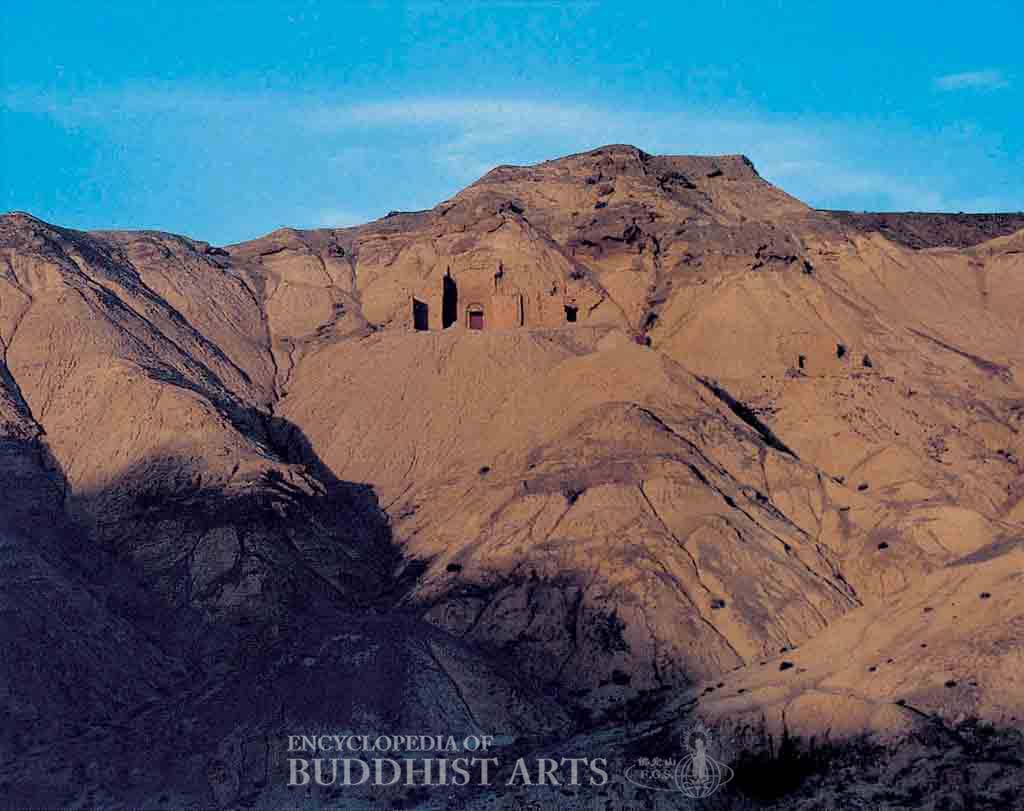
Eastern Thousand Buddha Caves
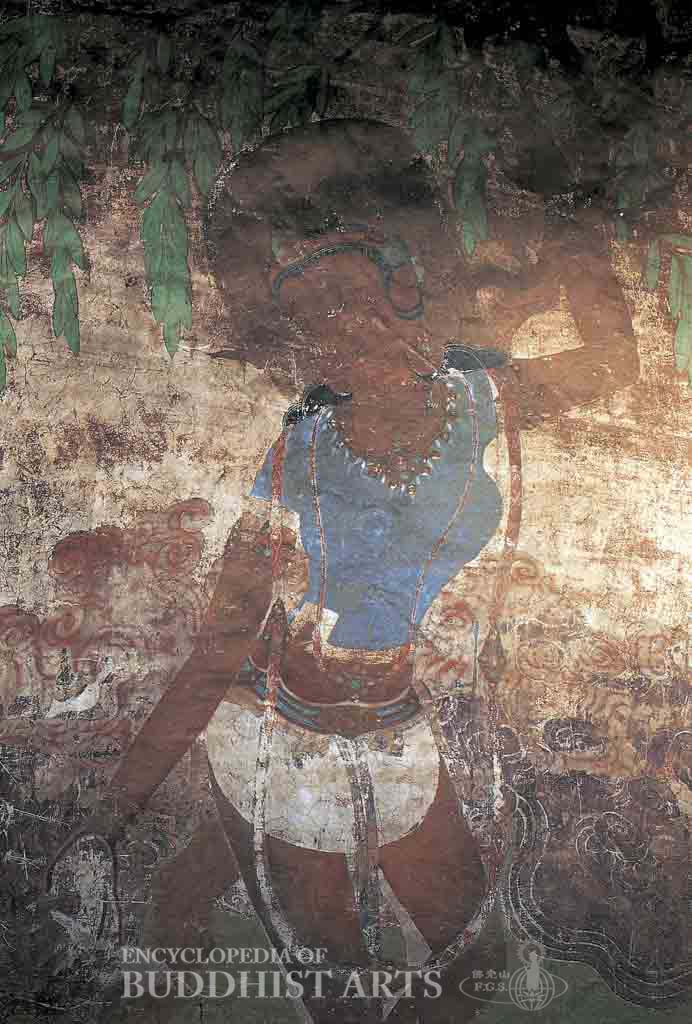
Eastern Thousand Buddha Caves: Cave 2 - Avalokitesvara Bodhisattva

Eastern Thousand Buddha Caves: Cave 5 - Mandala
Eastern Thousand Buddha Caves
CHINA, Gansu, Guazhou
The Eastern Thousand Buddha Caves were carved into the cliff face of a riverbed 35 km southeast of Qiaozi village, Guazhou, Gansu. They were constructed during the Western Xia period (1032–1227), with new caves added and some repairs made during the Yuan (1271–1368) and Qing (1644–1911) dynasties. There are 23 surviving caves divided between the east and west cliff faces. There are nine caves on the east cliff; six on the upper level and three on the lower level, as well as 14 caves on the west cliff, with eight on the upper level and six on the lower level. Of these, eight caves still contain sculptures and murals; the total surface area of the remaining murals is 486.7 sq m, while there are 46 remaining sculptures from the Qing dynasty. Caves 2, 4, 5, and 7 were created during the Western Xia period, though there were repairs done to Cave 7 during the Qing dynasty. Cave 6 was excavated during the Yuan dynasty, and Caves 1, 3, and 8 date to the Qing dynasty. The murals within the caves include combinations of Vajrayana Buddhist images of both Chinese and Tibetan origin. The Eastern Thousand Buddha Caves were listed as a National Cultural Heritage Site in 1996.
Caves 2, 4, 5, and 7 are all rectangular, central pillar caves. Each contain an illustration of the Buddha’s parinirvana on the wall of the rear corridor behind the central pillar. In Cave 2, a mandala featuring a dancing warrior and Avalokitesvara Bodhisattva reveals the influences of Tibetan, Indian, and Nepalese art.
The murals in Cave 4 are badly damaged and are for the most part no longer discernible. The few that remain include a standing Buddha, an illustration of the Buddha teaching the Dharma, an Eleven-Headed Avalokitesvara, and donor figures. There are remnants of a painting of a peacock holding a flower in its mouth on the vaulted ceiling. An image of a monk wearing Western Xia clothing can be seen on the back (west) wall. Scholars speculate that the cave was created to commemorate a high ranking monk from that period.
In Cave 5, there are mandalas painted on the north and south sides of the central pillar. On the ceiling of the cave, a seated Buddha is surrounded by floral motifs. Numerous images of Avalokitesvara with two, four, eight, or ten arms, as well as a depiction of Manjusri Bodhisattva, are visible on the south wall. An illustration of Water-Moon Avalokitesvara, Four-Armed Avalokitesvara, the Eight Stupas, Tara, and Samantabhadra Bodhisattva are located on the north wall. Six Buddhas and additional Bodhisattva images are painted on the front (east) wall above the entrance, and three warriors line the bottom on either side.
The murals in Cave 7 include depictions of an Eight-Armed Avalokitesvara, an Eleven-Headed, Eight-Armed Avalokitesvara, and an illustration of the Buddha’s parinirvana. There are also images of the Pure Land and the Buddha Teaching the Dharma with Avalokitesvara and Mahasthamaprapta Bodhisattvas flanking the sides. A niche that was repainted during the Qing dynasty can be found on the back wall. The ceiling of the corridor is decorated with phoenixes and a scrolling pattern.
Cave 6 has a mandala on the ceiling, as well as images of Manjusri and Samantabhadra and niches containing a Buddha and four Bodhisattvas on the north and south walls.
For more details, go to the Encyclopedia of Buddhist Arts: Caves A-E, page 328.
Cite this article:
author = Hsingyun and Youheng and Johnson, Peter and Mankuang and Huntington, Susan and Edson, Gary and Neather, Robert,
booktitle = {Encyclopedia of Buddhist Arts: Caves A-E},
pages = 328,
title = {{Eastern Thousand Buddha Caves}},
volume = 5,
year = {2016}}