
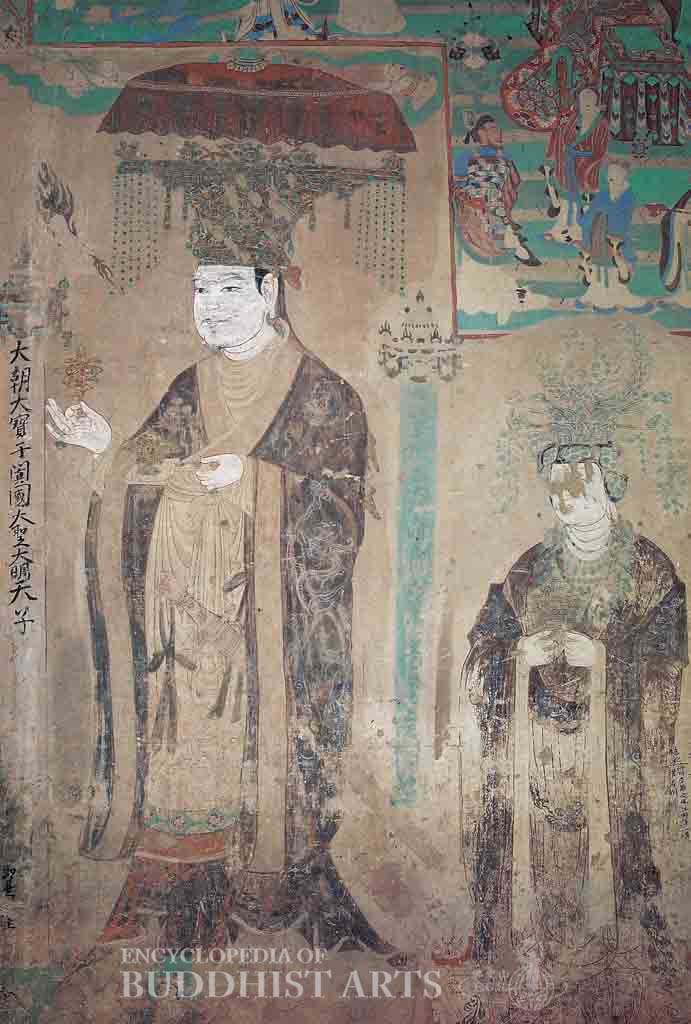
Mogao Cave 98: King of Khotan as Donor
Mogao Cave 98: King of Khotan as Donor
CHINA, Gansu, Dunhuang; Five Dynasties
This image, along with a depiction of the Queen of Khotan behind him, was painted on the front (east) wall during the Five Dynasties (907–960). An inscription on the left states “The holy and brilliant king of the great Khotan kingdom.” The Cao family, the rulers of Dunhuang at the time, treat their son-in-law as the donor of this cave to reflect their policy of maintaining peaceful relations with the neighboring kingdom. The king wears an elaborate crown embellished with hanging ornaments, turquoise, and carved dragons. Two child-like apsaras hold up a canopy above the crown. These small figures serve as the king’s protectors and distinguish him from other donors. The king wears an imperial ceremonial garment embroidered with a sun and moon on the shoulders, and dragons, tigers, and clouds on the sleeves. He holds a flower in his right hand and an incense burner in his left. The kings of Khotan traditionally claimed Vaisravana, Heavenly King of the North, as their ancestor. In the mural, a goddess supports the feet of the king, signifying his status as equal to that of the Heavenly King.
For more details, go to the Encyclopedia of Buddhist Arts: Caves M-Mo, page 927.
Cite this article:
author = Hsingyun and Youheng and Johnson, Peter and Mankuang and Huntington, Susan and Edson, Gary and Neather, Robert,
booktitle = {Encyclopedia of Buddhist Arts: Caves M-Mo},
pages = 927,
title = {{Mogao Cave 98: King of Khotan as Donor}},
volume = 7,
year = {2016}}